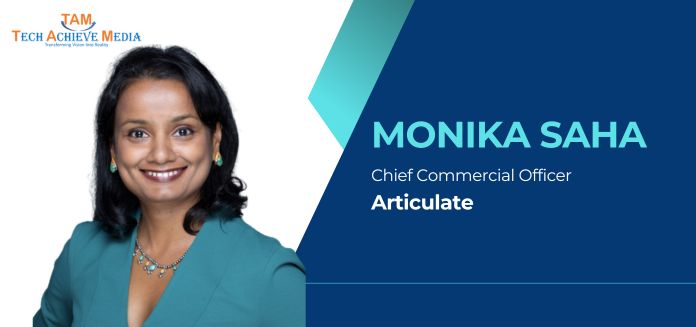
As organisations navigate rapid technological change, workplace learning is undergoing a significant transformation, driven largely by the rise of artificial intelligence. In a conversation with Tech Achieve Media, Monika Saha, Chief Commercial Officer, Articulate shares insights into how learning has evolved from largely informal, “shadow learning” practices to more structured, scalable, and technology-enabled experiences. Drawing from global trends observed across thousands of organisations, she highlights how AI is democratising content creation, embedding instructional design into everyday tools, and enabling businesses to bridge the gap between learning and measurable outcomes.
TAM: Articulate with organisations across the world and across industries. To begin with, how has the workplace, and particularly workplace learning, evolved over the past few years? What are some of the key shifts you are observing?
Monika Saha: Absolutely. We work with a wide range of organisations globally. In fact, Articulate is used by over 125,000 organisations across 187 countries, and the learning created on our platform serves around 133 million learners. This gives us strong visibility into how workplace learning is evolving. One key insight is that even before the advent of AI, nearly 80 percent of workplace learning was happening informally, what I call “shadow learning.” Only about 20 percent came through structured programmes led by learning and development teams. The rest involved employees learning on their own, experimenting, and sharing knowledge with peers.
With the rise of AI, this shadow learning has expanded significantly. However, it also presents an opportunity. For the first time, we have the ability to enhance this informal learning by equipping employees with tools that embed instructional design principles. This means that even non-experts can create effective, structured learning experiences, reducing reliance on limited instructional design resources.
TAM: What has been the biggest change in how organizations approach learning today compared to five years ago?
Monika Saha: One of the biggest shifts is that organisations are now more open to enabling a wider group of employees to create learning content at scale. Earlier, content creation was largely limited to instructional designers, and anything outside that was often basic or unstructured.
Today, AI has lowered the barrier significantly. Non-instructional designers can now use sophisticated tools that already have instructional design principles built in. At Articulate, for example, our AI-powered platform allows users to create high-quality learning without requiring deep expertise. I often describe this as instructional design having its “Figma moment.” Just as Figma made design accessible to non-designers while embedding best practices, AI is doing the same for learning creation. This democratisation is one of the most significant changes we are seeing.
TAM: AI itself is evolving rapidly, from generative AI to agent-based systems. Do you think corporate learning is keeping pace with this transformation, or is there still a gap?
Monika Saha: There is definitely a gap, and it is important to acknowledge that it may never be fully closed. However, the goal should be to narrow that gap and improve the quality of learning within it. One key approach is to establish the right guardrails. Organisations must ensure that AI-driven learning is grounded in their own proprietary knowledge and trusted data. While general AI tools can generate content, the outputs may not always be contextually relevant or accurate for a specific organisation. At Articulate, we focus on enabling learning creation based on a company’s own vetted information, combined with instructional design and learning science principles. This ensures that the output is not just information, but a meaningful learning experience that improves retention and outcomes.
TAM: ROI is often a key concern for business and technology leaders when adopting AI solutions. How can organisations measure the real return on investment of AI-driven learning?
Monika Saha: Measuring ROI in learning, whether AI-driven or not, has always been challenging unless it is directly tied to a business outcome or behavioural change. That said, we are now in a better position to get closer to ROI measurement. For instance, consider a salesperson who undergoes training. We can track the courses they have completed, their engagement levels, and areas of difficulty. At the same time, their sales performance is also being measured as part of business KPIs.
With the help of data and AI, organisations can begin to correlate learning activities with performance outcomes. While this may not provide a perfect one-to-one attribution, it allows for a much closer approximation. A useful parallel is marketing attribution. Marketers realised long ago that no single activity drives outcomes; instead, it is a combination of touchpoints. Similarly, in learning, we are moving towards attribution models that connect a series of learning experiences to business results.
TAM: From Articulate’s perspective, how is AI being embedded into your product ecosystem to enable more personalised, scalable, and efficient learning experiences?
Monika Saha: AI is integrated across multiple layers of our platform. At the creation stage, users can input raw materials such as technical documentation or meeting notes, and the AI generates a first draft of the learning content. This can then be tailored based on the target audience, for example, sales teams versus support teams.
Another key area is localisation. With AI, a course created once can be translated into up to 80 languages almost instantly. Learners can select their preferred language, making the experience highly personalised. We also place strong emphasis on accessibility. AI can evaluate whether a course meets accessibility standards and recommend improvements, ensuring that learning is inclusive for all users, including those who are differently abled. Overall, AI enables faster creation, deeper personalisation, and broader scalability across the learning lifecycle.
TAM: Finally, does the platform support Indian languages as part of its localisation capabilities?
Monika Saha: Yes, absolutely. Our platform does support Indian languages, enabling organisations in India to deliver learning experiences in regional languages and improve accessibility and engagement.