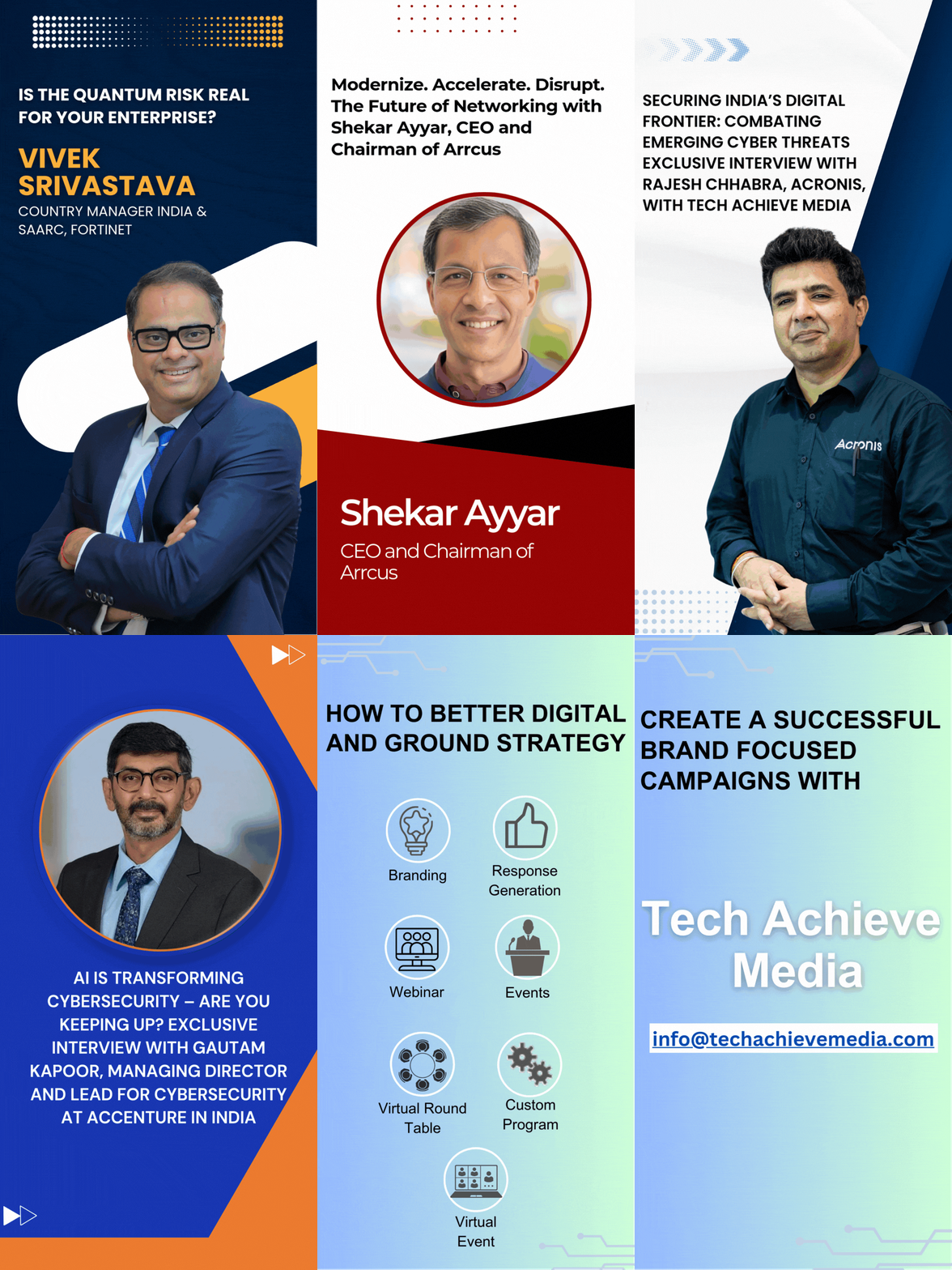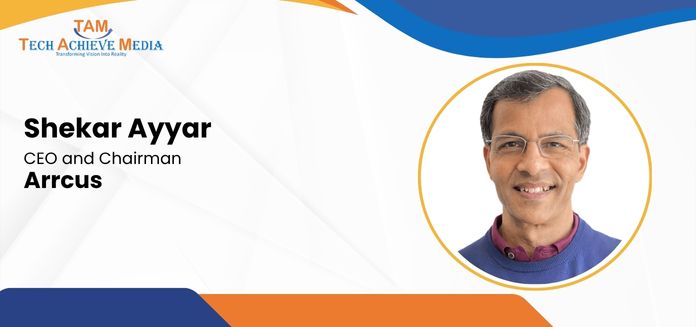
As enterprises worldwide accelerate their transition toward AI-driven, cloud-native, and software-defined architectures, the networking layer has emerged as the foundation for agility, scalability, and innovation. Arrcus, a global leader in hyperscale networking software, is redefining how networks are designed and operated through a disaggregated and programmable approach.
In this exclusive interaction with Tech Achieve Media, Shekar Ayyar, CEO and Chairman of Arrcus, shares insights into the company’s strategic expansion in India, its focus on leveraging local engineering talent, and the pivotal role India will play in its global roadmap. He also discusses how Arrcus is enabling enterprises and service providers to modernize infrastructure, accelerate AI readiness, and navigate the next wave of disruption in the networking industry.
TAM: What strategic factors influenced Arrcus’s decision to expand operations in India at this stage, and how does this fit into your broader global growth roadmap?
Shekar Ayyar: There are two key reasons. First, from a global vision standpoint, India has always played a significant role in our operations at Arrcus. A large part of our team is based here, primarily in Bengaluru, with some members located across other parts of the country. So, when we think about how we’ve built the company and the infrastructure that supports it, India has always been central to that framework.
More recently, what has changed is India itself emerging as a major market opportunity. While we are here for the India Mobile Congress, we are also seeing substantial growth across other verticals such as financial services and industrial sectors. This expansion is driven by several factors, namely the increasing maturity of processes within India, as well as the broader geopolitical developments that are creating new opportunities globally. For us, establishing a stronger presence in India as a market to serve has now become just as important as having India embedded in our operational fabric from the very beginning.
TAM: Will the India operations primarily serve as a delivery and R&D hub, or do you see it evolving into a strategic market for customer acquisition and ecosystem partnerships?
Shekar Ayyar: Yes, absolutely the latter. Historically, India has primarily been a hub for our delivery operations, and a home for our engineering talent and core technical teams. However, looking ahead, we see India evolving into a very important market in its own right.
The scale of mobility here is phenomenal. The penetration of 5G and mobile connectivity in India is among the highest globally, and every statistic runs into hundreds of millions, if not billions. There are over a billion mobile connections, around half a billion smartphones, and a rapidly growing share of those are already on 5G, with many more to follow soon.
Except perhaps for China, very few markets in the world can match these numbers. Now, when you combine that with India’s growing strength in artificial intelligence, the potential becomes extraordinary. While AI adoption is still in its early stages, there’s a clear and growing momentum. The government has introduced several sector-specific initiatives, and there’s a well-defined vision to make India a global AI powerhouse by 2030. So, when you bring together the forces of mobility and AI in a market of this scale, it creates an incredibly powerful and transformative combination, and its the one that we simply cannot afford to ignore.
TAM: Arrcus has been a strong advocate of disaggregated networking. How does this model empower enterprises to move away from traditional, monolithic architectures and achieve greater scalability and efficiency?
Shekar Ayyar: I spent a significant part of my career at VMware before joining Arrcus. One of the key value propositions that VMware pioneered at the time was in compute infrastructure. It introduced an abstraction layer that separated operating workloads from the underlying hardware. That separation gave enterprises tremendous flexibility and efficiency.
When I came across Arrcus, I realized that the company was applying a similar philosophy, but within the networking domain. I later joined as CEO, and what we do at Arrcus is essentially enable the separation of network applications from the underlying hardware by creating a software-defined abstraction layer. That’s what we mean when we talk about network disaggregation.
The advantages of this approach are significant. Whether you’re an enterprise, a network operator, a cloud provider, or a telecom company, disaggregation gives you complete freedom to choose the semiconductor processors or hardware that best fit your needs, and to build your network functions independently of that hardware. It’s a level of flexibility that simply hasn’t existed in traditional networking.
In many ways, today’s network model is where compute was about two decades ago. You still have to go to vendors like Cisco, Juniper, Arista, Huawei, Ericsson, or Nokia and purchase purpose-built boxes for specific functions in the network. Each box performs one role, and you can’t modify, reprogram, or extend it. It’s an inherently rigid and inefficient model.
Right now, the focus across the industry is on two main objectives:
- How to create and deploy new monetizable services to grow the top line, and
- How to reduce infrastructure costs and improve operational efficiency to strengthen the bottom line.
Disaggregation directly addresses both. By introducing flexibility and programmability into the network, organizations can innovate faster, building new applications and unlocking greater monetization opportunities. At the same time, they can optimize costs by decoupling software from hardware. For instance, a company could build its data center by combining Broadcom’s latest silicon with NVIDIA’s most advanced SmartNICs, all running on a unified network operating environment. That level of openness and interoperability was unheard of before, but it’s exactly what disaggregation makes possible.
TAM: With AI workloads reshaping the data center, how is Arrcus optimizing its architecture to deliver high-performance, AI-ready networking solutions?
Shekar Ayyar: If you break down the AI landscape, it essentially consists of two key elements: training and inference. At its core, AI is about leveraging insights derived from past data to predict or anticipate future outcomes. That is really the essence of artificial intelligence. Today, most AI models, particularly large language models (LLMs), reside in massive data centers powered by vast GPU clusters. These systems handle enormous amounts of compute to train models on huge datasets. However, looking ahead, there are two major shifts that will shape the future of AI infrastructure.
The first is compute overcapacity. We are rapidly reaching a point where organizations are stockpiling GPUs at an unprecedented scale. As that happens, the focus will inevitably shift from high-performance compute to high-performance networking, because that is what will ultimately determine efficiency.
To illustrate, you can integrate GPUs with SmartNICs, which are intelligent network interface cards that offload certain compute tasks from GPUs. By doing so, you can make your GPU infrastructure more efficient and enable it to focus on the most critical operations. This is a prime example of how efficiency can be built into AI infrastructure to get more performance out of less hardware.
The second crucial element is inference. Once you have trained your models and performed billions of operations to refine intelligence, the real question becomes how quickly and efficiently those models can respond to new queries. Where do those queries originate? How do you distribute the workload, cache prompts intelligently, and route requests across the architecture?
This is where true value creation happens. The distinction between a trained model and one that delivers real-world impact lies in how effectively it performs inference, and that depends on a highly efficient network fabric. You need a network that can connect every point in your global architecture, execute decisions with microsecond latency, and dynamically decide when to process locally and when to consult the “mothership.”
Achieving this demands modularity, distributed compute, and a seamlessly interconnected network, which is where the network becomes the strategic differentiator. AI, in many ways, is like a tsunami heading our way: inevitable and transformative. For organizations across the spectrum, whether consumers, enterprises, B2C, B2B, or service providers, the key is to prepare their infrastructure now. If you wait two years to begin, you are already behind. The time to act is today: to start building infrastructure designed for distributed, networked AI workloads so that when this wave of AI transformation hits, you are not just ready for it, you are already riding it.
TAM: India is home to world-class engineering talent in networking and cloud infrastructure. How is Arrcus planning to leverage this talent pool to accelerate innovation?
Shekar Ayyar: We are certainly looking to grow in India. We have had a long and positive experience here, and more importantly, we are quite unique in the way we operate. The Indian and U.S. teams at Arrcus are not separate entities; they form an integrated part of our innovation cycle, which truly sets us apart. This level of integration is rare, regardless of company size. Even among large multinationals, operations in India often remain in support or delivery roles rather than being at the forefront of innovation.
At Arrcus, our engineering team in India is deeply involved in driving innovation from product design and technology to architecture. This approach has worked very well for us, and we value our ability to continue building on this strength in the years ahead. From a talent perspective, India offers exceptional potential. The country has a strong base of networking professionals with experience, which makes it an ideal talent pool for us. We are currently at an exciting stage, a fast-growing, pre-IPO company with a strong reputation, which makes Arrcus an attractive destination for top talent.
We are also finding that India has become a real magnet for the kind of engineers and innovators we want to attract. This gives us the advantage of selecting the right talent, which is critical because the people you hire define the company’s culture and its future trajectory. At present, our operations are centered in Bengaluru, and as we continue to grow, we are open to expanding into other cities across India as well.
TAM: Channel and technology partnerships often play a critical role in scaling operations. How is Arrcus planning to expand through its partner ecosystem in India and the broader Asia-Pacific region?
Shekar Ayyar: Given that we are still a relatively young company, much of our engagement so far has been direct. We have been working closely with several large customers, and in fact, some of the largest financial institutions in India are already our clients. While we cannot yet disclose their names, it has been important for us in the initial phase of building the company to engage directly with customers, meet them in person, and demonstrate the value of what we offer.
Now, as we enter a more mature stage of our journey, partnerships and channel relationships are becoming increasingly important for us. We have already begun collaborating with several global partners. For example, Fujitsu is a key partner, and we are also working closely with organizations such as NTT, Hitachi, and others. These companies are engaging with us from a hardware ecosystem perspective to create more integrated solutions.
We also collaborate with hardware partners, which are all eager to work with Arrcus to expand our presence in terms of product innovation, technology development, and go-to-market strategies.cAt the same time, we are now beginning to build relationships with Indian partners. Although I cannot share names just yet, some of the leading India-based partners have started working with Arrcus after learning about our strong performance and success in global markets. They see significant potential in extending that success to India.
So, the next time we have this conversation, I will be able to share the names of all the Indian partners that have officially joined hands with Arrcus.
TAM: In a market dominated by established players, how does Arrcus differentiate itself to win trust among large enterprises and service providers?
Shekar Ayyar: Every fifteen years or so, a new company comes in and disrupts the landscape, which completely rattles the existing incumbents. If you look back, there was Lucent, then Cisco, followed by Juniper and others. We’re now at a point in time where that kind of disruption is about to happen again, and from that standpoint, we at Arrcus are hopeful that we will be the ones leading this transformation. When you consider the innovator’s dilemma, there’s always a tendency for large incumbents to operate with blinders on, focused solely on their existing business and customers.
It’s very hard to take a massive organization moving full speed in one direction and turn it around completely. Much of the business, profitability, and margins for these large incumbents are tied to offering end-to-end networking solutions built on their own hardware and software, packaged together. Because of that, the disaggregated model doesn’t align well with their existing business strategy.
We, on the other hand, are new and are here to disrupt and change the way networking works. So when we speak to customers, we ask: why continue using an inefficient architecture where margins are unclear? Instead, move to a model that’s open and transparent, and one that lets you clearly see how your hardware and software are performing.
You can choose your partners freely. Today, it could be Nvidia; tomorrow, Nvidia and Broadcom; and in the future, perhaps Nvidia, Broadcom, AMD, and Intel together. This is the power of what we’re building, and organizations are beginning to recognize it. We already have several large companies that are making the shift to Arrcus from their traditional networking setups.
TAM: What emerging technologies do you see driving the next wave of industry disruption?
Shekar Ayyar: Artificial intelligence. It’s clearly out there as a major force of disruption, and it’s certainly not something to be ignored. I think we’re going through a phase where people are wondering whether AI will take over the world or not. But instead of speculating, I believe it’s time to start adopting. Organizations should get on board and ask, how can we make this part of our fabric? Of course, we also need to address questions around safety, how do we use it productively and responsibly, in a way that benefits rather than harms? These are the right directions to move in, rather than simply debating whether AI will happen or not.
That’s the macro force that’s shaping everything. Now, if you look at the mobility infrastructure in particular, there’s been a lot of evolution, from 3G to 4G to 5G, and now discussions about 6G. Each generation has required massive capital investments, and with every cycle, the challenge of monetization has only grown. 5G is a classic example: operators have built out huge infrastructures, yet many are still figuring out how to monetize those investments before even thinking about the next wave with 6G.
This is where Arrcus comes in. We’re enabling customers to make their infrastructure programmable and software-driven, so they can create and deploy new applications on the fly. You no longer need to wait three years to launch something new. The cloud revolutionized computing in the same way, offering IP-level programmability that unlocked rapid innovation. Think about an app like WhatsApp: it could be conceived one night, built the next day, and reach millions of users almost instantly. That kind of agility has never been possible in the mobility domain, launching a messaging service or a new security feature often took years.
We’re changing that. Arrcus is bringing IP-level programmability to mobile infrastructure, making it part of the AI-driven transformation sweeping across industries. If you then look at other types of infrastructure, such as on-premise or private networks, they’ve traditionally been very hardware-centric. You would order a box, wait six months for it to arrive, and if you wanted a new feature, you’d wait another few years until it was built into the next hardware release. From a disaggregation standpoint, Arrcus is transforming this model through a software-driven network operating system that offers far greater flexibility and speed to market.
To summarize, AI is the defining force of our time, and it demands lower latency, higher efficiency, and adaptable infrastructure. That’s exactly what Arrcus is enabling. When you look at the building blocks, mobility has historically been rigid and slow to adapt, but we’re bringing flexibility and agility to that architecture. And across enterprise and cloud data centers, which have also been constrained in the past, Arrcus delivers higher levels of programmability and intelligent interconnectivity. We enable data center interconnects to function in smarter, more dynamic ways, and that is what Arrcus brings to the table.