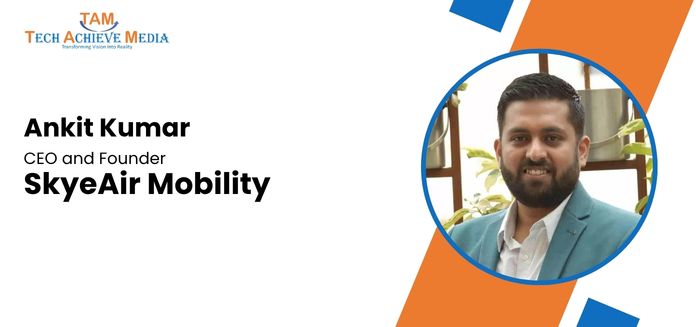
As India accelerates its ambitions to become a global deep-tech and AI innovation hub, homegrown startups are beginning to redefine what next-generation infrastructure could look like. One such company is SkyeAir Mobility, which is building what it calls a “physical AI network” for autonomous last-mile delivery combining drones, robotics, and intelligent software into a seamless delivery ecosystem. In an exclusive conversation with Tech Achieve Media, Ankit Kumar, CEO and Founder of SkyeAir Mobility, discusses the challenges of solving India’s complex last-mile problem, the company’s breakthrough in camera-free drone delivery, and how Indian engineers are building the foundation for a globally scalable autonomous delivery infrastructure, which has been designed in India, for the world.
TAM: SkyeAir Mobility has been conducting drone deliveries across cities such as Gurugram and Bengaluru. Last-mile delivery in India is notoriously complex. What have been some of the biggest operational challenges you have faced?
TAM: Can you share a specific use case where SkyeAir solved one of these challenges in an innovative way?
Ankit Kumar: One good example is how we addressed the COD challenge. We tackled it on two fronts. First, we created a dynamic QR payment system. Every customer receives a personalised payment link and QR code through our app and WhatsApp. Instead of paying cash to the delivery agent, they can pay digitally directly into our system. This gives customers a digital record of payment, improves trust, and significantly reduces cash handling risks.
Second, we built a wallet-based reconciliation system for delivery agents and stations. If a delivery agent collects cash, that amount is automatically reflected as a negative balance in their wallet. Once the cash is deposited at the station, the balance resets, and the station assumes accountability until it deposits the money into the company account. This closed-loop wallet system ensures transparency and accountability at every level of the cash flow. As a result, we have reduced our COD cash handling from nearly 60% to just 10% in the last month alone.
TAM: One of the most interesting aspects of your technology is that your drones operate without cameras. Why did you make that design choice?
Ankit Kumar: Yes, that is one of our most unique innovations. We are perhaps the only drone delivery company in the world operating commercial delivery drones without onboard cameras. This was a deliberate design decision. From day one, we knew we were not building only for India, we were building for global markets. And if you think five years ahead, privacy concerns will become much more prominent.
As AI becomes more powerful, people will increasingly view any camera-equipped device as a potential surveillance tool. Even if a drone is not recording anything, people will assume it is. There is also the issue of national security. In India, urban environments often overlap with defence zones and sensitive infrastructure. Flying camera-enabled drones in such environments can create regulatory and security challenges.
So we asked ourselves: if we remove cameras, how do we still navigate safely?
That led us to create what we call a SkyeAir Corridor (SCAR) Tunnel, which is a virtual 10-metre-wide air corridor between Point A and Point B. This invisible corridor contains terrain data, weather inputs, obstacle intelligence, and geofencing rules. The drone flies within this predefined tunnel using GPS and LiDAR sensors, which detect dynamic obstacles such as birds, kites, or unexpected aerial objects. This allows us to navigate safely without relying on computer vision.
TAM: SkyeAir recently unveiled its AI-powered autonomous doorstep delivery system. How exactly does AI power this last-mile network?
Ankit Kumar: We use AI in two ways. The first is what we call a physical AI network where drones, Skyports, and autonomous robots communicate with each other without human intervention. A package is picked up automatically, transported by drone, transferred to a robot, and delivered directly to the customer’s doorstep. The customer receives an OTP to unlock the robot’s compartment and collect the package.
That entire process involves zero human touchpoints. The second layer is our UTM (Unmanned Traffic Management) system, which acts like an air traffic control system for low-altitude drone traffic. It manages airspace access, drone routes, altitude adjustments, and collision avoidance in real time. If another drone enters the same corridor, the system automatically changes altitude or route to maintain safety. That software intelligence is critical to scaling drone operations safely.
TAM: How extensive is your current Skyport network, and what are your expansion plans?
Ankit Kumar: We currently operate around four to five stations in Gurugram, with three more coming up in Delhi and two in Bengaluru. This is scaling rapidly because our goal is large-scale deployment. The infrastructure is being designed to support city-wide autonomous delivery networks.
TAM: What kind of support do you need from government and policymakers to scale faster?
Ankit Kumar: The biggest requirement is access to data and continued collaboration. For systems like ours, data is everything. We work closely with multiple government departments to access relevant data layers that help improve navigation, compliance, and safety. We are also part of organisations such as IN-SPACe, TSDSI, and the NVIDIA Inception Program, which gives us access to research ecosystems, standards development, and technology collaboration opportunities. We are also exploring grants and co-development opportunities with institutions and government bodies to continue strengthening our R&D.
TAM: Finally, what partnerships are most important to scaling SkyeAir’s solution to the end customer?
Ankit Kumar: Partnerships are central to our growth strategy. Today, we work with companies such as Flipkart, Blue Dart, Zepto, Shiprocket, Bombay Shaving Company, and several others. We currently serve dozens of customers, but our goal this year is to scale to 100+ enterprise customers, particularly across D2C brands and e-commerce platforms. That is where we see the next major growth opportunity.