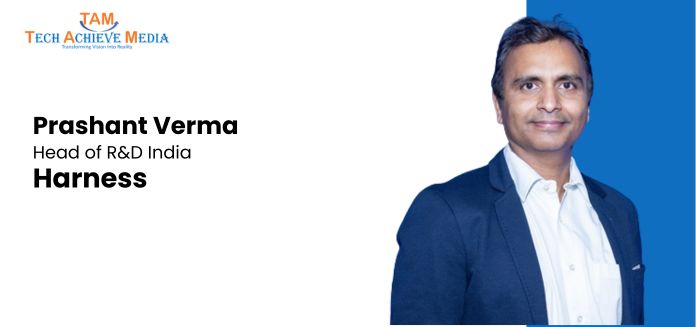
As enterprises rush to adopt AI-powered coding tools, a new challenge is emerging: faster code does not automatically mean better software delivery. In this exclusive conversation, Prashant Verma, Head of R&D India at Harness, explains why the industry is facing an “AI velocity paradox”, where code generation is accelerating, but bottlenecks around testing, security, deployment, and governance are eroding much of that value. He shares how Harness is rethinking DevOps for the agentic era, the strategic role India plays in its global innovation engine, and why enterprises must move beyond “AI for coding” to “AI for everything after code.”
TAM: AI has dramatically accelerated code generation, but industry data now suggests productivity gains are not necessarily translating into better software delivery outcomes. Are developers writing code faster because of AI, but becoming less careful about software quality, design, and long-term maintainability?
Prashant Verma: Of course, when the first generation of LLMs came in, people immediately started thinking about what problems they could solve for the software industry. And historically, coding has been considered the most intensive part of the entire Software Development Life Cycle (SDLC). You start with a product requirement, move into design, and then coding takes up the bulk of the time. After coding, you move into quality assurance, security, and deployment.
So, if there are seven or eight stages in the entire SDLC cycle, the industry initially saw coding as the most valuable area to optimise because that is where the bulk of manpower is deployed. That became the first problem we started solving with Vibe Coding and the tools we see today, like Cursor and Claude. And to be fair, these tools are able to generate a strong first draft of an application incredibly quickly. What used to take weeks or even months can now be done in hours.
From that perspective, it’s clear that things can move much faster. But the problem is that this addresses only one part of the SDLC. It takes a very micro view focusing only on functionality and building it out. If you look at it from a macro perspective, however, there are still several bottlenecks around architectural principles and everything that comes after coding.
What we are saying is this: coding velocity has gone up 4X, and much more code is being generated. But that does not mean the entire SDLC has become equally efficient. Key aspects of software delivery, architecture, resilience, scalability, security, quality, and deployment, are still not being addressed adequately. And that is what is creating this AI velocity paradox that everyone is experiencing today.
TAM: Harness’s latest data shows that 81% of frequent AI tool users find their current ways of working unsustainable. What is the “hidden tax” of AI-driven development that leaders are failing to account for?
Prashant Verma: If the volume of code being generated has increased by 4X, but you have limited control or visibility into what is actually being produced, that creates a significant challenge. When that code moves into production, organisations may begin to see a sharp rise in incidents, potentially 50% more, simply as a result of AI-assisted code generation. This can mean more bugs being reported in production, more deployment issues, and greater operational complexity during releases.
As a result, teams are forced to spend much more time on code reviews, quality assurance, and security validation. They are also dealing with more rollbacks and fixes. At the same time, as the volume of features being shipped continues to increase, it becomes increasingly difficult for humans alone to keep track of everything.
That is the challenge the industry is currently facing and struggling to keep pace with. While coding speed has increased dramatically, the rest of the software delivery assembly line has not scaled at the same rate. This creates bottlenecks precisely at the stage where software needs to be delivered to the end user. As a result, much of the value gained through faster code generation is being eroded by multiple friction points further down the delivery pipeline.
TAM: As AI accelerates development cycles, our traditional delivery systems are becoming bottlenecks. What does a “mature” delivery infrastructure look like and If AI lets us build software much faster, what kind of modern engineering and DevOps systems do companies need so releases remain reliable, secure, and scalable?
Prashant Verma: I believe that to address the overall delay in software delivery, we need to think about the entire SDLC, and not just the coding phase, but every aspect of software delivery. It begins with defining the right module structure and establishing sound architectural principles. One of the core principles of good architecture is simplicity. However, with AI-generated code, where thousands, or even tens of thousands, of lines of code can be produced rapidly, there is often very limited visibility into what is actually being written. In many ways, it becomes a black box.
This challenge becomes even more complex when that AI-generated code has to integrate with legacy codebases, where there is significant historical context. Today’s models do not inherently understand that context unless it is explicitly provided through intelligent rules, policies, and domain-specific guidance.
The key question, then, is: how do we embed the kind of maturity, judgment, and contextual understanding that senior architects and engineering leaders bring into the process? Without that, software may be delivered functionally, but it will struggle to scale, modernise, and remain sustainable over time. There are also downstream implications. If AI enables 4X more code generation, it naturally creates 4X more testing requirements. That means significantly greater functional and non-functional test coverage.
Beyond testing, we also need to address performance. Who is evaluating whether the generated code is efficient and optimised? Earlier, engineering teams consciously focused on intelligent algorithms and efficient coding practices. Today, when code is being generated autonomously, we need new ways to validate performance and efficiency.
Security is another major consideration. How do we build security into the development lifecycle from the beginning, rather than discovering vulnerabilities after deployment? Whether it is data exposure through APIs or vulnerabilities introduced through packaged software dependencies, organisations must address both static and runtime security risks much earlier in the process.
This is why all these capabilities must become part of an intelligent DevOps pipeline, where teams truly “shift left.” Security scanning should happen as part of the build process. Testing should become intelligent enough to run the most relevant test cases based on the changes being introduced. Infrastructure provisioning should scale dynamically as functionality expands.
All of this needs to be built into a modern DevOps platform. And importantly, these processes can no longer be entirely human-led. If coding is becoming agent-led, then every stage of the software delivery lifecycle must also become increasingly agentic, with humans remaining in the loop to provide oversight, governance, and strategic decision-making.
TAM: With strategic partnerships like Wipro, Infosys, and Google, how is Harness leveraging the Indian ecosystem to solve the unique challenges of AI adoption at the massive scale required by global enterprises?
Prashant Verma: Google is at the forefront of the AI revolution we are witnessing today, and it is also one of the most trusted cloud partners for enterprises globally. By partnering with Google, we believe we can offer customers greater confidence, particularly around data security, privacy, and data sensitivity. Enterprises want assurance that their data remains secure and is not exposed to unintended risks, and this partnership helps us build that trust with our customers.
The second part of the partnership involves Wipro and Infosys, whom we see as key global system integrators driving large-scale DevOps modernisation. Both organisations are deeply involved in helping enterprises navigate this transition and transformation. By partnering with them, we gain access to the broader DevOps modernisation opportunities they are driving across large Fortune 500 organisations. Being part of that ecosystem enables Harness to go beyond just AI for coding and deliver what we call “AI for everything after code”, which includes testing, security, deployment, reliability, and overall software delivery.
These organisations are already leading this transformation, and our platform acts as a multiplier for them. If AI is generating 4X more code, Harness helps ensure that organisations can also realise 4X more value from that code. That is the fundamental premise behind these partnerships.
To give you an example, we recently worked with a BFSI customer where we helped reduce their release cycle from multiple days to less than seven minutes. Today, they are able to deploy multiple times a day with far more efficient feature delivery. And if an incident occurs, they can roll back almost instantly. That is the scale of transformation we are talking about, from days to minutes.
TAM: What specific innovations are being “Born in India” at Harness that are now defining the standard for DevOps modernization worldwide?
Prashant Verma: I think one of the strengths of Harness is that, while we are a global company, a significant part of our R&D is based in India. That means a great deal of our product innovation is happening out of the Harness India R&D Centre. Our focus has never been limited to AI alone. From the very beginning, we have been deeply focused on one mission: how do we bring greater productivity across the entire SDLC? Our goal has always been to help 40 million developers build software faster, more reliably, more securely, and in a more optimised way. Today, that mission has evolved from enabling 40 million developers to enabling an infinite number of agents.
The question now is: how do we empower these AI agents not just to write code, but to take that code through the entire software delivery lifecycle? For example, when it comes to building software, how do we make the build process more efficient? In large monolithic codebases, build and test cycles can often take hours. We have developed intelligent algorithms that help optimise and significantly reduce build times.
Similarly, through our test intelligence capabilities, we can identify exactly which tests need to run when a specific piece of code changes. Instead of running thousands of test cases every time, we understand what has changed and what is likely to be impacted. On the security side, we are focused on shifting security further left into the development lifecycle. Through our partnership with Checkmarx, for example, security scans can now happen directly within the IDE while developers are writing code. This means security is no longer something that happens after deployment, it becomes an integral part of both coding and the delivery pipeline.
We are also investing heavily in what we call AI SRE, AI-powered Site Reliability Engineering, which is designed to automate how software is managed in production. For example, we enable continuous verification during deployments by comparing system metrics before and after deployment. If there is any abnormal variance in engineering health metrics, the system can automatically trigger a rollback.
We also support a wide range of deployment models, whether that is canary deployments or feature flag-based releases. Beyond that, AISRE looks across the entire software ecosystem, pull requests, security scans, production releases, and operational signals, to continuously monitor system health. If it detects an anomaly, it can automatically raise an incident. But it goes beyond simple alerting, it can also generate hypotheses, assist engineers in diagnosing the issue, and help accelerate remediation. Ultimately, the goal is to reduce overall mean time to recovery and make software operations far more intelligent, proactive, and autonomous.
TAM: If we don’t close the gap between AI speed and process maturity by 2027, what does the software landscape look like? Are we heading toward a “technical debt bubble”?
Prashant Verma: I think that is one of the clearest signals we are seeing today. Enterprises are expanding their investments in AI tools and expecting a significant increase in velocity. While they are certainly seeing faster code generation, they are not always realising the full value they initially expected.
At the same time, there are important reverse indicators emerging. Incident rates are rising, security vulnerabilities are increasing, and organisations are seeing more rollbacks and hotfixes. The people responsible for governance, oversight, and policy enforcement are also feeling the strain. They are experiencing burnout because there is simply too much to manage manually.
Without broader support across the rest of the software lifecycle, this can become a serious challenge, potentially even a catastrophic failure. That is why, as an industry, we need to move beyond thinking only about AI for coding. AI for coding is important, and it delivers clear benefits. But we also need to think about how AI can support every other stage of the lifecycle, whether that is design, architecture, testing, security, cost optimisation, or infrastructure management. Every one of these areas needs to be approached from an agentic perspective. Without that, scaling AI-led software development sustainably will be extremely difficult.