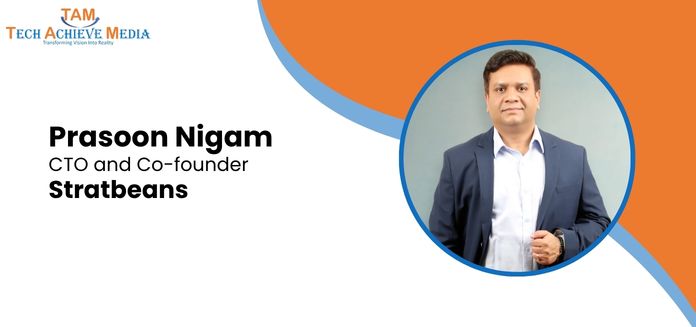
As India witnesses a sharp surge in digital learning adoption, the conversation is shifting from scale to substance. While AI is driving renewed interest in upskilling, organisations are grappling with a critical question: Are they building real capabilities or simply reacting to the fear of being left behind? In this interaction with Tech Achieve Media (TAM), Prasoon Nigam, CTO and Co-founder of Stratbeans, shares his perspective on the evolving learning landscape, the cultural and structural barriers to AI adoption, and why enterprises must fix foundational gaps before chasing advanced AI-led transformation. He also highlights the importance of adaptability, data integration, and outcome-driven learning in building a truly AI-ready workforce.
TAM: India has seen a 3 to 4x surge in digital learning adoption. Is this growth driven by a genuine skill transformation, or is it a “defensive” reaction by Indian enterprises terrified of being left behind by the AI wave?
Prasoon Nigam: That’s a very pertinent question. FOMO is definitely one aspect, but there’s also a natural human response at play, what I call “fight or flight” behaviour. Whenever a new technology emerges, organisations either resist it or rush to adopt it.
We’ve seen this with earlier technology waves like cloud and the internet. AI is no different. Some organisations are adopting it defensively because they feel pressured to respond in boardroom conversations. However, this is part of the natural evolution of any technology.
In learning and development (L&D), what we’re seeing is a mix. Organisations attempting large, revolutionary changes with AI are more likely to fail because the technology is still evolving. AI works best as an amplifier, not a starting point. If your foundational systems, like content, platforms, and data, are not in place, AI will only amplify the inefficiencies. The surge in learning is real and irreversible. However, organisations need to focus on solving the basics first, like improving content creation and delivery, before expecting large-scale AI-driven transformation.
TAM: In the Indian workforce, which tier is most resistant to AI-powered learning? Is the challenge a lack of technical infrastructure or a cultural mindset of “this is how we’ve always done it”?
Prasoon Nigam: While infrastructure plays a role, the bigger challenge is often cultural, particularly at the middle management level. The younger workforce is already quite comfortable with AI tools. However, middle managers are often accustomed to traditional ways of working and can feel overwhelmed by the pace of change. Interestingly, AI is also changing work dynamics. Tasks that earlier took days are now completed in hours, which creates new pressure points, especially for decision-makers. In many cases, leaders themselves become bottlenecks.
To address this, organisations need to invest in AI and data literacy across all levels. Leaders must enable teams to experiment with AI while focusing on identifying and removing operational bottlenecks. Change management needs to be driven from the top, but with flexibility and openness.
TAM: What is the one “blind spot” Indian CTOs and CHROs consistently have when they try to deploy AI-powered learning models at scale?
Prasoon Nigam: One of the biggest blind spots is treating AI as a magic solution. Organisations often try to jump directly into advanced AI use cases without addressing foundational gaps.
For example, if content creation, localisation, or platform integration is weak, AI will not deliver meaningful results. We’ve seen real cases where organisations created high-quality content, but it failed because it wasn’t relevant to the audience, like using an American accent for a vernacular workforce.
Another major challenge is legacy complexity. Many organisations have multiple disconnected systems, older LMS platforms, newer tools, and now AI layers. When these systems don’t integrate well, it creates friction rather than value. The key is to move from buzzwords to bottlenecks. Identify where you are losing time or money, fix that, and then apply AI strategically.
TAM: What skills will define workforce readiness in an AI-first economy, and how should organisations prioritise them?
Prasoon Nigam: The most basic skill today is prompting, knowing how to interact effectively with AI tools. But beyond that, the real differentiator is adaptability. Earlier, expertise was defined by deep knowledge in a specific technology. Today, that is changing. The ability to quickly learn, unlearn, and apply knowledge across domains is far more valuable.
AI is reducing the importance of memory-based skills. Instead, the focus is shifting to problem-solving, critical thinking, and the ability to assemble solutions using multiple tools. People who are flexible and open to change will thrive, while those rigidly tied to one skill set may struggle.
TAM: How are you helping Indian enterprises move from fragmented learning initiatives to structured, AI-powered learning at scale?
Prasoon Nigam: Historically, learning systems like LMS platforms were designed to track completion, not actual learning outcomes. This has led to a situation where completion rates are high, but real impact is minimal. The shift now needs to be from completion-based metrics to behaviour-based outcomes. For instance, completing a 45-minute course in 10 minutes should raise a flag, it indicates either poor content design or disengagement. Another key issue is lack of integration between systems. Learning platforms often operate in silos, disconnected from performance management systems. Without this data flow, AI-driven recommendations become inaccurate or irrelevant. The right approach is to first fix the data and system connectivity. Once the foundation is strong, AI can significantly enhance learning through better recommendations, personalisation, and scalability. Ultimately, learning should not be an end in itself, it should drive performance. Organisations that align their learning strategy with business outcomes will see the real value of AI.