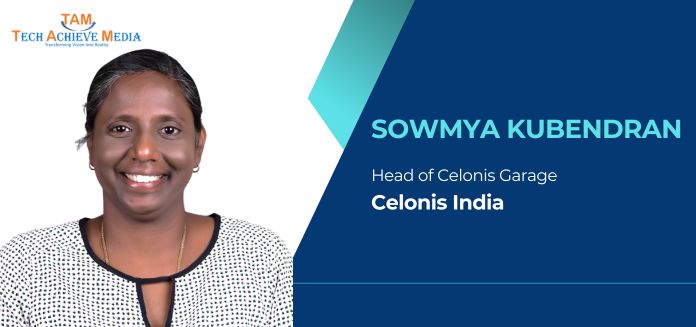
As organisations in India continue to scale their AI and digital transformation efforts, the focus is clearly moving from experimentation to delivering tangible business outcomes. In this interaction with Tech Achieve Media, Sowmya Kubendran, Head of Celonis Garage, Celonis India, shares insights from her journey across enterprise technology, data and analytics. She talks about how the Garage model is evolving, the role of partnerships and ecosystem-led innovation, and how organisations can move from pilot projects to real impact, along with her perspective on leadership and building more inclusive workplaces.
TAM: You have had a diverse career spanning enterprise technology, data, and analytics. What have been the defining moments that shaped your leadership journey and approach to driving large-scale transformation?
Sowmya Kubendran: I’ve spent two decades transitioning from building systems to building the teams that transform them. Starting as an engineer gave me a “builder’s mindset” that I’ve carried through every Fortune 500 engagement in Financial Services, High Tech, and the Public Sector.
Also read: India – The New Nerve Centre of Process Intelligence for Celonis
My approach to leadership was forged in the trenches of high-complexity data and analytics projects – specifically, building petabyte-scale warehouses and turning raw data into strategic insights. The defining moments for me have always been about orchestrating large-scale initiatives through the entire lifecycle of planning, delivery and creating customer impact. At Celonis Garage India, we are co-innovating with customers – we don’t just build features; we bring a new perspective to customer challenges using the power of AI and Process Intelligence:
TAM: As VP of Celonis Garage in India, how are you evolving the Garage model to move beyond traditional innovation approaches and deliver measurable business impact?
Sowmya Kubendran: We are evolving the Garage into a high impact co-innovation engine. In fact, our mission at Garage is to co-innovate at the intersection of AI, Process Intelligence and real-world business impact – right here in India. We are solving high-complexity problems alongside our customers and academic partners. A perfect example is our new Scenario Simulation capability, which is an innovation that came out of Garage just this past year. Traditionally, changing a business process felt like “trial and error” with real-world stakes. With Scenario Simulation, we’ve built a sandbox where users can design changes in natural language, and the system simulates the KPI impact using historical data before a single change is made.
By “drinking our own champagne” – testing these innovations internally on our own Lead-to-Opportunity flows – we ensure that by the time a solution reaches a customer, it isn’t just a cool tech demo. It’s a de-risked, proven tool for business orchestration. In the Garage, we aren’t just imagining the future. We’re engineering the confidence to go out and execute it.
TAM: How does co-innovation with startups and partners change the way large enterprises approach transformation?
Sowmya Kubendran: Large enterprises have the scale, but they often carry the “gravity” of how things have always been done. Co-innovation, whether with a nimble startup or an academic powerhouse, injects a level of creative friction that forces us to look at a problem differently. It moves us from a “vendor-client” relationship to a “shared-lab” environment where we focus purely on the best way to build.
Our partnership with IIIT Allahabad is a perfect example. By launching the Celonis x IIITA Research Centre, we aren’t just funding research; we are embedding academic rigor directly into enterprise workflows. For instance, in our work on Order-to-Cash efficiency, we are using Causal ML and Explainable AI to replace “black-box” models.
When you combine a student’s fresh perspective on AI with our deep operational data, you get breakthroughs like our LION 2026 paper on “Process Intelligence Engines.” It changes the conversation from “Let’s hope the AI works” to “Here is exactly why this KPI shifted and how we fix it.” That level of transparency is what finally allows large enterprises to automate with confidence rather than caution.
TAM: As a leader, what has your experience been as a woman navigating this space, and what more needs to be done to drive inclusive leadership in the industry?
Sowmya Kubendran: In twenty years of building systems and teams, I’ve learned that the first hurdle is often internal, overcoming the self-doubt that society can mirror back at you. Once you find that internal grounding, the challenge shifts to proving your vision to the world. Navigating this space has taught me that while individual resilience is key, having real mentors and sponsors is what truly accelerates that journey from the “builder” to the “leader.”
I’ve learned that you can’t just “patch” a culture for inclusivity; you have to build it into the OS. At the Celonis Garage, we operate with a startup mindset where the best idea wins, regardless of who it comes from. That only works if the “system” is designed for it.
To drive real change, we have to move past treating “inclusive leadership” as a side program or a HR initiative.. We need to normalize environments where the “quieter” voices are intentionally brought into the design phase of a project, not just the review phase. Representation is the starting line, but the real goal is creating a space where people feel safe enough to take the creative risks that lead to actual innovation. We’ve made progress, but as an engineer, I’m always looking at the delta between where we are and where we could be. There’s still plenty of building left to do.
TAM: What differentiates Celonis Garage as an innovation model, and how is it helping enterprises translate AI-led ideas into real, scalable business outcomes?
Sowmya Kubendran: The “innovation gap” in most enterprises isn’t a lack of ideas – it’s a lack of context. Most AI pilots fail to scale because the AI doesn’t actually understand how the business runs. What differentiates the Celonis Garage is that everything we build is anchored in Process Intelligence. We provide the living digital twin that gives AI the context it needs to be reliable.
Our model is about moving from a cool demo to a deployed tool as fast as possible. A great example from this past year is our Competitive Intelligence agent. We saw that our GTM and account teams needed more than static reports to stay ahead of market shifts. The Garage built an AI-powered agent that delivers real-time, strategic insights directly into their daily workflows. We’ve already moved from an MVP to integration within our sales and strategy cycles.
Whether it’s that Competitive Agent or our Scenario Simulation tools, the philosophy is the same: we don’t layer AI on top of a process and hope it works. We embed it into the workflow. By the time a Garage innovation reaches a customer, it has already been battle-tested in our Garage.
TAM: India is increasingly being seen as a hub for enterprise AI innovation. From your perspective, what strengths set India apart, and where do you see gaps that still need to be addressed?
Sowmya Kubendran: India isn’t just “ready” for AI; we are the global pacesetter for Return on AI (RoAI). While much of the world is still experimenting, leaders in India are industrializing it. Our research shows that 86% of Indian business leaders recognize that optimized processes are the engine of productivity – significantly higher than in Europe.
What sets India apart is the “leapfrog effect.” Similar to how we bypassed traditional banking for mobile payments, Indian enterprises and GCCs are skipping the era of rigid, monolithic SaaS and moving straight to AI-driven, composable operations. At Celonis India, we serve nearly 200 GCCs – including giants like AstraZeneca and Hitachi Energy – and we see firsthand that India is where the most complex global transformation programs are actually being engineered.
The gap I’m focused on closing at the Celonis Garage is the “pilot-to-production” lag. Globally, 82% of global CEOs agree that AI fails when it doesn’t understand how the business actually runs. We are solving that by providing the “connective tissue” – the Process Intelligence – that turns an isolated AI experiment into an industrialized solution.
By the time an innovation leaves our Bengaluru hub, it’s designed to function in the real world, orchestrating AI agents across ERP and CRM boundaries. We aren’t just building for the local market; we are proving that when you combine India’s digital infrastructure with Process Intelligence, you create the blueprint for the Agentic Enterprise worldwide.