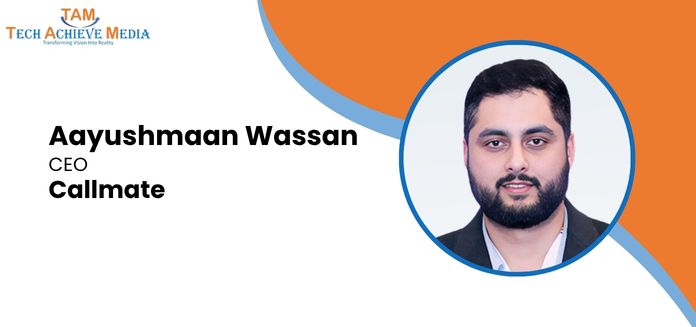
India’s mobile accessories market has transformed dramatically over the past three decades right from the early days of feature phones to today’s hyper-competitive, D2C-driven ecosystem. Yet amid changing technologies, shifting consumer expectations, and intense competition, Callmate India has not only endured but evolved. In this exclusive interaction with Tech Achieve Media, Aayushmaan Wassan, CEO, Callmate India reflects on the company’s 30-year journey, the lessons learned from navigating multiple industry transitions, and how Callmate is redefining itself not just as a mobile accessories brand, but as a “daily tech infrastructure” company focused on solving real consumer needs through innovation, utility, and affordability.
TAM: Callmate was founded in 1995 and has successfully navigated multiple industry shifts. What is the one core institutional habit that has helped the company survive while many legacy hardware brands disappeared?
Aayushmaan Wassan: My father, Atul Wassan, founded Callmate in 1995, just as mobile phones were entering India, and I think that early vision laid the foundation for everything. Over the years, what has helped us survive is our ability to understand the fundamentals of what the customer truly needs. Early on, when brands like Nokia, Samsung, and Sony Ericsson all had different charging ecosystems, we identified a simple but important consumer need, multi-device charging, and built around that. That ability to solve real utility problems has remained our core strength. Trends have changed, marketplaces have changed, brands have come and gone, but our belief in solving for everyday utility has stayed constant.
TAM: India’s accessories market today is crowded with low-cost imports and aggressive D2C players. How does Callmate avoid becoming just another commoditized hardware brand?
Aayushmaan Wassan: That’s something we think about constantly because this is an extremely competitive category. Many product segments, chargers, cables, even audio, have become commoditized almost overnight. We made a conscious decision not to chase every trend. For example, we moved away from building our own branded audio products because it had become a race to the bottom. Instead, we doubled down on our strength, which is power solutions. Today, Callmate stands strongly for power banks, portable chargers, and power stations. Customers associate our brand with reliability in that category, and that brand trust matters.
TAM: What major consumer shifts have you seen in the post-pandemic era, and how has Callmate adapted?
Aayushmaan Wassan: The pandemic actually surprised us. We initially thought demand for portable chargers would decline because people were staying home but our power bank sales nearly tripled. Screen time exploded, and consumers wanted power security at all times. That was a big learning moment. Post-pandemic, we’ve also seen strong demand for lifestyle technology, which is wearables, safety-focused products like dash cams, and utility-driven devices. Our strategy has been to stay focused on products that solve practical problems rather than just chase flashy features.
TAM: With global geopolitical shifts and the growing “China+1” strategy, how is this influencing Callmate’s long-term manufacturing and sourcing roadmap?
Aayushmaan Wassan: Honestly, in electronics, I think “China+1” is still more aspiration than reality. India is making strong progress, but the ecosystem is not yet mature enough to fully replace China, especially for core components like sensors, ICs, and cells, where dependence on East Asia remains high. We’ve made a genuine effort to localize more of our manufacturing, but the full-stack ecosystem still needs time to develop. Once that matures, Indian brands like ours can truly scale globally.
TAM: If you had to define Callmate’s next phase in one sentence, what would it be?
Aayushmaan Wassan: We no longer think of ourselves simply as an accessories company. Instead, we see ourselves as a daily tech infrastructure company. Our focus is on providing solutions that make consumers’ everyday lives easier, whether that’s power, mobility, or connected utility products. That mindset has fundamentally changed how we build and innovate.
TAM: Can you share an example of this solutions-first thinking?
Aayushmaan Wassan: A good example is our power station category. Globally, these products are positioned mainly for outdoor and camping use. But in India, we adapted them for a very different need, unreliable electricity in tier 2 and tier 3 cities. Today, our compact power stations help users power appliances like mini-fridges, TVs, and small household devices. That’s exactly how we think, which is to take a global product concept and localize it for Indian needs.
TAM: You also mentioned newer categories like dash cams. Why is that an important growth area?
Aayushmaan Wassan: We strongly believe every car should have a dash cam. It helps with insurance claims, road safety, and personal peace of mind. Because of our confidence in this category, we are opening a new assembly facility dedicated specifically to dash cams. We are also in discussions with major automotive OEMs for customized solutions. We believe this will be a major growth engine for us over the next few years.
TAM: Finally, what broader market trend excites you most right now?
Aayushmaan Wassan: Premiumization. Indian consumers today are far more willing to pay for better technology and better experiences than they were even a few years ago. Utility still matters but increasingly, customers also want aspirational products. That gives Indian brands like Callmate a tremendous opportunity to innovate and build stronger value propositions.