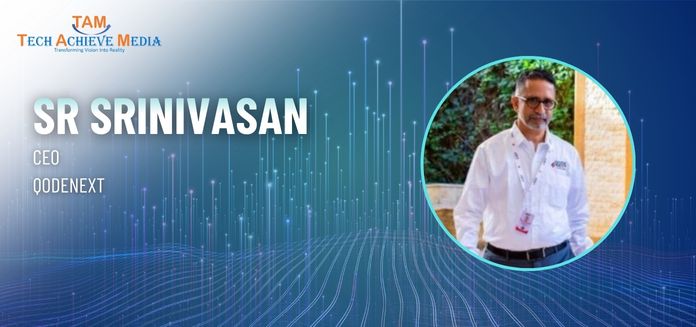
As businesses navigate an increasingly unpredictable global environment, the definition of a strong supply chain has evolved far beyond speed and efficiency. In this conversation with Tech Achieve Media on the occasion of National Technology Day, SR Srinivasan, CEO, QodeNext, shares how resilience, real-time visibility, and intelligent automation are becoming critical pillars of economic security and business continuity. He also highlights how India-built innovations in RFID, IoT, and connected systems are helping enterprises modernize supply chains and compete more effectively on the global stage.
TAM: In the context of National Technology Day, how has the definition of an “unbreakable” supply chain evolved from being just about efficiency to being a cornerstone of national economic security?
SR Srinivasan: If you go back a few years, most conversations around supply chains were about efficiency ; cost, speed, optimization. That’s still important, but it’s no longer enough. Today, the real question is: how quickly can you respond when something goes off track? Because disruptions are not rare anymore, they’re part of the environment.
So “unbreakable” now really means resilient and visible. You need to know what’s happening across your operations in real time, and you need the ability to act on it. At a global level, this has become even more important. Supply chains are now directly linked to economic stability. If they slow down or break, the impact is immediate and quite widespread.
TAM: With India’s growing role in global manufacturing, what specific “Made in India” technological innovations are currently doing the heavy lifting in making domestic supply chains globally competitive?
SR Srinivasan: What we’re seeing is a shift towards solutions that are actually built and adapted for Indian conditions. Technologies like RFID, vision systems, and IoT-based tracking are being used much more widely now. But what makes the difference is how they’re implemented. India has a very mixed operating environment; different levels of infrastructure, scale, and complexity. Solutions that work here have to be flexible.
So a lot of the innovation is not just in the technology itself, but in how it’s applied. Systems that connect multiple stakeholders, give real-time visibility, and still remain cost-effective — that’s where Indian solutions are doing well.
TAM: For a legacy enterprise, the transition to a digital-first supply chain is often compared to “changing the engines of a plane while in flight.” What is your roadmap for companies to modernize without systemic collapse?
SR Srinivasan: That’s actually a pretty accurate way to describe it. The biggest mistake companies make is trying to transform everything at once. That usually creates more disruption than improvement. What works better is starting with one or two areas where the impact is clear, maybe entry and exit operations, maybe inventory tracking.
You don’t need to replace everything immediately. You can layer new systems on top of existing ones, let teams get comfortable, and then expand.
Integration is also key. If systems don’t talk to each other, you just end up adding complexity. And honestly, a big part of this is people. Adoption takes time, and that needs to be planned for.
TAM: Beyond the buzzwords, where are you seeing the most tangible ROI for Artificial Intelligence in supply chain management today? Is it predictive maintenance, demand forecasting, or warehouse automation?
SR Srinivasan: There’s a lot of discussion around AI, but the actual value right now is coming in fairly specific areas. Demand forecasting is one. Exception handling is another; where systems can flag what needs attention instead of teams going through everything manually. But the bigger point is, AI depends heavily on the quality of data. If your data capture is not reliable, AI won’t really help. In warehouses, there are improvements in optimizing operations, but again, it works best when supported by strong data capture systems like RFID or vision. So AI is useful, but it’s not where you start. The foundation still matters more.
TAM: Looking at the next few years, what is the single biggest “blind spot” CEOs still have regarding their supply chain technology, and how is QodeNext addressing it?
SR Srinivasan: A common assumption is that having reports means having visibility. But in many cases, the data behind those reports is delayed or manually entered. So the blind spot is assuming control where there isn’t complete control. Real visibility comes from capturing data at the source, automatically. That’s where technologies like RFID, cameras, and sensors come in. At QodeNext, we spend a lot of time solving that layer. Once the data is accurate and real time; everything else, reporting, analytics, decision-making becomes much more reliable.
TAM: As a National Technology Day message, if you could dispel one common myth about the state of supply chain technology in India today, what would it be?
SR Srinivasan: One common myth is that advanced supply chain technology is only relevant for very large or global companies. That’s not really the case anymore. We’re seeing adoption across mid-sized organizations as well. The technology is more accessible, and it can be implemented in a phased way. What usually holds companies back is not availability, but the perception that it’s too complex or too expensive. Once that changes, adoption becomes much more straightforward.
India is actually in a good position right now, not just to adopt these technologies, but to build solutions that work in complex, high-scale environments.