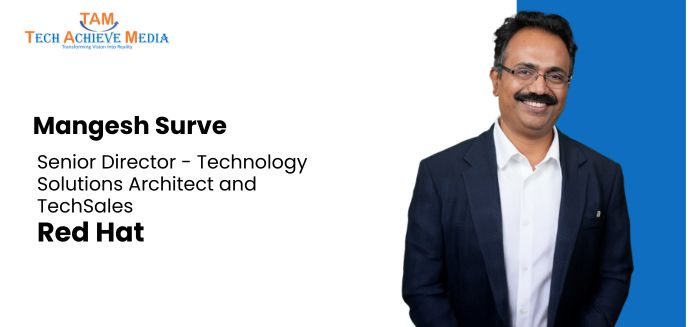
As enterprises accelerate their AI adoption journeys, the limitations of traditional, script-based operations are becoming increasingly evident. What once worked as a cost-effective approach is now turning into a bottleneck, slowing down scale, increasing risk, and creating heavy dependency on individuals. In this interaction with Tech Achieve Media, Mangesh Surve, Senior Director – Technology Solutions Architect and TechSales at Red Hat, shares his perspective on why automation is now non-negotiable, how organisations can move beyond legacy systems, and the critical role of event-driven platforms in enabling scalable, secure and AI-ready operations. He also highlights how enterprises can address challenges like cloud sprawl, lack of transparency, and siloed environments by adopting a more unified, platform-driven approach.
TAM: What is the price that enterprises are paying by clinging to scripted, manual processes in an AI-driven market? What risks are organisations underestimating?
Mangesh Surve: Many times, scripts tend to be error-prone and require constant manual maintenance, which becomes a major challenge. The second issue is the dependency on people. Skilled talent becomes expensive, and over time, the entire setup becomes heavily reliant on specific individuals. When these people leave the organisation, it creates significant risk because there is often limited visibility into how the scripts were written, maintained, or evolved over time.
Another challenge is that scripts can quickly become outdated. Technology is evolving rapidly, with new and better ways of handling operations emerging all the time. If you continue to rely on older, legacy scripts, it can hold back efficiency and innovation. These are some of the key challenges, among others. From an Indian context, one important point to add is that earlier, organisations would rely on FTEs (full-time employees) for automation tasks, including writing and managing scripts. At that time, it may have been a feasible approach from a cost perspective.
However, today that model is no longer sustainable. The scale at which organisations operate has increased significantly, especially with the rise of large and complex environments like sovereign cloud setups. At this scale, automation becomes non-negotiable. Relying on manual scripting is simply not a viable solution anymore. It is, in fact, a recipe for failure.
TAM: TAM: Can an enterprise actually succeed in scaling AI if their underlying infrastructure isn’t event-driven? What are the key gaps you still see in enterprise readiness for automation, and how is Red Hat addressing them?
Mangesh Surve: I agree that some enterprises are still lagging when it comes to modernising their infrastructure and assets. However, at the same time, there is strong momentum, and many organisations are actively catching up and accelerating their modernisation efforts. Let me give you a simple example. In some organisations, provisioning PaaS services can still take around 20 to 25 hours. But with solutions like Ansible Automates, this can be reduced to as little as 15 minutes, especially when infrastructure automation is also integrated into the process. That kind of reduction, from 25 hours to 15 minutes, delivers significant efficiency gains. So while the problem exists, the solution is already available. It’s not really a question of readiness anymore, but of adoption.
When it comes to moving away from legacy systems, there are multiple approaches, and this is an area where we are particularly strong. From an infrastructure standpoint, if organisations want to modernise and move towards a single control plane that can manage Kubernetes, containers, as well as legacy virtualised workloads, we offer a robust platform to enable that. It helps customers standardise their environments, much like they have done with operating systems over the years.
Also read: Automation as Strategy, Not Afterthought, in the AI Era: Sathish Balakrishnan, Red Hat
At the same time, many organisations are now building applications directly on the cloud, driven in part by evolving business and geopolitical needs. Here too, we provide end-to-end solutions that are ready to deploy. On the application side, modernisation has been a key focus area for us over the past 6 to 7 years. We have supported a large number of enterprises in transitioning from monolithic architectures to microservices-based, cloud-native applications. This shift allows them to fully leverage the flexibility and scalability that cloud technologies offer, and it has proven to be highly successful across the region. So yes, there are challenges, but there are equally strong solutions available. We have been able to provide a clear path forward for customers and are well positioned to support them. Now, with AI coming into the picture, the same approach continues. Our hybrid cloud platform extends into the AI space as well, giving customers the flexibility and choice they need. That is the direction we are actively working towards.
TAM: Organizations are struggling with “cloud sprawl.” What is Ansible’s approach to event-driven automation across hybrid and multi-cloud environments that are traditionally siloed keeping the regulation aspect in mind? How do you provide a “single source of truth”?
Mangesh Surve: Let’s look at a typical security journey, where an organisation is trying to secure every aspect of its environment, right from identity and access control to separation of duties, data protection, compliance and vulnerability management. In such scenarios, customers usually have multiple security tools in place, such as CrowdStrike, Zscaler, NetScaler and others. The challenge then is how to bring all of this together and also accelerate it using AI. This is where Ansible plays a central role. It acts as the orchestration layer, when a vulnerability is detected in any of these tools, the request can be routed to Ansible, which can automatically trigger the appropriate playbook and execute the required action.
At the same time, Ansible also enables strong governance. Organisations can define who has the privilege to execute specific playbooks, under what conditions, and at what time. These controls ensure that even while automation is happening at scale, company policies and compliance requirements are always enforced. Now, if we take this a step further, organisations may also want to leverage different large language models (LLMs) that are best suited for their specific industry or domain. These models need to be integrated seamlessly into the overall system.
This is where a platform approach becomes critical. With a solution like Red Hat’s AI platform, organisations can bring in multiple models, run them on the infrastructure or accelerators of their choice, and integrate them with Ansible for end-to-end automation. This enables a complete, unified approach, where security operations are automated, AI is effectively leveraged, and governance is maintained at every step without compromise.
TAM: What is the one “friction point” in enterprise IT that you believe will be completely obsolete in the near future thanks to event-driven shifts?
Mangesh Surve: I would say one of the biggest challenges we continue to see is around support tickets, escalations and root cause analyses (RCAs). Even today, despite having multiple tools and systems in place, these issues persist. A major part of the problem is the lack of transparency, which often leads to a blame game between different teams, technologies and business silos within an organisation. This is something I’ve observed quite frequently, especially in our context. While markets like North America may be more structured, this challenge still exists in many organisations here.
There have been several situations where commitments were made to customers but couldn’t be delivered. In such cases, we had to step in, support the teams, and ensure that critical applications went live successfully. Through all of this, one consistent issue has been the lack of alignment and the tendency to shift responsibility across teams.
This is where AI can make a meaningful difference. By bringing in greater transparency and the ability to correlate events across systems and technologies, AI can help reduce disagreements and improve problem resolution. While RCAs may still involve some level of complexity and internal dynamics, the availability of clear, data-driven insights can make the process far more objective. From a vendor perspective as well, this would reduce friction, as we would be able to share more transparent and actionable data with customers, leading to faster and more effective outcomes.