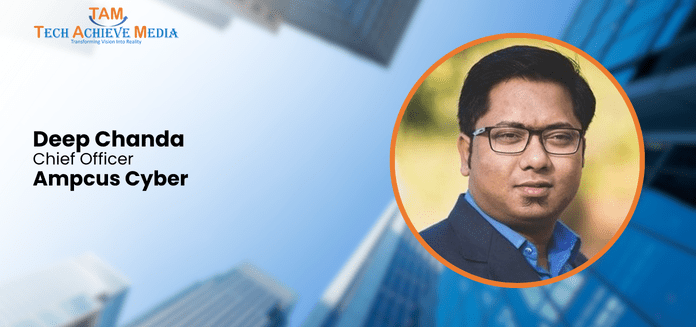
As cyber threats grow faster, smarter, and increasingly AI-driven, organisations are being pushed to rethink how they approach security as a core business priority instead of only a technical safeguard. In this exclusive interaction with Tech Achieve Media, Deep Chanda, Chief Officer at Ampcus Cyber, shares sharp insights on the biggest blind spots in today’s cybersecurity strategies, the rising importance of governance and leadership accountability, and the urgent need to shift from reactive defence to continuous, intelligence-led security. He also highlights how evolving risks across cloud, identity, and digital ecosystems are reshaping enterprise security priorities, and how organisations can build resilience in the face of growing complexity and talent shortages.
TAM: As cyber threats grow more sophisticated and increasingly AI-driven, what do you see as the biggest blind spot in how organisations currently approach cybersecurity?
Deep Chanda: One of the biggest blind spots is that many organisations still treat cybersecurity as a reactive function rather than a continuous, intelligence-led discipline. As threats become more sophisticated and increasingly AI-driven, many security strategies still rely on periodic assessments and static controls that struggle to keep pace with real-time attack patterns. There is also an overreliance on automation, with the assumption that AI alone can detect and resolve everything, when in reality it can miss context, generate noise, or fail to distinguish business-critical risk. AI-powered threats such as deepfake phishing, credential abuse, and automated reconnaissance are evolving rapidly, which means organisations need more than tools. They need continuous visibility, faster validation, and stronger governance around decision-making. The real shift is not just toward automation, but toward combining AI with human judgment, contextual intelligence, and a security model that evolves as quickly as the threat landscape itself. The World Economic Forum’s 2026 outlook found that 77% of respondents reported an increase in cyber-enabled fraud and phishing, underlining how quickly this threat environment is intensifying.
TAM: Cybersecurity is often viewed as a technical function rather than a strategic business priority. How should leadership teams rethink security in the context of enterprise risk and growth?
Deep Chanda: Leadership teams need to stop viewing cybersecurity as an IT safeguard and start treating it as an enterprise risk, trust, and growth issue. A cyber incident today can affect revenue continuity, regulatory standing, customer confidence, partner trust, and brand value within hours. As businesses expand across digital channels, AI-led workflows, cloud environments, and connected ecosystems, security can no longer be brought in after decisions are made. It must be embedded into the business strategy from the start. The strongest leadership teams recognise that cybersecurity is not separate from growth. It is what makes sustainable growth possible. It supports resilience, enables innovation with greater confidence, and helps organisations scale without exposing themselves to avoidable operational and reputational risk. This is especially important when the global average cost of a data breach reached USD 4.44 million in IBM’s 2025 Cost of a Data Breach Report, making weak security a material business issue, not just a technical one.
TAM: How should leadership teams rethink security in the context of enterprise risk and growth?
Deep Chanda: Leadership must also rethink security through the lens of governance and accountability. In today’s environment, cybersecurity is closely tied to regulatory preparedness, third-party risk, data stewardship, and the governance of AI-led systems. That means security should not only be discussed when there is a breach, audit, or compliance review. It should be part of ongoing boardroom conversations around business planning, digital transformation, and operational resilience. Leaders need clear ownership structures, measurable accountability, and regular risk reviews that connect technical exposure to business impact. When security is governed properly, it becomes easier for organisations to make faster decisions, expand with more confidence, and maintain trust across customers, partners, and regulators. Strong cybersecurity governance is no longer about control in isolation. It is about making the business more defensible, more resilient, and better prepared to grow in a risk-heavy environment.
TAM: With organisations rapidly expanding their cloud, SaaS, and digital ecosystems, where are the most critical vulnerabilities emerging today?
Deep Chanda: The most critical vulnerabilities are emerging around identity, access control, misconfigurations, and fragmented visibility across environments. As organisations expand across cloud, SaaS, APIs, and distributed digital systems, they often create more trust relationships than they can effectively govern. Attackers are increasingly exploiting stolen credentials, weak access controls, exposed interfaces, and poorly configured cloud assets rather than relying only on conventional intrusion techniques. The challenge is compounded when organisations do not have a unified view of users, assets, permissions, and risk signals across platforms. In that kind of environment, exposures remain unnoticed until they become incidents. This is why identity-centric security, stronger access governance, API security, and continuous posture validation have become so important. Verizon’s 2025 DBIR notes that credential abuse remains the most common breach vector, and in basic web application attacks, 88% of breaches in that pattern involved the use of stolen credentials, which directly reinforces the need for stronger identity and Zero Trust-based controls.
TAM: What practical steps can organisations take to build resilient security teams while addressing the shortage of skilled professionals?
Deep Chanda: To build resilient security teams despite the talent shortage, organisations need to strengthen both capability and operating model. Upskilling existing teams through continuous training, practical certifications, and hands-on exposure can help close immediate gaps. At the same time, automation and AI-led tools should be used to reduce repetitive workload, improve visibility, and help teams focus on higher-value decisions rather than routine alerts. But technology alone is not the answer. Organisations also need better workflows, stronger collaboration between teams, and a culture where security responsibility is distributed rather than isolated. Partnering with external experts and managed security providers can further extend capacity where internal resources are limited. This challenge is very real: the World Economic Forum’s 2025 Global Cybersecurity Outlook found that two out of three organisations reported moderate-to-critical cyber skills gaps, and only 14% were confident they had the people and skills they need today. That is why resilient security today depends on smarter structures, not just more hiring.
TAM: Looking ahead, what qualities will define effective cybersecurity leadership as threats evolve and businesses become more digitally interconnected?
Deep Chanda: Effective cybersecurity leadership will be defined by the ability to connect cyber risk with business direction. Leaders will need to understand not only threats, but also governance, regulation, AI oversight, operational resilience, and how all of these influence enterprise growth. They must be able to make timely decisions in uncertain conditions, communicate clearly across business functions, and ensure that security is not seen as friction but as a foundation for continuity and trust. The most effective leaders will also know how to balance innovation with control, especially as organisations adopt AI, automate more decisions, and expand across increasingly interconnected ecosystems. Just as importantly, they will create cultures in which security is shared across the organisation rather than left to technical teams alone. In the next phase of cybersecurity, leadership will not be defined only by technical understanding, but by strategic judgment, ownership clarity, and the ability to build confidence in a more volatile risk environment.
TAM: At Ampcus Cyber, how is the company positioning itself to help enterprises address the next wave of cybersecurity challenges?
Deep Chanda: At Ampcus Cyber, we are focused on helping organisations move from reactive security to a more proactive, continuous, and intelligence-led approach. Through our platform and services, we help enterprises identify security gaps in real time using automated and AI-driven testing rather than relying only on point-in-time assessments. Our products under ComplyX, including Mirror, GRACE, and Wizard, together with our expert-led services, with a strong focus on GRC (Governance, Risk, and Compliance), and certifications such as CAISS – Certified AI Security Specialist and Certified NIST (CSF v2.0 + AI RMF) Specialist, help organisations to the wave of cybersecurity challenges. We help organisations gain clearer visibility into their security posture, governance readiness, and compliance alignment, so they can make faster and better-informed decisions. As cyber threats become more dynamic and more closely tied to business risk, our focus is on making cybersecurity more actionable, more measurable, and more connected to enterprise resilience. We see the next wave of cybersecurity not just as a challenge of stopping attacks, but as a challenge of helping businesses operate with stronger trust, better governance, and greater readiness for an increasingly interconnected and AI-shaped threat landscape. That is how we are positioning ourselves: not simply as a cybersecurity provider, but as a partner in helping enterprises build defensible growth.