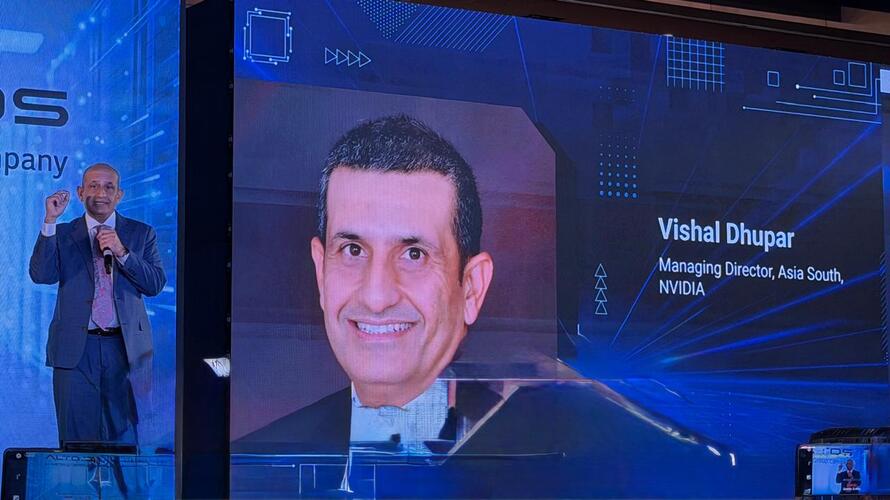
In a strong push towards building India’s sovereign AI capabilities, Altos Computing, part of Acer, recently unveiled its Make-in-India AI server portfolio, including the flagship Altos BrainSphere R300 AI Series Server. At the launch event, In a wide-ranging and thought-provoking address, Vishal Dhupar, Managing Director, Asia South at NVIDIA, traced the evolution of computing from its early days to the current AI revolution, while presenting the current moment as a decisive opportunity for India to emerge as a global intelligence powerhouse.
Opening his address with an analogy, Dhupar linked the birth of NVIDIA to the era of technological and cultural disruption in the early 1990s. Referring to Jurassic Park, he said the company was founded at a time when personal computing was at its peak, but chose to take a different path.
“When the PC evolution was at its peak, the birth of NVIDIA took place. Most importantly, it was contrarian to the way computing was done,” he said. He emphasised that while traditional computing methods had served the industry well since the 1960s, innovation often requires challenging established approaches. “The old way was a good way, and the new way is also a good way,” he added.
Also read: Dell AI Factory with NVIDIA Delivers Proven Path to Enterprise AI ROI
Highlighting the company’s growth journey, he noted that NVIDIA, which listed in 1999 with a valuation of $300 million, has since scaled dramatically. “Two years back, we announced a record-breaking quarter of $30 billion in enterprise business. Last quarter, we reported net profit of $46 billion,” he said, underscoring the impact of its long-standing contrarian philosophy.
The Limits of General-Purpose Computing
FDhupar traced the roots of modern computing to systems introduced by IBM in 1964, which separated software from hardware and enabled the rise of general-purpose computers. “This architecture allowed software to live longer and continue to evolve, and it is the same foundation you see even in smartphones today,” he said.
However, he pointed out a critical limitation. “An algorithm may be just 5% of the software, but it can consume 99% of the computing power,” he explained, noting that traditional systems were not optimised for such workloads. This gap, he said, led NVIDIA to focus on accelerated computing, especially in areas where specialised algorithms demanded high performance.
Why Gaming was the First Scalable Breakthrough
In the 1990s, one such application was computer graphics, driven by the rise of visual effects in cinema and gaming. Dhupar said NVIDIA identified gaming as the first large-scale opportunity to bring specialised computing into the mainstream. “How could you get into a niche algorithm and still achieve scale? The answer was gaming,” he said.
Also read: NVIDIA DLSS 5 Unveiled: What It Means for Gamers in Simple Terms
He added that gaming not only matched the scale of personal computing but also became a deeply inclusive ecosystem. “If humans work, humans play. As PCs were adopted, more gamers came, and gaming became almost like cinema,” he said. This phase, he noted, laid the technological foundation for what would later become the AI revolution.
2012: The ‘Big Bang’ Moment for AI
Dhupar described 2012 as a landmark year in computing history, when breakthroughs in deep learning enabled machines to solve one of the toughest challenges, which was perception. “They solved the longest-standing problem of the computer world, which is how computers can see and understand,” he said, crediting pioneers like Geoffrey Hinton and others. He explained that these advancements were made possible by using GPU-based systems originally designed for gaming. The development of what he referred to as a “universal approximator algorithm” allowed machines not only to handle vision tasks but also to solve a wide range of problems.
As AI evolved, Dhupar said it became clear that incremental improvements would not be enough. Instead, the entire computing architecture had to be reimagined. “You have to own every part, CPU, GPU, networking, links, everything has to come together if you want to reinvent computing,” he said.
This led to the development of integrated AI systems such as DGX, which played a foundational role in enabling organisations like OpenAI to build and scale advanced AI models. He noted that while generative AI tools have recently captured public attention, the underlying transformation began years earlier. The focus is now shifting towards reasoning and autonomous systems.
Turning to India, Dhupar made a strong case for the country to move beyond being a global software services hub to becoming a product and innovation leader. “It is absolutely great that every line of software is written by an Indian. And yet, every product is owned by the rest of the world,” he said. “Isn’t this our moment to build our own products?” He described the current phase as a “movement” that India must seize to become the “global capital of intelligence”.
The Five Layers of Future Computing
Explaining what it would take to achieve this vision, Dhupar outlined a five-layer model of computing:
- Energy: He highlighted the massive power requirements of AI infrastructure, noting that one data centre can consume electricity equivalent to nearly 100,000 households.
- Chips: He stressed the importance of semiconductor manufacturing and integration, calling chips the backbone of modern computing.
- Data Centres: He said data centres are evolving from storage facilities to “AI factories” that continuously generate and serve intelligence.
- Software Infrastructure: A growing ecosystem of companies is building platforms to support AI workloads.
- AI Models and Applications: He emphasised the need for India-specific models that reflect local languages and sensibilities.
Building for Scale, Sovereignty and Inclusion
Dhupar also highlighted the importance of building indigenous AI models tailored for India’s diverse population. He noted that most global AI systems are designed around English-speaking users, who represent only a small fraction of the world. “For the first time, models are being built in India so that our languages and sensibilities are preserved,” he said, adding that open-source efforts are playing a key role in democratising access.
Concluding his address, Dhupar urged industry, government and ecosystem players to act with urgency. “This is our opportunity to be the global capital of intelligence. It’s not about tomorrow, it’s about today,” he said. He emphasised that India already has all the ingredients, talent, infrastructure, policy support and growing industry participation, and that collective action can help the country leapfrog into a leadership position in the AI era. As the global technology landscape undergoes a fundamental shift, the message was clear: India stands at a critical juncture, and the choices made now will define its place in the future of computing.