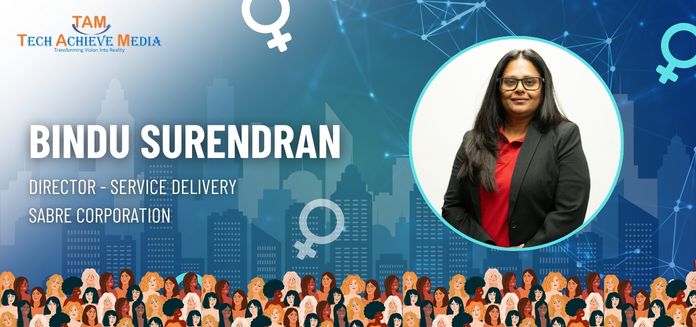
Women in technology are steadily transforming the industry, bringing diverse perspectives that influence innovation, leadership, and responsible technology development. As the world marks International Women’s Day 2026, Tech Achieve Media spoke to Bindu Surendran, Director – Service Delivery at Sabre Corporation. She reflects on the evolving role of women in tech, the subtle credibility challenges that still exist in technical environments, and how inclusive leadership and thoughtful AI governance can shape a more balanced and sustainable future for the industry.
TAM: What part of the tech ecosystem still systematically underestimates women, and what’s the real cost of that blind spot?
Bindu Surendran: In many situations, women engineers still feel a greater need to continuously demonstrate their technical depth compared to their peers. This can show up in subtle but consistent ways, such as pursuing additional certifications, preparing extensively for meetings, double checking work more than necessary, or feeling pressure to deliver without visible mistakes simply to be seen as equally competent. Over time, this creates uneven expectations.
Their expertise may be questioned more frequently, their ideas may require more validation, and minor errors can linger longer in memory. Achievements are sometimes attributed more to diligence than to strategic capability, while others may be given trust based on perceived potential rather than demonstrated outcomes.
This dynamic is almost never driven by conscious intent. Credibility in technical environments has been shaped over decades by established norms and familiar leadership archetypes. That familiarity can influence perceptions of competence, even in organizations committed to fairness.
Because these patterns are subtle and embedded in everyday interactions, they can create an additional invisible workload for some individuals. Addressing this requires deliberate focus on clear outcomes, measurable impact, and consistent performance standards, along with reflection on how we assess competence and potential. Without that intentional effort, the imbalances will always exist.
TAM: If women truly dominated tech leadership, what would change first: products, workplace culture, or business models and why?
Bindu Surendran: With stronger representation of women in tech leadership, we should be able to see a natural evolution in how decisions are made. There may be greater emphasis on understanding context, listening to diverse perspectives, and weighing options thoughtfully. These practices do not slow organizations down – they only support well informed decisions, grounded in long term thinking.
Over time, this would translate into stronger products, healthier team dynamics, and more sustainable business outcomes. Teams perform better when leaders create clarity, encourage collaboration, and consider broader impact. The result is progress that is fast, sustainable, and scalable.
Leadership in this case would be less about individual heroics and more about building dependable systems that support people, scale effectively, and remain resilient through change. This does not make the industry softer. It makes it more thoughtful, adaptable, and better positioned for long term success.
It also strengthens accountability. When leadership prioritizes inclusion and structured decision making, expectations become clearer and ownership more evenly distributed. People feel safer contributing ideas and challenging assumptions, which reduces risk and improves execution.
This is not about replacing one leadership style with another. It is about expanding perspectives at the table, so that decisions reflect the complexity of the environments we operate in.
TAM: Is AI amplifying existing gender bias or quietly correcting it? What have you seen on the ground?
Bindu Surendran: From what I have seen in practice, AI does not invent bias. It learns from the data, rules, and historical decisions we feed into it. Because those systems reflect human behavior and past outcomes, existing gaps and assumptions can be absorbed and reflected in AI outputs.
Without deliberate oversight, those patterns can be amplified and scaled, often appearing objective or data driven. There have been plenty of cases recently that reflected this bias. This is where intent and discipline matter. When organizations embed diverse perspectives into model design, data selection, and validation, and regularly review outcomes, AI can become a tool to surface blind spots and reduce bias.
Without those safeguards, however, AI simply automates past assumptions at greater speed and scale! It reinforces the status quo rather than challenging it. Ultimately, AI reflects the quality of our data, the questions we ask, the checks we implement, and the standards leadership upholds. The technology may be new, but accountability remains human. Responsible AI is therefore not only a technical issue but an organizational one. AI will only be as fair and effective as the governance, and culture surrounding it!
TAM: What’s the most uncomfortable truth about diversity in tech that no one wants to talk about?
Bindu Surendran: We have made meaningful progress in measuring diversity. Representation, hiring metrics, and participation are now visible and trackable in ways that they were not before. That matters. But measurement alone does not change culture. The next step is placing equal weight on recognizing and rewarding inclusive leadership.
Inclusive leadership reflects everyday behaviors – how leaders build capable teams, create psychological safety, nurture diverse talent, and make space for different perspectives in decision making. When this leadership is visible and rewarded, it sends a clear signal. People respond to what is recognized. Over time, diversity grow stronger as a natural outcome, because inclusive workplaces retain talent, enable performance, and allow individuals to contribute fully.
This also reinforces accountability. When inclusive behaviours are reflected in performance evaluations, succession planning, and promotion criteria, they become relevant to the business as well. Culture shifts happen, when incentives shift. If diversity is to be durable rather than cyclical, inclusive leadership must be integrated into how success is measured and rewarded.
TAM: What should young women unlearn before entering the tech workforce in 2026?
Bindu Surendran: I would say – unlearn the belief that they must feel completely prepared before stepping forward. That mindset often delays growth, more than lack of skill ever does. No one begins a role or opportunity with all the answers. Learning happens through action, by asking questions, making decisions, and sometimes getting things wrong.
Speaking up, sharing ideas, and taking on responsibility are not reward; they’re part of the development process. Progress comes from participation, not perfection. Letting go of the pressure to get everything right and choosing to show up while still learning can be quite impactful. Confidence grows through visibility, engagement, and experience.
The right moment rarely arrives fully formed. It is created by those willing to step in and grow into the role. Supportive environments matter as well. Leaders and mentors play a key role in encouraging early contribution, normalizing mistakes, and reinforcing that development is expected.