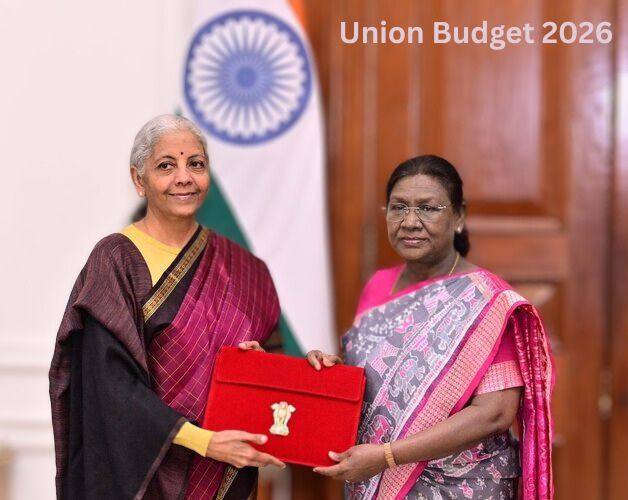
The Union Budget 2026 announcements are being made by Nirmala Sitaraman, Union Minister for Finance at the Lok Sabha of the upcoming financial year. While the industry was hoping for policy clarity, infrastructure investments, and regulatory reforms, it is yet to be witnessed if the announcements made will help India’s digital and economic ambitions. The finance minister termed the budget announcements as “Yuva Shakti driven budget”.
She also added that six key areas will be key to drive India’s economic growth. These include scaling up manufacturing across seven frontier sectors, rejuvenating the industrial sector, strengthening and championing MSMEs, accelerating infrastructure development, ensuring long-term economic stability, and promoting city economic regions as engines of sustained growth.
The Indian Government has termed the Union Budget 2026 as a “Kartavya” driven budget centred around three important aspirations:
- Accelerate and sustain economic growth alongwith building resilience to volatile global
dynamics - Fulfill aspirations of people and build their capacity.
- Ensure that every family, community, region and sector has access to resources, amenities and opportunities.
Key Highlights of the Union Budget 2026
While a detailed update on the budget announcements is yet to be provided, the following are the key announcements made across the domains of telecom, AI, manufacturing data protection, cybersecurity, fintech, and BFSI among others:
- Indian semiconductor mission 2.0 announced. Outlay of PLI in electronic component scheme doubled to Rs 40,000 crore.
- Public Capex increased to Rs 12.2 lakh crore in FY2026-27.
- Bio-pharma gets a Rs 10,000 crore boost. To develop India as a global bio-pharma hub, Finance Minister Nirmala Sitharaman has proposed the Biopharma Shakti initiative with an outlay of Rs 10,000 crore over five years.
- The focus is on creating champion MSMEs, supported by a strong push towards infrastructure development.
- The government has proposed to introduce a dedicated 10,000 crores SME growth fund to create future jobs, incentivising enterprises based on select criteria.
- The self-reliant India Fund will be topped up with Rs 2,000 crore to continue supporting micro enterprises.
- To help MSMEs, the government will enlist professional bodies like ICAI, ICSI, and ICMAI to design short-term modular courses aimed at building a cadre of “Corporate Mitras. They will help MSMEs meet compliance requirements at affordable costs.
- More than Rs 7 lakh crore will be made available to MSMEs with TReDS.
- A high-powered Education to Employment and Enterprises Standing Committee has been announced to recommend measures focusing on the services sector as a core driver of Viksit Bharat, with services targeted to account for 10% of the global market share by 2047.
- It will also assess the impact of emerging technologies, including Al on jobs and skill requirement.
- The government has proposed setting up AVGC (Animation, Visual Effects, Gaming, and Comics) content creator labs in 1,500 secondary schools and 500 colleges. India’s AVGC sector is projected to require 2 million professionals by 2030.
- A high-level banking committee has been proposed to support the vision of Viksit Bharat. The committee will review the banking sector and align it with the next phase of growth, with a strong focus on financial stability, inclusion, and consumer protection. The Budget also outlines a clear vision for NBFCs, including targets for credit expansion and technology adoption, and proposes restructuring PFC and REC to enhance scale and operational efficiency.
- Restructuring of Power Finance Corporation and Rural Electrification Corporation to achieve scale and improve efficiency in the Public Sector NBFC.
- An incentive of Rs 100 crore for a single bond issuance of more than 71000 crore to encourage the issuance of municipal bonds of higher value by large cities.
- Investment limit for an individual PROI under Portfolio Investment Scheme to increase from 5% to 10%, with an overall investment limit for all individual PROls to 24%, from the current 10%.
- Tax holiday up to 2047 to any foreign company providing services globally by procuring data centre services in India.
- India is a global leader in software development services, IT enabled services, knowledge process outsourcing services and contract R&D services relating to software development. All these services are proposed to be clubbed under a single category Information Technology Services with a common safe harbour margin of 15.5% applicable to all.