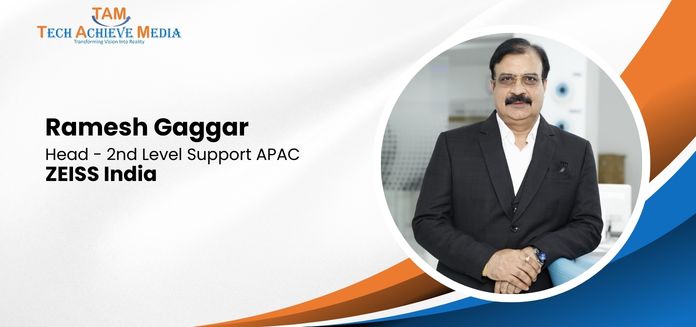
As customer expectations rise and service environments grow more complex, customer support is undergoing a fundamental shift from reactive problem-solving to intelligence-led, proactive engagement. In this interview, Ramesh Gaggar, Head – 2nd Level Support APAC, ZEISS India, shares how the company is leveraging AI, data analytics, automation and human expertise to transform customer support across the region. He discusses responsible data use, the balance between technology and human judgment, the growing role of predictive insights, evolving skill requirements for support teams, and what enterprises must do today to future-proof their service strategies over the next three to five years.
TAM: Customer support is rapidly moving from reactive to proactive. What role do AI, data analytics, and automation play in enabling this shift, and how is ZEISS India approaching this transformation across APAC?
Ramesh Gaggar: The shift from reactive to proactive customer support is indeed a significant trend within the medical sector and it is largely driven by advancements in AI, data analytics, and automation. ZEISS India is integrating these technologies to deliver faster, more personalized, and efficient service.
- Artificial Intelligence: AI learns from past interactions to predict potential issues early. For instance, AI-driven chatbots can handle routine inquiries, allowing Service experts to focus on more complex cases. This not only improves response times but also enhances customer satisfaction.
- Data Analytics: Provides insights into customer behavior and preferences to anticipate issues before they arise. For example, analyzing service tickets can help identify common problems, allowing proactive communication with customers about potential solutions or updates.
Automation: Automation streamlines processes such as ticket creation, routing, follow-ups, and feedback collection, reducing workload on service teams. Simple, automated systems enable easy service ticket registration with real-time status updates, delivering smoother customer experience. At ZEISS India, we are actively embracing this transformation across the APAC region by integrating these technologies into our customer support framework. We are investing in AI tools that enhance our ability to provide timely assistance and personalized experiences. Our data analytics initiatives are focused on understanding customer journeys and improving our service offerings. Additionally, we are implementing automation to optimize processes, ensuring that our service teams can operate more efficiently and effectively.
The integration of AI, data analytics, and automation is pivotal in transitioning to a proactive customer support model. At ZEISS India, we are committed to leveraging these technologies to enhance our customer engagement and satisfaction across the APAC region.
TAM: Intelligence-driven support models rely heavily on data. How can organizations ensure they are using customer and operational data responsibly while still delivering highly personalized service experiences?
Ramesh Gaggar: By combining robust governance, privacy compliance, ethical AI, and clear transparency, organizations can protect customer information while still delivering highly personalized service experiences.
- Data Governance Frameworks:
- Establish clear policies for data collection, storage, and usage and audit regularly.
- Implement role-based access controls to limit data exposure.
- Compliance with Privacy Regulations:
- Ensure customers have control over their data.
- Provide clear privacy policies that outline how data is used.
- Ethical AI Practices:
- Use anonymized or aggregated data whenever possible to reduce privacy risks.
- Avoid bias in algorithms by training AI models on diverse datasets and evaluate regularly.
- Transparency and Customer Trust:
- Intelligent Customer Care Ticketing system ensures easy access and address resolution.
- Communicate openly about data usage and benefits to customers.
- Build trust by demonstrating accountability in handling sensitive information.
By auditing and standardizing current practices, educating teams and raising awareness, and balancing personalization with responsible data practices, organizations can deliver superior service experiences while safeguarding customer trust and privacy.
TAM: Human expertise remains critical in complex service environments. How does ZEISS strike the right balance between AI-led efficiency and human judgment in customer support operations?
Ramesh Gaggar: ZEISS balances AI-led efficiency with human judgment by using AI for speed and consistency in routine tasks, while reserving complex, high-impact decisions for experienced service experts.
- Human Judgment for Complexity:
- ZEISS prioritizes human expertise for tasks requiring nuanced understanding, such as resolving technical challenges, interpreting ambiguous customer needs, or providing tailored solutions.
- Training programs ensure employees can collaborate effectively with AI tools, maintaining a high standard of service.
- AI for Efficiency:
- AI tools are used to automate routine tasks, such as ticket categorization, FAQs, and predictive maintenance.
- Machine learning algorithms analyze customer data to provide insights, enabling proactive support and personalized recommendations.
- Chatbots and virtual assistants handle straightforward queries, ensuring 24X7 availability for Field Service Engineers.
- Hybrid Approach:
- AI and human agents work collaboratively, with AI acting as an assistant rather than a replacement.
By combining AI-driven efficiency with human judgment, ZEISS delivers customer centric rated customer service that reflects its values of innovation, empowerment, and quality through continuous improvement, customer feedback, and empowered, skilled employees.
TAM: Predictive support is becoming a key differentiator. Can you share examples of how predictive insights are helping organizations anticipate customer needs and reduce downtime or service disruptions?
Ramesh Gaggar: Predictive insights enable organizations to anticipate and proactively address potential issues, reducing downtime and enhancing customer satisfaction. Examples across industries, including healthcare, manufacturing, and IT services.
Predictive support leverages data analytics, machine learning, and IoT technologies to forecast trends, detect anomalies, and optimize operations.
Here are some examples:
- Healthcare
- Predictive analytics in medical systems (e.g., imaging scanners and laser systems) can identify patterns indicating potential equipment failure. This allows service teams to perform maintenance before disruptions occur, ensuring uninterrupted patient care.
- Manufacturing
- Predictive maintenance in industry uses IoT sensors to monitor equipment health. For instance, vibration or temperature anomalies in machinery can signal wear and tear, enable timely repairs and avoid costly production halts.
- IT Services
- Customer support teams use predictive analytics to anticipate service requests based on usage patterns, enabling faster resolution times.
To implement predictive support effectively and act as differentiator, organizations invest in infrastructure, adopt integration of various sensors and collaborate to have transparency and speed.
TAM: As support models become more technology-driven, skill requirements are evolving. What new capabilities do support teams need to develop to succeed in intelligence-led service ecosystems?
Ramesh Gaggar: Support teams in intelligence-led service ecosystems need advanced technological, analytical, and interpersonal capabilities to adapt to evolving demands and deliver superior customer experiences.
- Customer-Centric Communication
- Empathy and Personalization: Balancing automation with human interaction so customers feel valued and proactively offered tailored solutions. Easy access to report issues, and prompt, interactive responses are crucial to service quality.
- Data Privacy and Ethical Service: Following compliance and regulations.
- Technical Proficiency
- Root Cause Analysis: Identifying underlying issues using data and technology-driven insights and provide timely solutions.
- Digital Tools: Familiarity with CRM systems, cloud platforms, and IoT technologies to manage customer interactions seamlessly.
- AI and Machine Learning: Understanding how AI tools like chatbots, predictive analytics, and automated workflows function to leverage them effectively.
- Training & Continuous Upskilling: Staying updated on emerging technologies, such as AI advancements and cybersecurity protocols and various trainings/ workshops to have certifications and understandings of evolving ecosystem.
- Collaboration and Cross-Functional Skills
- Interdisciplinary Knowledge: Working across departments (e.g., Quality Assurance, Product Development and R&D) to resolve issues efficiently.
- Monitor Progress
- Use KPIs to evaluate the effectiveness of new capabilities and refine strategies ensuring delivery as per expectations & planned.
By fostering these capabilities, support teams can thrive in technology-driven service environments while maintaining ZEISS’s commitment of customer excellence.
TAM: Looking ahead, how do you see intelligence-driven customer support models evolving over the next 3–5 years, and what steps should enterprises take today to future-proof their service strategies?
Ramesh Gaggar: Intelligence-driven customer support models enable organizations to leverage AI including machine learning, and automation to deliver personalized, proactive, and efficient service experiences. Enterprises should integrate advanced technologies, optimize data usage, and prioritize customer-centric strategies to future-proof their service models.
Key Trends in Intelligence-Driven Customer Support (3–5 Years)
- Hyper-Personalization:
- AI will enable real-time analysis of customer data to provide tailored recommendations, solutions, and experiences.
- Predictive analytics will anticipate customer needs before they arise, reducing response times and improving satisfaction.
- Proactive Support:
- AI-driven systems will identify potential issues (e.g., product malfunctions or service disruptions) and notify customers before they encounter problems.
- Automated workflows will resolve common issues without human intervention, reducing customer effort.
- Conversational AI:
- Chatbots and virtual assistants will become more sophisticated, capable of handling complex queries and mimicking human-like interactions.
- Interactive, multilingual and omnichannel support will ensure seamless service across platforms to register and get updates.
- Integration of IoT and Edge Computing:
- IoT devices will provide real-time data on product performance, enabling predictive maintenance and instant troubleshooting.
- Edge computing will enhance speed and efficiency in processing customer data locally.
- Human-AI Collaboration:
- AI will handle repetitive tasks, freeing service experts to focus on complex, empathetic interactions.
- Augmented intelligence tools will assist Back-Office staff with real-time insights during customer interactions.
- Focus on Data Privacy and Ethics:
- As AI becomes more integrated, enterprises will need to prioritize transparent data usage and compliance with privacy regulations.
Some steps that enterprises can take are:
- Invest in Scalable AI Infrastructure:
- Build or upgrade systems to support AI-driven tools, ensuring scalability as customer demands grow.
- Adopt cloud-based platforms for flexibility and cost efficiency.
- Enhance Data Management:
- Develop robust data collection, storage, and analysis frameworks to fuel AI models.
- Focus on data quality, security, and compliance with privacy laws.
- Adopt Omnichannel Strategies:
- Integrate customer support across channels (e.g., email, chat, social media, voice) for a seamless experience.
- Ensure AI tools can operate consistently across platforms.
- Make customers and team aware of upcoming changes and benefits using clear communication.
- Upskill Workforce:
- Train employees to work alongside AI tools, emphasizing skills like emotional intelligence, critical thinking, and technical proficiency.
- Foster a culture of innovation and adaptability.
- Pilot Emerging Technologies:
- Experiment with conversational AI, predictive analytics, and IoT integration to identify high-impact solutions.
- Use pilot programs to refine strategies before scaling.
- Prioritize Customer-Centric Design:
- Involve customers in the design and testing of new support models to ensure relevance and usability.
- Regularly gather feedback to improve processes and technology.
- Transparent and value-added Service Agreements which fulfills customer’s interest.
- Collaboration with Technology Partners:
- Partner with AI and tech providers to stay ahead of industry advancements.
- Leverage external expertise to accelerate innovation.
By taking these proactive measures, enterprises can position themselves to thrive in the evolving landscape of intelligence-driven customer support ensuring they audit current systems, develop roadmap and monitor trends but also keeping stakeholders engaged.