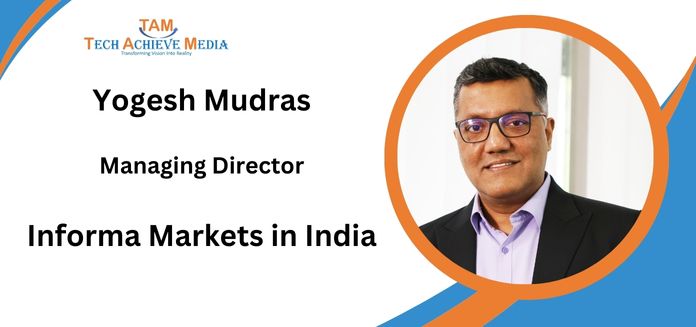
Over the past two decades, India’s security landscape has undergone a profound transformation, which includes shifting from basic surveillance systems to intelligence-driven, integrated security ecosystems. IFSEC India is a platform that has both reflected and shaped the industry’s growth. In this exclusive interaction with Tech Achieve Media (TAM), Yogesh Mudras, Managing Director, Informa Markets in India, shares his perspective on how changing threat perceptions, rapid technological innovation, the rise of AI, and the momentum of Make in India are redefining security in the country. He also offers insights into IFSEC’s growing role as a unifying platform for the entire security value chain and what lies ahead for the industry.
TAM: From the time IFSEC started nearly 18 years ago, what is the most significant change you have witnessed in India’s security industry?
Yogesh Mudras: The biggest change has been in the overall understanding and acceptance of security as an essential part of everyday life. When IFSEC began almost 18 years ago, the industry itself was still at a very nascent stage. India had not experienced security challenges at the scale we see today, and security was not viewed as a strategic priority.
Over the years, that mindset has completely changed. Security is now seen as integral to how we live, work, and operate as a nation. Alongside this shift, technology has evolved dramatically, from basic analog surveillance cameras to digital, cloud-based, IP-controlled systems, and now AI-driven technologies such as facial recognition. Similar advancements have taken place across perimeter security, access control, and biometric solutions. This evolution has significantly strengthened the country’s preparedness against future threats.
TAM: IFSEC has become a key platform for the industry. How do you see its role in bringing together stakeholders across the security ecosystem?
Yogesh Mudras: IFSEC has evolved into a truly inclusive platform for the entire security ecosystem. It brings together manufacturers, distributors, dealers, technology providers, policymakers, government departments, CSOs, and key buyers under one roof. Our objective has always been to create a space that feels like the industry’s own platform, where stakeholders can interact openly, exchange ideas, showcase innovation, and conduct meaningful business. The presence of eminent speakers and decision-makers further strengthens IFSEC’s relevance as a thought leadership and networking hub.
TAM: What would you identify as the inflection point that triggered accelerated innovation in the security industry?
Yogesh Mudras: The year 2008 was a major inflection point. The security threats the country faced during that period fundamentally changed the national security paradigm. Until then, security was not always taken with the seriousness it deserved. Post-2008, security became a non-negotiable part of life. Once that demand and urgency were established, the industry naturally responded with innovation. Technology providers, manufacturers, and solution developers began investing heavily to address these emerging needs, which led to the rapid evolution we see today.
TAM: There is a strong presence of Indian companies at IFSEC. How do you assess the impact of the Make in India initiative on the security sector?
Yogesh Mudras: The introduction of STQC guidelines has been a real game changer for the industry. Earlier, a large volume of security equipment was imported, white-labelled, and sold as Indian products. The new guidelines clearly define localization requirements, what percentage of a product must be locally manufactured and which components must be sourced domestically.
While this has impacted some players initially, it has also encouraged global companies to take India much more seriously as a manufacturing hub. Given the sheer size and potential of the Indian market, international players can no longer ignore it. Many are now setting up manufacturing bases in India instead of relying on imports. This not only strengthens domestic capabilities but also positions India to serve global markets in the future.
TAM: Earlier, there was some resistance to Indian-made security products. Has customer perception changed over the years?
Yogesh Mudras:
Yes, there has been a clear shift in perception. Initially, price sensitivity and a preference for international brands did exist. However, Indian manufacturers have become far more efficient over time. Government incentives and subsidies have also helped in achieving competitive price points. While imported products, particularly from China, may still be cheaper in some cases, customers today understand the long-term value of choosing Indian-manufactured products. There is greater acceptance now, and the mindset of buyers has evolved significantly over the last 18 years.
TAM: What would you describe as the most transformative force shaping the security industry today?
Yogesh Mudras: Without a doubt, Artificial Intelligence. AI has fundamentally transformed security solutions. The distinction between physical security and cyber security is rapidly disappearing. Video surveillance systems today are cloud-connected, data-driven, and vulnerable to cyber threats if not properly secured. Physical and cyber security are now deeply embedded into one unified ecosystem. At IFSEC, we have consciously integrated cyber security as a core component of the show. As one of our speakers mentioned, today security may be 70% physical and 30% cyber but in the next five years, this ratio could reverse. That is the level of dominance cyber security is expected to achieve.
TAM: IFSEC is witnessing growing footfalls every year. What can the industry expect from IFSEC going forward?
Yogesh Mudras: Last year, IFSEC saw around 15,000 to 16,000 visitors, and this year we are confident of crossing 20,000-plus visitors. But beyond numbers, our focus remains on continuously reinventing the platform. Immediately after each edition, we go back to the drawing board to plan what more we can bring to the next one. While we cannot announce everything yet, there are plans for greater international participation, high-profile global delegations, and possibly inter-governmental engagements in the coming editions. IFSEC will continue to evolve in line with the industry’s future needs.