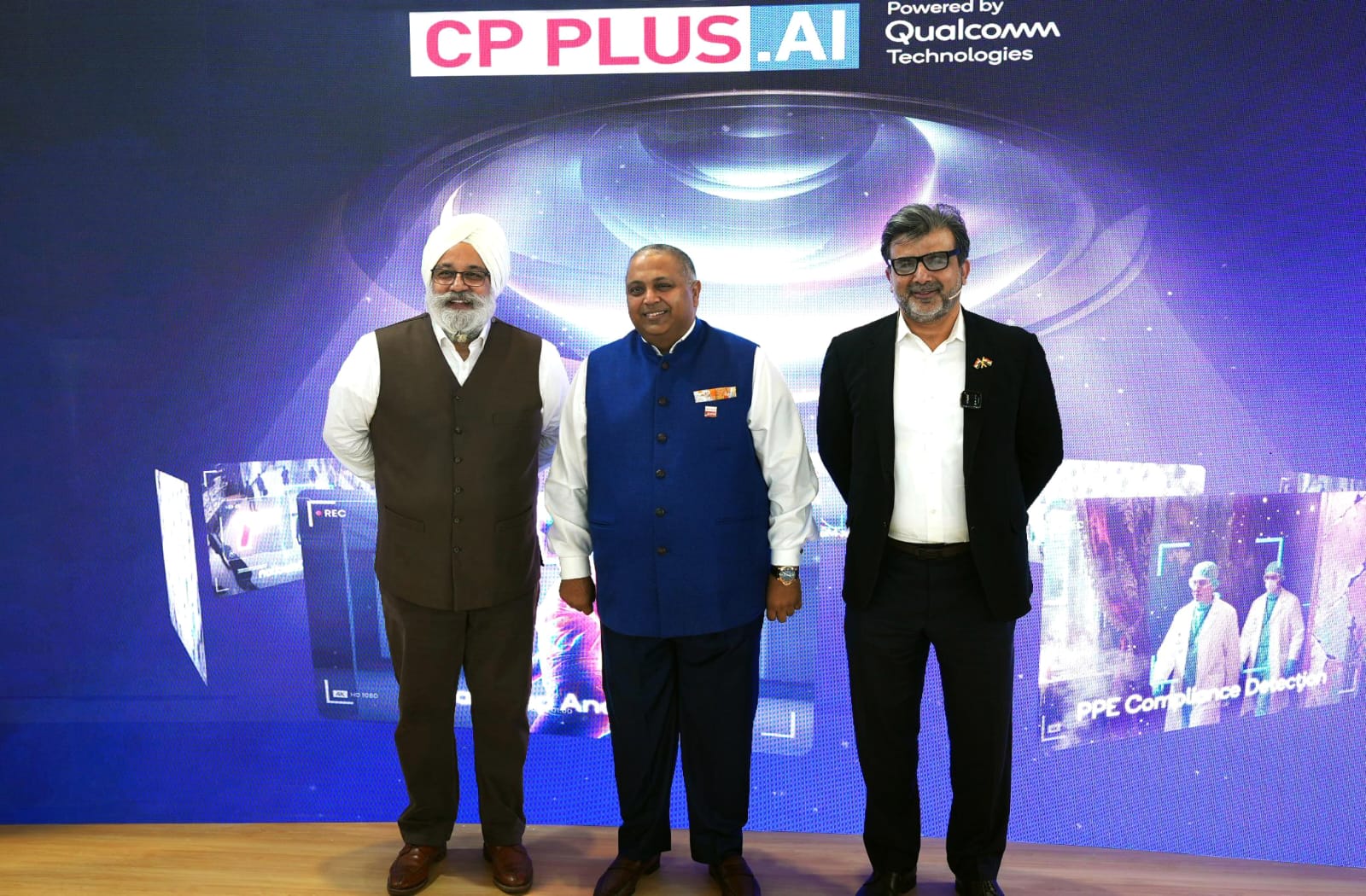
CP Plus has announced a first-of-its-kind collaboration with Qualcomm Technologies, a global leader in edge compute and AI technologies, to introduce a new generation of AI-enabled, insight-driven video security solutions tailored for India’s rapidly evolving industrial and public safety landscape.
The collaboration combines CP PLUS’ extensive product portfolio, Video Management System (VMS) expertise and nationwide distribution network with Qualcomm Technologies’ advanced on-device AI and edge-processing capabilities, powered by Qualcomm Dragonwing processors and the Qualcomm Insight Platform. Together, the companies aim to move video security beyond traditional surveillance toward intelligent systems capable of delivering real-time insights and actionable outcomes.
The most integral aspect of this joint offering is a scalable, one-stop solution enabled through edge boxes integrated with VMS. By processing data at the edge, either within the camera or in close proximity, the solution enables faster decision-making, reduced latency and enhanced privacy, while addressing safety-focused use cases across enterprises, industry, homes, institutions and public infrastructure. The companies say the collaboration sets new benchmarks not only for India but also for the global video security industry.
Explaining the combined value proposition and where demand is expected to scale, Suri Maddhula, Vice President, IoT Solutions at Qualcomm, highlighted strong traction across multiple verticals. “Retail is a big area where we are seeing a lot of use cases coming in,” Maddhula said. “Loss prevention and shrinkage are key concerns, but beyond that, retailers are looking at heat maps to understand customer movement and inventory management. In India, retail adoption is particularly strong.”
He added that construction management is emerging as another major area of demand. “Construction projects are often worth billions of dollars, and inefficiencies, losses and overruns can also run into billions. Being able to track assets, people and operations in real time is driving significant demand for enterprise-scale deployments,” he noted.
According to Maddhula, industrial and manufacturing environments are also adopting AI-driven video analytics for asset inspection and operational efficiency. “Tracking what’s happening on the manufacturing line, understanding workforce movement and identifying inefficiencies are all strong use cases. In addition, we’re seeing growing demand around traffic management, crowd control and law enforcement-led public safety initiatives,” he said.
Sudhakaran Ramchandran, Senior Director of Engineering, Qualcomm Insight, said the collaboration represents a shift in how video security systems are designed and used. “Traditionally, the security industry, including CP PLUS and others, has focused on storing video and sending alerts, and then going back to check what happened,” Ramchandran said. “Even in mature markets like the U.S., this is being disrupted by systems that make it easy to know what happened at the instant it happened.”
He added that the joint solution takes this evolution a step further by performing advanced analytics directly at the edge. “We are generating insights in real time, either in the camera or in edge boxes close to the camera. That itself is a significant market opportunity,” he said.
Ramchandran pointed to a wide range of practical applications across sectors, from retail and industrial sites to schools and public spaces. “You can identify whether a person is authorized to be in a particular area, detect loitering, count people entering or exiting a facility, or monitor restricted zones,” he explained.
He also highlighted potential applications in education and child safety. “Cameras are already installed on school buses. With AI, you can build a secure, authorized view for parents, showing when a child boarded the bus, arrived at school and returned home. The power lies in proactive alerts. Instead of checking footage, parents or administrators are notified if something doesn’t happen by a certain time,” he said.
Beyond safety, Ramchandran emphasized the role of AI in transforming video into structured, searchable data. “The video itself hasn’t changed, but now it comes with a huge amount of data, tagged, indexed and available in real time. Whether it’s detecting weapons, identifying unruly behavior or flagging suspicious activity, you’re no longer waiting for an incident to occur and then reviewing footage afterward,” he said.