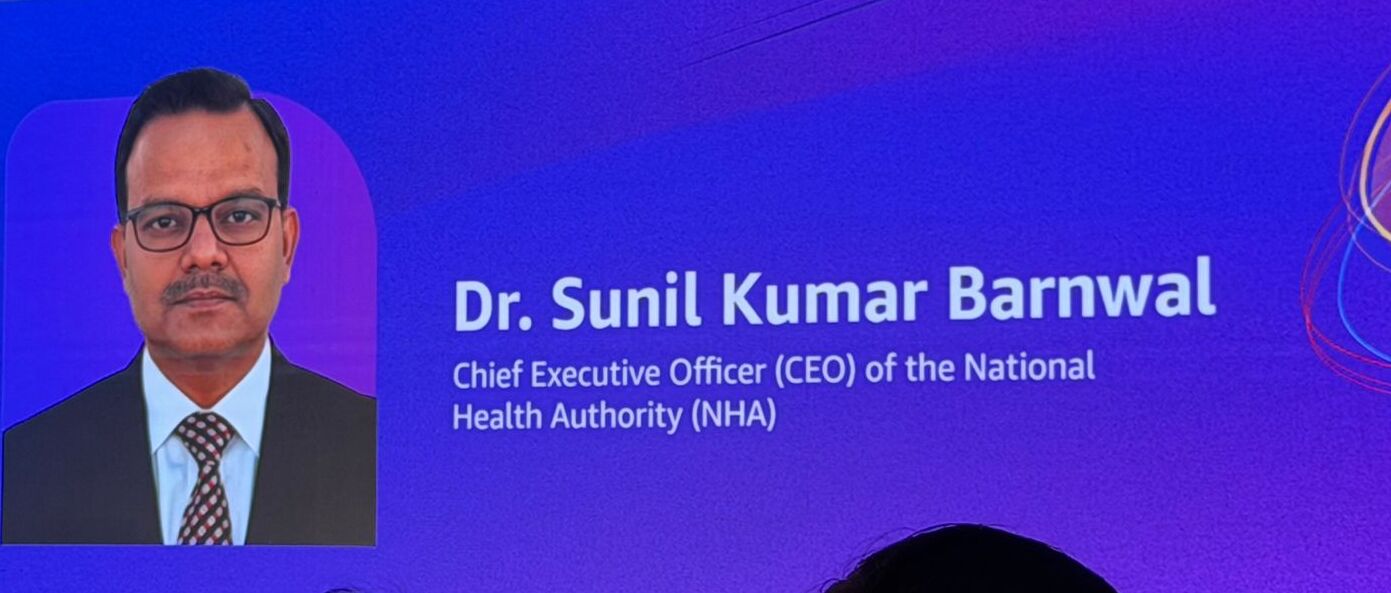
At the AWS Symposium 2026 themed “Innovating for a Viksit Bharat,” Sunil Kumar Barnwal, Chief Executive Officer of the National Health Authority (NHA), delivered a comprehensive and forward-looking address, explaining how technology, data, and artificial intelligence are transforming healthcare delivery under the Ayushman Bharat Pradhan Mantri Jan Arogya Yojana (PM-JAY), which is the world’s largest government-funded health insurance scheme.
Also read: Making of DigiYatra from Concept to Countrywide Transformation: Suresh Khadakbhavi
Speaking before policymakers, technologists, healthcare leaders, and industry stakeholders, Barnwal laid out the scale, complexity, and ambition of India’s flagship public healthcare program. “We are talking about the functioning of the biggest scheme of the Government of India, the Ayushman Bharat Pradhan Mantri Jan Arogya Yojana, which caters to the bottom 40 percent of our population, providing coverage of up to Rs 5 lakh for secondary and tertiary care treatment across more than 35,000 hospital networks,” he said.
Highlighting the unprecedented scale of the programme, Barnwal added, “As of today, 43 crore beneficiaries hold Ayushman Bharat cards. Nearly 11.5 crore patients have already received treatment, and Rs 1.7 lakh crore has been spent by the Government of India since 2018. This is the volume of work being done through the world’s largest health insurance programme, funded entirely by the government.”
Technology as the backbone of healthcare delivery
Barnwal emphasized that such scale of the Ayushman Bharat scheme would be impossible without a robust digital backbone. “This scheme not only ensures financial protection for the most vulnerable, but also creates a seamless healthcare journey across hospitals. Delivering this at a national scale cannot happen through traditional government outreach methods. It is only possible if we have a very strong IT system, right from beneficiary identification to hospital onboarding and claims processing,” he said.
With PM-JAY operational across 35 states and Union Territories, each with unique demographic and administrative challenges, Barnwal said technology is the only enabler of seamless execution. “IT is the solution that makes this happen and makes it scalable, flexible, stable, and agile. Also, that’s where technology partners play a vital role,” he noted.
Acknowledging the contribution of Amazon Web Services (AWS), Barnwal said, “Working with AWS has been exciting. They have enabled scale and stability, creating a robust transaction management system. This scalability has opened new possibilities not just for PM-JAY, but for even larger schemes in the future.”
He added that several government programs are now running on the same digital platform, including health schemes for central government employees, paramilitary forces, and multiple state governments. “This shared platform must operate flawlessly, 24×7, with the ability to handle massive demand. AWS has helped us build that capacity,” he said.
Building India’s National Digital Health Ecosystem
Barnwal also outlined India’s ambitious digital health vision, aimed at creating a unified National Digital Health Ecosystem. “We are building a system where healthcare is no longer fragmented. Patients become the unique identifier, facilities have verified identities, and professionals are authenticated through registries,” he explained.
This ecosystem will enable secure, consent-based sharing of health records. “Data is created at hospitals and linked to patients, but remains accessible only with their consent. The healthcare journey will become continuous by design, and will no longer be episodic,” he said. He also asserted that this interoperable architecture will unlock enormous potential for research, innovation, and advanced analytics. “Through federated systems, data can be securely exchanged, enabling training of models, disease surveillance, and predictive healthcare,” Barnwal noted.
AI as a force multiplier for healthcare
Calling artificial intelligence a transformative force, Barnwal said healthcare is poised to witness the deepest impact. “If India has to become a Viksit Bharat by 2047, it must be a healthy Bharat. And that can happen only on a strong digital foundation, powered by AI,” he said. He highlighted how AI can multiply the capacity of doctors, nurses, and paramedics. “AI solutions are already helping in disease prediction, early detection, clinical decision-making, and administrative automation. This allows professionals to spend more time on patient care and less on paperwork,” he explained. AI-powered disease surveillance, he added, could revolutionize preventive healthcare in a diverse country like India. “Mapping disease patterns across regions can help prevent outbreaks and improve public health planning,” he said.
Launch of open benchmarking platform and AI healthcare strategy
Recognizing the challenge of choosing reliable AI tools, Barnwal announced the launch of an open benchmarking platform for healthcare AI solutions. “Doctors often face multiple options for disease prediction. Which solution works better in which geography, age group, or population? Our benchmarking platform will answer these questions,” he said. He also underlined the importance of trust, transparency, and accountability in healthcare AI. “Healthcare data is highly sensitive. Trust and security are non-negotiable. We need strong guardrails, transparency on training data, performance metrics, and accountability frameworks,” Barnwal said.
In a major announcement, he revealed that NHA is launching India’s first sector-specific AI Strategy for Healthcare. “This will provide an enabling framework for innovation, while ensuring safety, trust, and accountability. It will create guardrails so that AI solutions can be adopted responsibly and confidently,” he said. Concluding his address, Barnwal said platforms like the AWS Symposium play a critical role in shaping the future of public service delivery. “The right technology, applied at scale, enables governments to perform better. AWS has helped us scale faster and continuously build capacity to serve the people of this country,” he said.