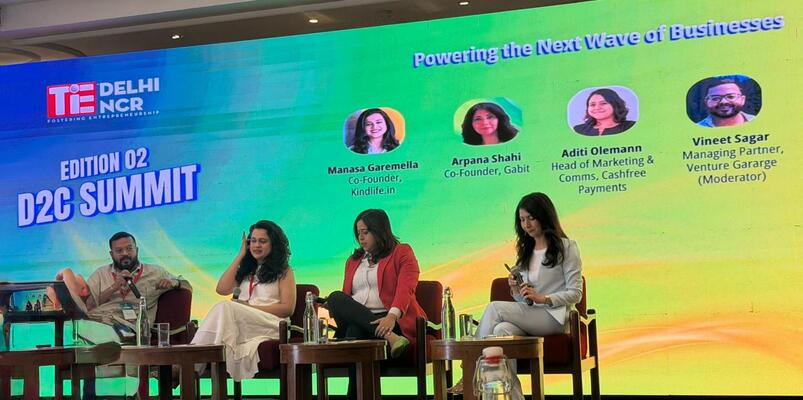
The rapidly evolving dynamics of India’s direct-to-consumer (D2C) ecosystem took centre stage at a high-energy panel discussion titled “Powering the Next Wave of Businesses” during the TiE Delhi NCR D2C Summit Edition 2. The session brought together an all-women leadership panel featuring Manasa Garemella, Co-founder, Kindlife.in; Arpana Shahi, Co-founder, Gabit; and Aditi Olemann, Head of Marketing and Communications, Cahsfree Payments. The discussion was moderated by Vineet Sagar, Managing Partner, Venture Garage.
The panel examined how Gen Z behaviour, AI-native commerce, preventive healthcare, new-age payments, and evolving beauty consumption patterns are reshaping the future of D2C in India, while also exploring why many early assumptions around digital-first brands have failed to fully materialise.
Setting the context, Sagar pointed to a fundamental shift in market realities. “There were certain expectations that we had as an ecosystem that did not settle in. We believed that if we could build a Rs 100-crore beauty and personal care brand online, life would become easier offline. But that did not turn out to be true,” he said.He noted that more than 90 percent of brands that reach the Rs 100-crore milestone tend to plateau. “There are segments like clean beauty and clean food that appear to have found long-term product-market fit, but scaling remains a complex challenge,” he added.
Preventive healthcare, wearables and longevity
Arpana Shahi spoke about the rapid transformation underway in healthcare, driven by preventive wellness and longevity-focused consumer behaviour. “The narrative has shifted globally and in India. Earlier, we waited for something to go wrong before taking care of our health. Today, people want to stay healthy before problems begin,” she said.
Shahi highlighted the acceleration in wearables adoption following the COVID-19 pandemic. “Preventive health and longevity are now fuelling the growth of wearables. Smart rings, in particular, are seeing strong traction due to their form factor and accuracy. They integrate seamlessly into daily life and allow continuous tracking, including during sleep, which bulky smartwatches struggle with.”
She added that Gen Z consumers are adopting health technologies at an unusually young age. “We see teenagers as young as 15 or 16 tracking nutrition, sleep and activity. They view health as an investment. They are influenced by founders and business leaders who openly speak about lifestyle changes, sobriety and wellness. This shift is structural and long term.”
Beauty, efficacy and the rise of discovery-first brands
Manasa Garemella said India is witnessing one of the fastest-growing beauty markets globally, with a growing emphasis on efficacy, discovery and cultural influence. “India has one of the fastest-growing beauty markets in the world, expanding at nearly 12 percent annually. Consumers today are placing self-care at the centre of their routines,” she said.
Referring to the rise of Korean beauty, she noted, “Almost 60 to 70 percent of young consumers now follow six-to-seven-step skincare routines. Discovery happens primarily online, while offline continues to play an important role in awareness and experiential engagement.”
Garemella added that investors are increasingly focused on outcome-driven brands. “There is growing scrutiny around efficacy. Consumers and investors alike want proof of results. Clinically backed and outcome-oriented products are gaining far more traction.”
Speaking about Kindlife.in’s strategy, she said the company focuses on category creation and collaboration. “We position ourselves as category builders, introducing Korean and Japanese beauty to Indian consumers. Our platform hosts over a thousand brands across beauty, supplements and wellness. Offline expansion for us is partnership-led, aimed at widening access rather than building large-format stores.”
Payments, affordability and conversion economics
Aditi Olemann highlighted the central role of payments in driving D2C conversion and growth. “When we talk about the last mile it is more about conversion than delivery. That final decision to pay directly impacts both top-line growth and profitability,” she said. She noted that affordability continues to be a critical lever. “EMI options and flexible payment models are acquisition tools as opposed to being just check-out features. For higher-value products, the presence of an EMI option often converts intent into purchase.” Olemann added that payment infrastructure must match the frictionless experiences offered by major e-commerce platforms. “Our focus is on building payment journeys that feel as seamless for D2C brands as they do on platforms like Amazon or Flipkart. Payments should never become a point of friction.”
Gen Z, AI-native commerce and new consumption behaviour
A recurring theme during the discussion was the rise of Gen Z as AI-native consumers. “Gen Z searches, discovers and shops in fundamentally different ways,” said Olemann. “They rely on creators, short-form content, micro-stories and AI-driven recommendations. Brands must become AI-native to remain relevant.” Garemella pointed to the emergence of micro-dramas and creator-led storytelling. “We launched India’s first Indo-Korean micro-drama series, featuring eight episodes under one minute each. This reflects how content consumption is evolving. More than 80 percent of Gen Z identifies as creators, and marketing will increasingly rely on authentic, creator-driven narratives.”
Tier 2, Tier 3 and emerging consumption frontiers
The panel also discussed the growing importance of non-metro markets. Shahi observed that average order values in Tier 2 and Tier 3 cities are rising faster than in metros. “There is a misconception that premium consumption is limited to Tier 1. Data shows that regions such as the Northeast are highly aspirational, digitally aware, and willing to spend.”
Sagar added that these emerging markets are likely to fuel the next phase of D2C expansion. “Whether in fashion, beauty or wellness, the Northeast and similar regions are consistently ahead of the curve. These markets will shape the next wave of growth.”
Looking ahead: predictive health and creator-led commerce
As the session concluded, Shahi outlined Gabit’s focus on predictive healthcare. “We are moving beyond preventive health into predictive wellness. With the data we now have, it is possible to anticipate health risks before they emerge, which marks a significant shift in consumer healthcare.”
Garemella highlighted the blurring lines between commerce, content and entertainment. “Storytelling, creators and micro-content will redefine brand engagement. The boundaries between commerce, entertainment and community are dissolving, shaping a new D2C playbook.”