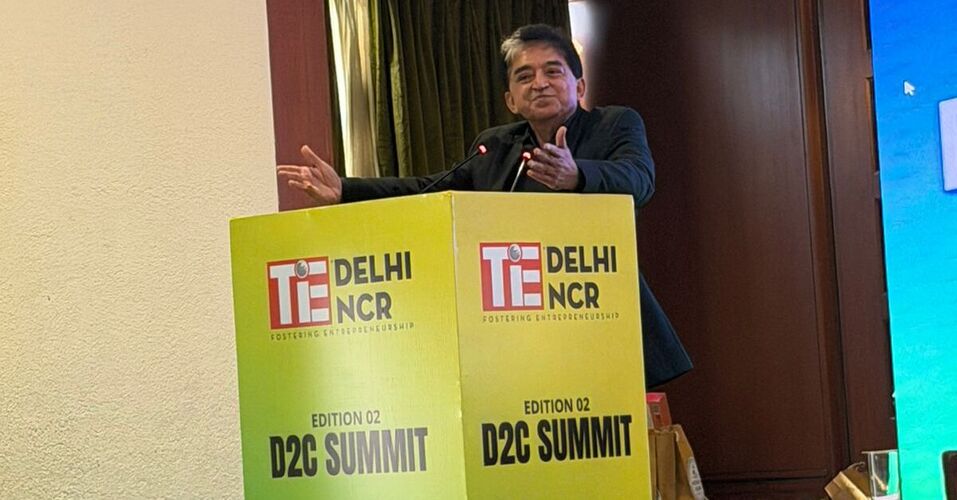
At the TiE Delhi-NCR D2C Summit – Edition 2, business and brand strategy expert Harish Bijoor, Founder of Harish Bijoor Consults Inc., delivered a compelling and thought-provoking keynote that challenged conventional D2C thinking and urged founders to rethink growth, loyalty, and customer engagement in a rapidly evolving consumer landscape. Opening his address with an anecdote from a restaurant experience, Bijoor illustrated the power of data-driven relationship management. Recounting how a restaurant staff knew intimate details about his companion’s preferences, he highlighted how deeply personalised service has become possible through technology.
“We don’t manage relationships anymore, we manage transactions. That’s the real problem. We need to get off this high horse of transactions and start building relationships again,” Bijoor said, drawing loud agreement from the audience. He stressed that while most B2C brands remain “needs-centric,” the future lies in addressing higher emotional layers of consumer behaviour. Mapping the evolution of consumer motivation, from needs to wants, desires, and aspirations, Bijoor introduced what he termed the fifth frontier: fantasy.\
“The current generation doesn’t just have needs or aspirations. Instead, they have fantasies. Brands of the future must learn to cater to these fantasies if they want to stay relevant,” he said, adding that this shift will define next-generation brand building. In another striking observation, Bijoor declared that brand loyalty is no longer the driving force behind consumer decisions.
“Brand loyalty is dead. What exists today is service loyalty and channel loyalty. If you want to win, invest in service, not just branding,” he emphasised.
Addressing one of the biggest growth challenges facing D2C brands, Bijoor spoke about the commonly observed revenue plateau around Rs 80 to 100 crore. He argued that this is not a “glass ceiling” but rather a “glass flooring” that companies fail to break due to narrow market focus. “Most D2C brands operate only at the top of the pyramid because it’s the easiest market to enter. Real scale comes when you penetrate deeper, and across multiple layers and territories of the consumer pyramid,” he explained.
He outlined a strategic framework involving ten business territories within a single D2C ecosystem, urging brands to diversify their approach across income levels, geographies, and consumer segments to unlock sustainable growth. Bijoor also drew a clear line between pure-play D2C and omni-channel strategies, asserting that excessive channel expansion dilutes the very essence of direct-to-consumer.
“Pure D2C is about one shop, one e-shop, and one promise. The moment you chase multiple channels, you lose the power of direct trust,” he remarked. In a powerful closing metaphor, Bijoor likened D2C to the Kalki avatar, which is the final incarnation of Vishnu destined to restore balance. He urged founders to see their brands as instruments of trust, fairness, and strategic discipline. “D2C has the power to restore dharma in buying and selling but only if you break the glass blockade and plan with intent, focus, and strategy,” he said.