Salesforce hosted its Innovation Leadership Summit this week in Mumbai, unveiling a slate of strategic announcements and thought leadership insights that define India’s rising importance in the company’s global innovation roadmap. The event featured the launch of the State of Data and Analytics Report 2025, an in-depth walkthrough of Salesforce’s Agentic Enterprise framework, and a major partnership announcement with TASC Outsourcing, one of the Middle East and India’s leading recruitment and HR solutions companies.
India at the Center of Salesforce’s Global Growth

Mankiran Chowhan, Managing Director – Sales & Distribution at Salesforce India, highlighted the company’s two-decade-long journey in the country and the rapid scale-up of its local footprint. “Salesforce has been in India for about 20 years. We’ve been invested in technology and innovation here from the start. Five years ago, we were 2,500 people; today, we are 14,000. This is a testament to the depth of our commitment to the Indian market and the global impact our teams deliver,” Chowhan said.
She noted that Salesforce recorded $1.5 billion in revenue last year, growing 47% year-over-year, driven by strong adoption across industries including financial services, telecom, technology, and retail. Chowhan emphasized that customer expectations are shifting fast, and enterprises must now move from experimentation to execution in their AI journeys. The divide, she said, lies in how consumers have rapidly embraced AI in daily life, while enterprises are still working to unify data and build trust in automation.
“As consumers, we’re already using agentic AI every day. But enterprise adoption hasn’t kept pace. Moving to an agentic model deepens customer loyalty, builds trust, and unlocks efficiency by freeing teams from mundane tasks so they can focus on relationships and outcomes,” she added.
Salesforce announced a major milestone: the evolution of its flagship Customer 360 platform into Agentforce 360, reflecting the company’s shift toward autonomous, AI-enabled workflows across sales, service, marketing, and operations. Chowhan shared how Salesforce itself has deployed agentic systems across business functions. “We’ve saved over $100 million in customer support using agent pools. In sales, our STR agent has contributed more than $60 million in pipeline. In marketing, we’ve grown website pipeline by 15%.” These internal deployments, she said, demonstrate what is possible when data, AI, and automation operate in a unified ecosystem.
TASC Outsourcing Joins Hands with Salesforce to Build a Fully Digitized Staffing Ecosystem
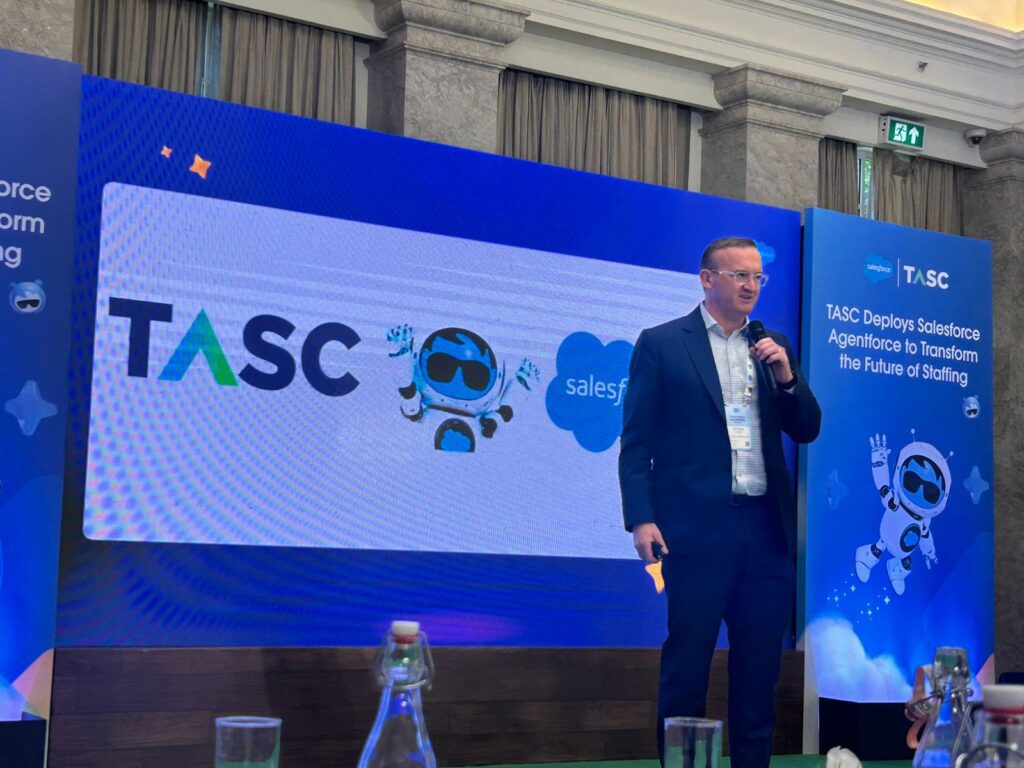
The Summit also featured a major client announcement, which is Salesforce’s new strategic collaboration with TASC Outsourcing that is unifying its sales and marketing operations on Salesforce and deploying Agentforce to modernize its end-to-end staffing lifecycle.Richard Jackson, Chief Transformation Officer at TASC Outsourcing, described the partnership as transformational for their fast-growing operations across the UAE and Saudi Arabia.
“We are a very sales-intense business operating in highly competitive markets. Upgrading our technology was essential, and Salesforce was the only real choice for us. Agentforce has already helped us cut deal cycles from four months to two, and our response rates have increased sixfold,” Jackson said.
TASC now uses AI agents, branded internally as TARA (Task Accelerated Revenue Agent), to identify leads, revive dormant contacts, and accelerate sales outreach. Jackson said clients appreciate the transparency of automated communication. “We make no attempt to hide that the outreach is from an agent. People actually reply and say, ‘Hi TARA, I’d like to talk to your sales team.’ This is what the future of work looks like. Everyone will have an AI agent working alongside them, and companies that don’t embrace this shift will be left behind,” he said.
State of Data Report Highlights the Urgency of Unified Data Strategies
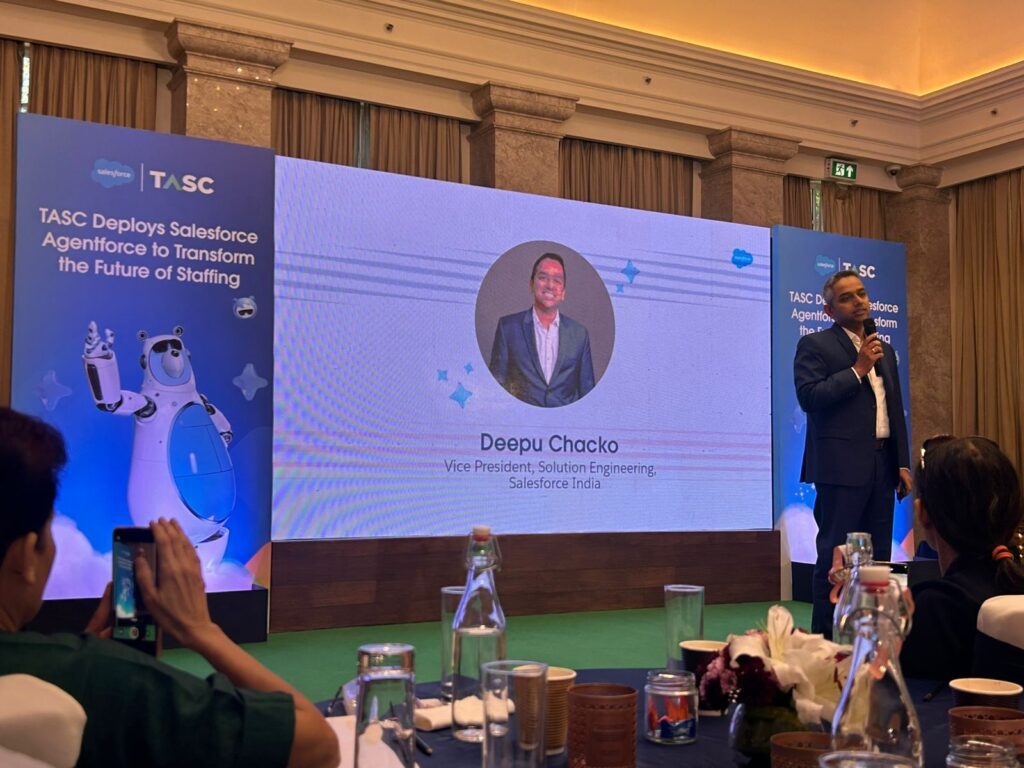
Salesforce also released the second edition of its State of Data and Analytics Report, surveying 8,000 business leaders across 14 countries. The findings reflect a growing urgency among Indian and global enterprises to unlock the value of fragmented data.
Presenting the report, Deepu Chacko, VP – Solution Engineering, Salesforce India, said: “AI is exploding, but data is becoming even more critical for AI to be effective. Almost half the leaders surveyed said they struggle to use data for timely insights, and 94% reported inaccurate or misleading AI outputs due to poor data quality.”
He added that India’s unique mix of digital-first enterprises and legacy-heavy industries amplifies the need for unified data models. “Twenty-six percent of company data is siloed or inaccessible, yet 75% of leaders believe that this trapped data holds their most valuable insights. Having a deeply unified platform like Salesforce becomes essential for stitching together transactional, behavioural, and engagement data to unlock meaningful AI-driven outcomes,” he explained.
“AI cannot fix what incomplete data creates. For India to truly unlock the promise of agentic Al, leaders must treat data as a strategic asset, unified, governed, and contextual. The companies that modernise their data foundations today will be the ones that scale Al responsibly and lead the economy tomorrow. Agentic Al isn’t the next technology, it’s the next revolution. Al agents handle routine tasks so humans can focus on creativity, relationships, and impact,” he added.
Key data from the report:
- Existing data foundations strain to support business ambitions: Nearly two-thirds of business leaders (66%) describe their organisations as data-driven. Yet just as many (52%) data and analytics leaders say their companies struggle to drive business priorities with data, exposing a gap between data maturity perceptions and reality.
- About half (51%) of business leaders say they can reliably generate timely insights.
- Nearly half (54%) of data and analytics leaders say their companies occasionally or even frequently draw incorrect conclusions from data with poor business context.
- Incomplete, out-of-date, or poor-quality data remains the number one factor preventing organisations from being truly “data-driven.”
Those who wish to access the full report may visit the official website for further details.