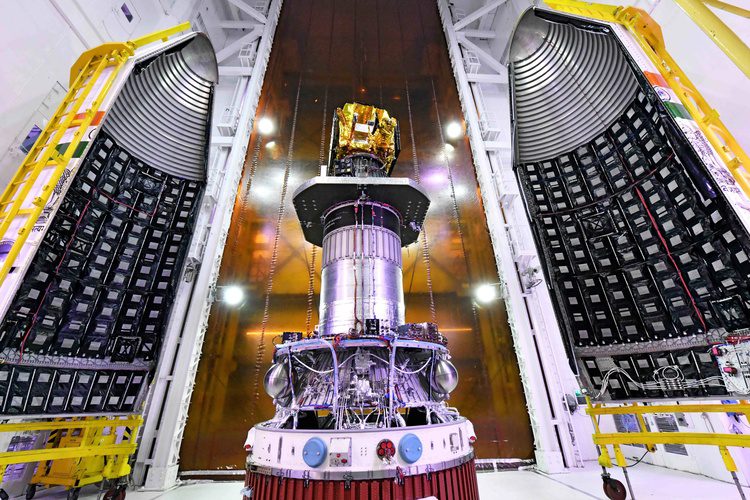
The ISRO PSLV C62 mission, which successfully lifted off from the First Launch Pad at Satish Dhawan Space Centre in Sriharikota at 9:45 am on 12 January 2026 seems to have encountered an issue. The Indian Space Research Organisation has informed that the mission encountered an anomaly in its third stage. “The PSLV-C62 mission encountered an anomaly during end of the PS3 stage. A detailed analysis has been initiated,” ISRO has stated on X.
The PSLV-C62 / EOS-N1 mission marked the ninth dedicated commercial launch undertaken by NewSpace India Limited (NSIL). The mission involved the construction and launch of the EOS-N1 earth observation satellite for a customer, along with launch services for 15 co-passenger satellites from both domestic and international clients. The launch was carried out using the PSLV-DL variant, equipped with two solid strap-on motors, and represented the 64th flight of the Polar Satellite Launch Vehicle (PSLV).
In addition to its primary objectives, the PSLV-C62 mission also demonstrated the Kestrel Initial Technology Demonstrator (KID), developed by a Spanish startup. The KID, a small-scale prototype of a re-entry vehicle under development, was deployed as the final co-passenger. Following its injection, the demonstrator was slated to re-enter the Earth’s atmosphere and splash down in the South Pacific Ocean.
The ISRO PSLV C62 mission also carried onboard the advanced multispectral imaging payload MIRA developed by Hyderabad-based deep-tech startup Eon Space Labs. The payload was integrated with MOI-1, a 14 kg CubeSat developed by Hyderabad-based startup TakeMe2Space. The satellite was designed to demonstrate the viability of India’s first AI-powered orbital image laboratories. The mission enabled near real-time, in-orbit processing of Earth observation data, significantly reducing data downlink costs.
Also read: India’s Space Industry Witnesses Major Growth in 2024 with Private Sector Push
MIRA, which was certified to NASA space-grade standards, was optimised for size, weight, and power efficiency, featuring compact dimensions of 54 × 54 × 87 mm and a weight of just 502 grams. The payload offered multispectral imaging across nine bands, with a ground sampling distance of 9.2 metres and a wide swath width of 18.7 km, making it well suited for earth observation applications. It was developed indigenously as part of India’s growing private space ecosystem. PSLV-C62 was a multi-payload mission that also carried EOS-N1 (Anvesha), an advanced earth observation satellite, along with multiple technology demonstration payloads.
The failure of the PSLV C62 could be viewed as a significant setback, given that the PSLV has long been regarded as ISRO’s workhorse launch vehicle. Prior to this mission, the rocket had successfully completed 63 flights, including landmark missions such as Chandrayaan-1, the Mars Orbiter Mission, Aditya-L1, and the Astrosat mission. In 2017, the PSLV had also set a world record by deploying 104 satellites in a single launch.