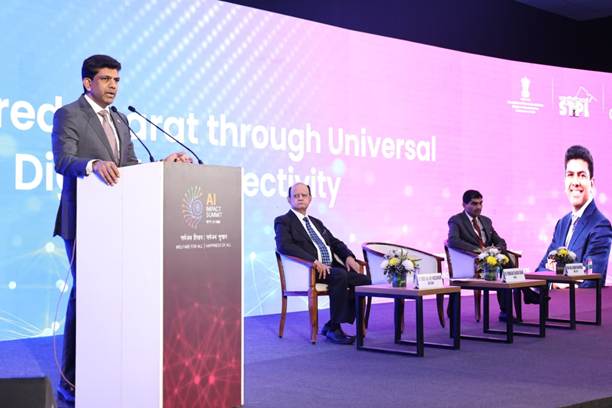
The Cellular Operators Association of India (COAI), in collaboration with the Department of Telecommunications (DoT) and Software Technology Parks of India (STPI), successfully conducted two high-level sessions on “Generative AI and Future Networks” and “AI Powered Bharat through Universal Digital Connectivity” at the India AI Impact Summit 2026, highlighting the critical role of telecom infrastructure in enabling India’s AI-led transformation.
The sessions brought together senior policymakers, industry leaders, technology experts and ecosystem stakeholders to deliberate on how next-generation telecom networks will serve as the foundational infrastructure for scaling artificial intelligence across governance, industry and society. Discussions during the sessions reinforced the view that the convergence of compute, connectivity and data will define the next decade of digital transformation, with telecom networks playing a central role in enabling AI-driven services at population scale. Industry leaders emphasised that as AI applications expand, from enterprise automation to public service delivery, robust, secure and future-ready connectivity will be essential to ensure reliability, inclusivity and trust.
Addressing the Summit, Dr. Pemmasani Chandra Sekhar, Hon’ble Minister of State for Communications, underscored the central role of telecom infrastructure in enabling India’s AI ambitions: “Telecom connectivity is the foundational layer upon which India’s AI ecosystem will be built. Without robust, secure and future-ready telecom networks, AI cannot scale to serve the needs of a billion citizens. India’s strong telecom infrastructure provides a unique opportunity to deploy AI at population scale, enabling inclusive growth, strengthening governance and positioning India as a global leader in AI-driven digital transformation.”
Also read: Day 2 of IMC 2025 Witnesses Inauguration of International AI Summit and API Hackathon
The session on “Generative AI and Future Networks” explored how AI will transform telecom networks themselves, with future networks evolving into intelligent, self-optimising and AI-native systems. Experts noted that emerging technologies such as 5G Advanced and 6G will integrate AI deeply into network architecture, enabling autonomous optimisation, improved efficiency and enhanced service quality. The session witnessed participation from stalwarts from the Government as well as the industry, such as Shri Anil Kumar Bharadwaj, Deputy Director General, Strategic Engagements (SE), DoT; Shri Syed Tausif Abbas, Deputy Director General, DoT and Head, Telecommunication Engineering Centre (TEC); Mr. Shyam Prabhakar Mardikar, President and Group CTO (Mobility), Reliance Jio Infocomm Ltd.; Ms. Jeanette Whyte, Head of Public Policy, Asia Pacific, GSMA; Mr. Manoj Gurnani, CTO & Head of Strategy at Nokia India; Col. P.K. Chaudhary, HCL and Mr. Gurvinder Singh Ahluwalia, Founder and Chief Executive Officer, Digital Twin Labs.
The session on “AI Powered Bharat through Universal Digital Connectivity” highlighted that India’s extensive telecom networks, which already connect over a billion citizens, provide the critical backbone required to democratise access to AI. Participants noted that universal connectivity will enable equitable access to AI-driven services across sectors such as healthcare, education, agriculture and governance, ensuring that AI becomes a tool for inclusive national development. At the same time, emerging technologies such as quantum computing are expected to reshape digital ecosystems, and therein, telecom networks will play a critical role in ensuring secure, trusted and resilient digital infrastructure for the country. The session witnessed participation from Shri Sanjeev Sharma, Deputy Director General, DoT; Shri Vikas Garg, Deputy Director General (SPPI), DoT; Shri Robert Ravi, Chairman and Managing Director, BSNL; Mr. Julian Gorman, Head of Asia Pacific, GSMA; Mr. Rahul Vatts, Chief Regulatory Officer, Bharti Airtel; Mr. Ravi Gandhi, President and Chief Public Policy and Regulatory Officer, Reliance Jio; Ms. Ambika Khurana, Chief Regulatory and Corporate Affairs Officer, Vodafone Idea Ltd alongside Lt. Gen. Dr. S.P. Kochhar, Director General, COAI.
Speaking at the Summit, Lt. Gen. Dr. S.P. Kochhar, Director General, COAI, emphasised, “Telecom networks are the backbone of AI-powered Bharat. As AI applications scale across sectors, telecom infrastructure will evolve into intelligent, AI-native platforms that enable secure, resilient and inclusive digital growth. Strengthening connectivity today will be critical to ensuring India’s leadership in the global AI-driven economy. Telecom operators are already deploying AI-driven network intelligence to strengthen digital trust by proactively detecting and mitigating spam, fraud and malicious communications. By investing in future-ready networks and building secure digital infrastructure, India has a unique opportunity not only to adopt AI but to lead globally in deploying AI for the benefit of humanity.”
COAI noted that India’s scale of connectivity, rapid digital adoption, and leadership in digital public infrastructure uniquely position the country to emerge as a global leader in AI-enabled digital transformation. Future telecom networks, particularly as the industry evolves toward 6G, will be AI-native by design, enabling intelligent automation, improved efficiency and new applications across governance, industry and public services. Strengthening telecom infrastructure will therefore be essential to ensuring India’s continued leadership in the global digital economy.