Global digital trust leader DigiCert announced the introduction of a locally hosted instance of DigiCert One in India, marking a significant milestone in the company’s long-term commitment to the country’s rapidly expanding digital economy. The announcement was made at a leadership-led event in New Delhi.
The event featured keynote addresses by James Cook, Group Vice President, Asia-Pacific and Japan; Anant Deshpande, Regional Vice President – India and ASEAN; and Deepika Chauhan, Chief Product Officer, DigiCert, each outlining how digital trust is evolving from a security requirement into a foundational pillar of digital transformation.
Taking the stage, James Cook emphasised that India has long been central to DigiCert’s growth story, both globally and within the Asia-Pacific region: “India is really at the heart of what we do from a global perspective. But it’s also very much at the heart of our go-to-market strategy for Asia-Pacific,” Cook said. “India is a market that is increasingly becoming pivotal for us.”
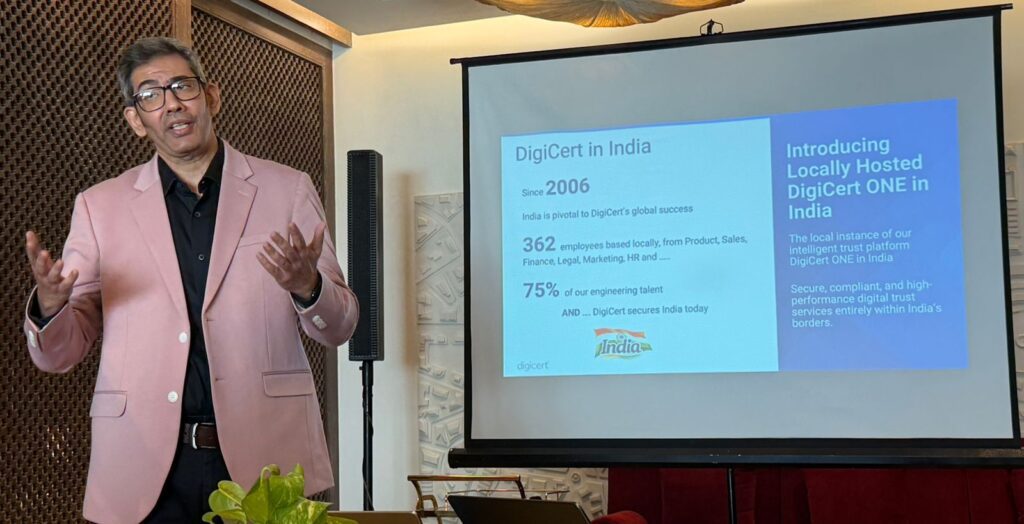
With one of the world’s fastest-growing digital economies, Cook described India as a unique growth opportunity, driven by enterprise-scale digitisation and increasing complexity. DigiCert has been present in India for nearly two decades and currently employs more than 360 professionals across locations such as Bengaluru and Pune, spanning engineering, sales, HR, and marketing functions. Notably, over three-quarters of DigiCert’s global engineering talent is based in India. “Indian enterprises operate at exceptional scale and complexity, which means they need a security platform to match that scale,” Cook noted.
Local Hosting of DigiCert One Announced
Against this backdrop, Cook announced the launch of a locally hosted version of DigiCert One in India, a move aimed at addressing data sovereignty, compliance, and performance requirements for Indian enterprises.
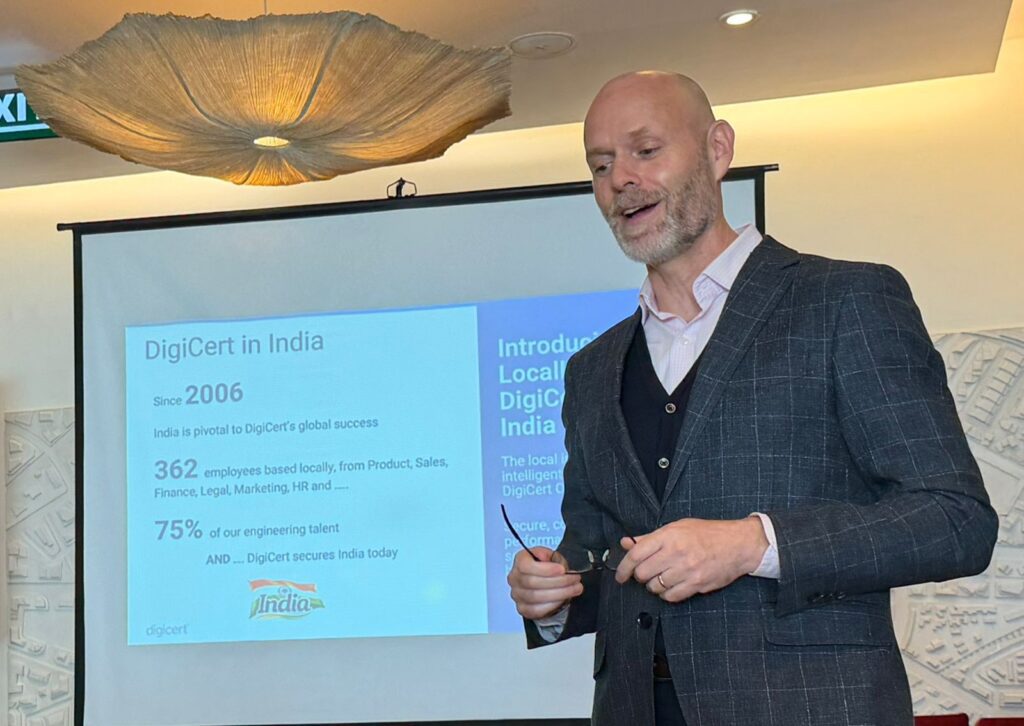
“Today, we’re introducing a locally hosted version of DigiCert One right here in India,” he said. “This allows organisations to access secure, compliant, and high-performance digital trust services entirely within India’s borders, which is extremely important.” The local hosting of DigiCert One reinforces DigiCert’s commitment to India’s digital transformation priorities, including data sovereignty and regulatory alignment, while supporting enterprises as they scale securely.
Building on this theme, Anant Deshpande placed DigiCert’s announcement within the broader context of India’s digital growth story: “India is digitising at an unprecedented rate, and it’s digitising at scale,” Deshpande said, pointing to platforms such as Aadhaar, which serves over 1.3 billion identities, and UPI, which processes billions of transactions every month.
“There can be no digitisation and no internet without digital trust,” he said. “Digital trust is the foundational infrastructure that holds all digital interactions together, whether you’re flying, making a payment, or sending a secure message.” Deshpande reiterated that DigiCert One, often referred to as DC1, is the company’s unified platform for delivering digital trust, combining PKI and DNS with automation and scale.
Five Trends Reshaping the Digital Trust Landscape
Deepika Chauhan, Chief Product Officer at DigiCert, delivered a detailed presentation on the transformation underway in the digital trust ecosystem, outlining five key trends shaping enterprise security strategies globally and in India:
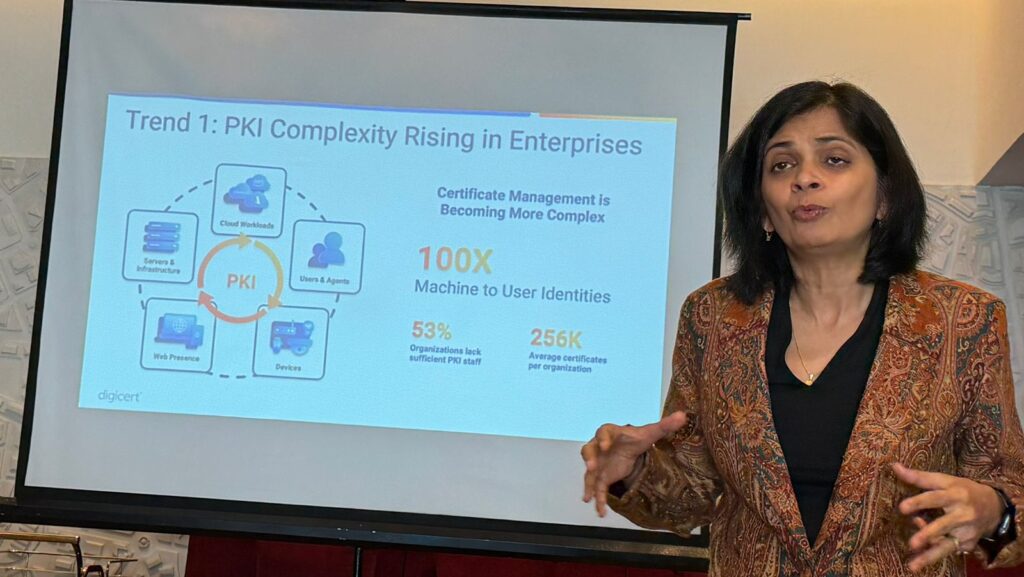
1. Rising PKI Complexity in Enterprises
Chauhan noted that enterprises are witnessing an explosion in machine identities, driven by cloud workloads, servers, devices, APIs, and connected infrastructure. “The number of machine identities in organisations today is nearly 100 times that of human identities,” she said. “Managing hundreds of thousands of certificates, often across silos, creates security gaps, ownership challenges, and operational risk.” She added that lack of unified visibility and governance often leads to outages when certificates expire, directly impacting business resilience.
2. Outages and Cost Driving PKI Modernisation
Highlighting recent global incidents, Chauhan cited certificate-related outages at major organisations, including financial institutions and cloud platforms, as proof that manual PKI management no longer works. With the industry moving toward shorter certificate lifespans, organisations will soon need to renew and validate certificates multiple times a year. “If one-year certificates are already causing outages, the risk multiplies dramatically as certificate lifetimes shrink,” she said, stressing the need for automation, centralised management, and modern PKI infrastructure.
3. Urgent Need for AI Trust
As AI adoption accelerates, Chauhan said enterprises must address trust across AI-generated content, AI models, and AI agents. “How do you know whether content is real or AI-generated? Who created it, when was it modified, and what is its provenance?” she asked. She explained that DigiCert is extending digital trust principles, such as identity, authenticity, and non-repudiation, to AI content, models, and agents, enabling organisations to govern access, permissions, and behaviour at scale.
4. Quantum-Safe Cryptography
Chauhan warned that quantum computing poses a real threat to today’s cryptographic systems. “Once quantum computers are viable, existing cryptography can be broken in minutes,” she said, adding that waiting until quantum arrives is already too late. With NIST approving post-quantum algorithms and major vendors beginning adoption, she urged organisations to start preparing now by gaining visibility into their cryptographic assets and planning phased transitions.
5. Evolving Regulatory Landscape
Finally, Chauhan pointed to increasing global and regional regulations around data sovereignty, cyber resilience, and post-quantum readiness: “Regulators are now treating certificate outages as operational risk,” she said. “Organisations are being required to maintain central registries, enforce governance, and demonstrate compliance.” She noted that enterprises are looking for platforms that reduce regulatory burden through centralised visibility, governance, and enforcement.
A Unified Platform for Intelligent Trust
Bringing the discussion together, Chauhan said DigiCert One provides a unified foundation for managing PKI, DNS, AI trust, and quantum readiness, which is now available as a locally hosted platform in India. “Digital trust is currently strategic, pervasive, and foundational,” she said. “With DigiCert One hosted in India, organisations can modernise PKI one step at a time while meeting sovereignty, performance, and compliance needs.”