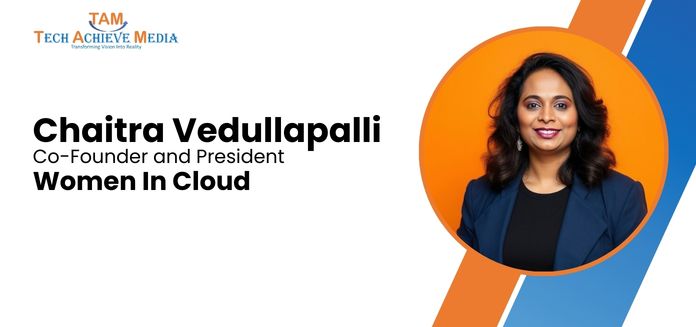
India has demonstrated unmatched digital ambition, connecting billions through identity, payments, cloud, and AI platforms. Yet the true test now lies in converting scale into sustainability. In this wide-ranging interview with Tech Achieve Media, Chaitra Vedullapalli, Co-Founder and President of Women In Cloud, shares her views on why cyber resilience, talent infrastructure, and inclusive leadership must become core pillars of India’s development strategy. She outlines the structural shifts needed to make Viksit Bharat executable rather than aspirational, and explains how durable leadership, rather than short-term programmes, will define India’s digital future.
TAM: India has no shortage of digital initiatives, but very few achieve sustained, systemic impact. How does WICxSaksham avoid becoming another skills programme and instead evolve into a durable national capability for cyber resilience and AI readiness by 2030?
Chaitra Vedullapalli: Connecting a Billion People Was the Easy Part. Making the Digital Economy Safe and Inclusive Is India’s Real Test
India does not suffer from a lack of digital ambition. It suffers from a lack of durability. Over the last decade, the country has launched some of the world’s most ambitious digital initiatives, spanning payments, identity, cloud adoption, and AI experimentation. Yet very few of these initiatives evolve into long-term, systemic capabilities that endure beyond pilots, funding cycles, or leadership tenures. As India moves toward a $7 trillion economy, the challenge is no longer about launching programmes. It is about building infrastructure for leadership readiness, particularly at the intersection of cybersecurity, AI, and economic participation.
That is the lens through which initiatives like WICxSaksham must be understood.
From Skills Programme to National Capability
Most skilling efforts fail because they treat education as an output rather than as an operating system for the economy. #WICxSaksham was intentionally designed to avoid this trap by anchoring itself in a long-term, structural goal: the creation of 100 Cyber Resilience Centers of Excellence across India, each designed to serve as a talent-to-employment engine rather than a training hub. These Centers of Excellence focus on one outcome above all else: preparing students and early-career professionals for DevSecOps & Cyber roles that industry is actively hiring for. Cybersecurity is not taught in isolation. It is embedded directly into cloud, AI, and software development workflows so security becomes part of how systems are built, not an afterthought layered on later. What makes this model durable is its design logic.
First, it aligns universities, employers, and technology partners around a shared outcome: job-ready cyber talent. Students are not trained speculatively. They are trained against real enterprise use cases, real tooling, and real hiring demand.
Second, it creates distributed resilience, not centralized expertise. Cybersecurity capacity is built locally across institutions and regions, reducing dependence on a narrow elite workforce.
Third, it closes the loop between education and employment. Talent pipelines that end in certificates fade quickly. Pipelines that end in jobs, income, and enterprise trust compound over time.
By 2030, India will not measure cyber resilience by the number of courses delivered, but by how many professionals are actively defending, building, and scaling secure systems across the economy. That is the shift WICxSaksham is engineered to deliver.
TAM: The ambition of contributing to a $7 trillion Viksit Bharat is bold. What are the three non-negotiable structural shifts, policy, industry, or talent-related, that India must get right in the next five years for this vision to be realistic rather than aspirational?
Chaitra Vedullapalli: Making Viksit Bharat Executable, Not Aspirational
The ambition of contributing to a $7 trillion Viksit Bharat is bold and achievable, but only if India gets three structural shifts right in the next five years.
The first is talent readiness for innovation, not just talent supply. India produces graduates at scale, but innovation requires professionals who can operate in ambiguity, manage risk, and apply AI and security responsibly. This means moving beyond static curricula toward applied, continuously evolving skill pathways tied directly to industry demand.
The second is public-private partnerships as operating systems, not sponsorships. When government, industry, and academia operate in silos, initiatives fragment. When they co-design outcomes together, scale becomes sustainable. The most effective digital ecosystems treat policy, enterprise adoption, and workforce readiness as interconnected levers.
The third is iconic leadership that democratizes economic access. According to insights from the WIC 2026 Economic Access Report, access is not constrained by ambition or effort. It is constrained by visibility, sponsorship, and pathways into economic opportunity. Leadership that understands how to unlock access for others is no longer a moral aspiration. It is an economic necessity. Without these three shifts, growth remains uneven. With them, inclusion becomes a multiplier rather than a constraint.
TAM: Despite progress, women entrepreneurs globally still face structural disadvantages in capital access and enterprise adoption. From your experience unlocking $500 million in economic opportunities, what is the single biggest myth policymakers and corporations still believe about women-led businesses, and how is it holding growth back?
Chaitra Vedullapalli: The Myth Holding Women-Led Growth Back
Despite progress, women entrepreneurs globally continue to face a persistent economic access gap.
The biggest myth policymakers and corporations still believe is that women-led businesses are inherently smaller, riskier, or less scalable.
In reality, what exists is not a performance gap, but an access gap. Women-led businesses receive less early enterprise adoption, fewer pilot opportunities, slower capital pathways, and limited access to decision-makers. When scale inputs are restricted, scale outcomes naturally follow. Over $500 million in economic opportunities unlocked across ecosystems has shown one consistent pattern: when women-led businesses gain equal access to enterprise markets and capital signals, they perform at or above benchmarks. The constraint is not capability. It is access to buyers and GTM investments.
Closing the economic access gap is not about preferential treatment. It is about removing structural friction that prevents capable businesses from entering core value chains.
TAM: As India digitises at population scale, cyber risk is no longer just a technology issue but a societal one. Do you believe India is underestimating the human and cultural dimensions of cyber resilience, and what should government, enterprises, and universities be doing differently today?
Chaitra Vedullapalli: Cyber Resilience Is a Human Challenge
As India digitizes at population scale, cyber risk can no longer be framed as a backend technology issue.
It is a societal capability issue. India has made progress in platforms and regulation, but the human and cultural dimensions of cyber resilience remain underestimated. Most cyber incidents succeed not because systems fail, but because trust is manipulated through fear, authority, urgency, and social pressure. Government must normalize cyber awareness and reporting, shifting from reactive enforcement to preventive literacy. Enterprises must move beyond compliance training toward behavioral security, where employees understand how trust is exploited and how their actions protect customers and brands. Universities must treat cybersecurity and AI ethics as foundational skills for all disciplines, not electives reserved for specialists.
Resilience is not built by tools alone. It is built by people who know how to think critically in digital environments.
TAM: Having operated at the intersection of Big Tech, venture capital, and global ecosystems, how do you define effective leadership in an era where AI, geopolitics, and economic inclusion are colliding, and what skills will separate tomorrow’s leaders from today’s?
Chaitra Vedullapalli: Leadership in an Exponential World
We are living in an era where AI acceleration, geopolitical shifts, and economic inclusion are colliding.
Yet most leadership models remain linear, designed for predictable environments that no longer exist. Linear thinking in an exponential world is no longer sufficient.
What is required is a leadership shift toward quantum thinking, the ability to hold multiple realities, manage complexity, and design systems that adapt rather than break.
This is the foundation of the ICONIC Leadership Preparation Model. A framework built for leaders who are not trying to simplify complexity, but to lead through it. ICONIC leadership is not about doing more. It is about preparing better. It emphasizes systems awareness, ethical grounding, and ecosystem orchestration. Leaders must understand how technology decisions impact trust, how policy shapes markets, and how inclusion drives resilience. Tomorrow’s leaders will not be defined by certainty. They will be defined by their ability to navigate ambiguity with integrity and build coalitions that outlast any single initiative.
The Path Forward
India has proven it can move fast. The next test is whether it can build systems that last. Cyber resilience, AI readiness, and economic access are no longer separate conversations. They are interconnected pillars of national strength.
By investing in durable talent infrastructure, aligning public and private ecosystems, closing access gaps, and preparing leaders for complexity, India can ensure that its digital future is not just large, but inclusive, secure, and resilient. That is how ambition becomes capability. And leadership capability becomes national advantage.