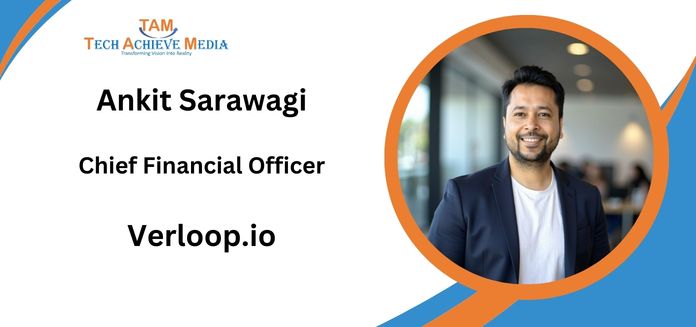
As Agentic AI begins to redefine how enterprises scale, it is also reshaping the financial architecture of modern SaaS businesses. The traditional link between growth and headcount is breaking, forcing CFOs to rethink unit economics, pricing discipline, capital allocation, and long-term profitability. In this in-depth conversation with Tech Achieve Media, Ankit Sarawagi, Chief Financial Officer, Verloop.io, shares insights on how the company is building structurally sound growth in a hyper-competitive AI market, balancing automation-led scale, regional complexity, high-margin models, and capital efficiency. From modular localisation strategies and interaction-based pricing to disciplined margin management and durable revenue visibility, Sarawagi offers a CFO’s perspective on what it takes to build financially resilient AI platforms in an increasingly automated world.
TAM: Agentic AI breaks the traditional link between growth and headcount. How does that shift change the way you design unit economics, pricing discipline, and long-term profitability at Verloop.io?
Ankit Sarawagi: At Verloop.io, Agentic AI has completely changed how we think about scale. In older SaaS or BPO models, growth usually meant hiring more people. That trade-off doesn’t apply to us anymore. Growth is driven by automation and usage, not headcount. This shift allows us to design unit economics that improve as automation increases. Our interaction-based pricing is modular and transparent, especially for our Voice AI Agent solutions. Customers pay based on value delivered, and as automation rises, our margins expand alongside it.
We’ve been EBITDA positive on average for the past seven months. That gives us the discipline to reinvest in product innovation while staying operationally lean. Profitability, for us, is built into the model, not something we chase later.
TAM: Verloop.io operates in markets with extreme linguistic and cultural complexity. From a capital perspective, where do you draw the line between necessary localisation and scalable global architecture?
Ankit Sarawagi: You cannot build for markets like MENA or India without respecting linguistic nuance. At the same time, localisation cannot come at the cost of architectural fragmentation. We take a modular approach. For instance, we have built speech profiles tailored to Khaliji Arabic and English Hindi blends, but they sit on a common orchestration layer. This ensures we support regional diversity without forking our core platform.
From a capital allocation standpoint, we invest in localisation only when it directly impacts customer outcomes, revenue, or retention. That is why we prioritised Arabic voice training and WhatsApp workflows for the Gulf. On the other hand, we have consciously delayed expansion into lower impact dialects where the revenue upside is limited. It is about investing where localisation strengthens the business, while continuing to build a global architecture that scales efficiently across regions.
TAM: In an AI market crowded with capital and ambition, what internal financial metrics tell you that Verloop.io’s growth is structurally sound and not momentum-driven?
Ankit Sarawagi: We focus on financial signals that indicate structural strength, not just growth velocity. Revenue per employee is one of our clearest indicators. We are deliberate about not scaling headcount unnecessarily, especially in areas where AI can operate more efficiently. As our Voice AI business has grown 6 to 8 times in ACV, revenue per employee has steadily improved. That tells us the growth is productivity-led.
We also closely track LTV to CAC. Because customers see measurable ROI quickly, retention and expansion are strong. Lifetime value significantly outweighs acquisition costs, and payback periods remain short.
Gross margins per interaction are another core metric. AI-driven automation should be inherently high margin. We have built our stack to maintain over 80 percent gross margins even at scale. If margins compress as volume increases, that is usually a red flag in this market. We have been disciplined about avoiding that trap.
TAM: When customers automate maximum interactions, ROI is no longer theoretical. How do you translate operational savings for clients into durable revenue visibility for Verloop.io?
Ankit Sarawagi: Once customers achieve 70 percent or higher automation rates, ROI becomes tangible. It is visible in reduced agent hours, faster resolution times, and improved customer experience. At that point, the conversation shifts from experimentation to long-term commitment. We typically see this translate into longer contracts, higher ACVs, and multi-channel expansion. Many customers expand across voice, chat, and regional languages once they see consistent performance, including 99.9 percent uptime.
Our pricing model supports this. Since we price based on usage and interaction volume, higher automation does not cannibalise revenue. Instead, as customers scale automation across functions and geographies, usage deepens. We also build platform-led nudges and optimisation recommendations into the product. That ensures customers unlock the full value of automation, which strengthens stickiness and drives predictable expansion revenue.
TAM: As Agentic AI becomes core infrastructure rather than experimentation, what financial signals will separate enduring AI platforms from those that peak early?
Ankit Sarawagi: The early hype phase of AI rewarded speed of launch. The next phase will reward financial durability. Gross margin consistency is a clear signal. If margins deteriorate as volume scales, it often means hidden manual effort behind the scenes. Sustainable AI platforms should see stable or improving margins as usage grows.
Implementation speed is another signal we watch closely. Many AI projects get stuck in pilot mode. We have focused heavily on reducing go-live timelines because speed to value directly influences retention and expansion. Finally, net revenue retention will separate enduring platforms from short-term players. If customers expand usage year after year, adopt more channels, and increase ACVs, the product is delivering real operational impact. For us, a voice-first strategy combined with deep integrations and agent tools has created that stickiness. In the long run, enduring AI businesses will be defined less by narrative and more by disciplined unit economics, strong margins, and measurable customer value.