As enterprises move from AI experimentation to production, the conversation around data is shifting from infrastructure and efficiency to business value. For Confluent, the opportunity lies in helping organisations turn real-time, contextual and governed data into an operational advantage, while also controlling the cost and complexity of increasingly data-intensive AI workloads.
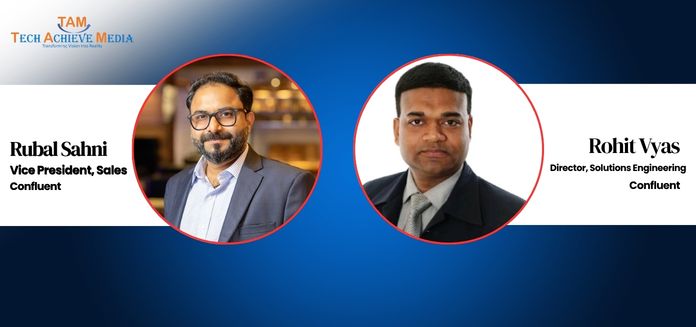
In this conversation with Tech Achieve Media along the sidelines of the Data Streaming World Tour to New Delhi, Rubal Sahni, Vice President, Sales, Confluent and Rohit Vyas, Director, Solutions Engineering, Confluent discuss how Confluent’s integration with IBM is shaping its go-to-market strategy, why data, not AI models, is often the biggest challenge for enterprises, and how streaming technologies such as Apache Flink are helping organisations build more responsive and cost-efficient AI environments. They also discuss the growing importance of data governance, multi-cloud architectures and real-time data, and why enterprises should look beyond simply managing data to asking a more fundamental business question: how can they create more value from the data they already have?
TAM: Confluent is now part of IBM. How has the integration influenced your sales playbook and go-to-market strategy, particularly in India and APAC?
Rubal Sahni: Our sales engagement has grown multifold following the IBM integration. We have kept our GTM and engineering teams intact, and in fact, both teams continue to grow. The integration has also given us access to IBM’s extensive relationships, particularly across India and the broader APAC region. We are able to leverage those relationships and elevate conversations beyond data to areas such as compute, sovereign infrastructure and security. As a result, the nature of our customer conversations has evolved significantly, and we are seeing multifold engagement across the market.
TAM: Enterprises often have significant investments in legacy infrastructure and cannot simply take a rip-and-replace approach. What are some of the common architectural anti-patterns you see when engineering teams try to feed real-time AI models using legacy data architectures?
Rohit Vyas: AI has been at the centre of technology conversations for the past couple of years. While we continue to talk about applications, operations and information security, AI has now taken centre stage. However, the challenges associated with AI have not fundamentally been frontier-model problems or even storage problems. In many cases, they have been data problems.
We continue to see legacy, disparate and fragmented systems that do not communicate effectively with one another, while organisations try to feed data into AI applications. Even with modern technology stacks, organisations can end up with fragmented silos, point-to-point integrations and disparate connections. Our approach is to look beyond being a systems provider and act as an advisor to customers across sectors, including BFSI, the public sector, digital-native businesses and Industry 4.0 organisations. Data has become horizontal; every organisation needs it. If AI has access to real-time, rich, contextual, safe and governed data, the effectiveness of the AI improves significantly. That principle applies across predictive AI, generative AI and AI agents.
TAM: Enterprises are enthusiastic about AI pilots, but many struggle to move those pilots into profitable production. How is Confluent helping enterprises capture the economic value of being the live operational memory for their AI systems?
Rubal Sahni: This is a very pertinent question. One aspect is whether AI applications or agents are performing accurately in production and whether they are producing reliable results. Confluent helps address this by supplying fresh, contextual data at scale, collected from multiple source systems and made available in a form that organisations can trust. This helps improve and accelerate the transition of AI applications into production. There is also a significant economic consideration. We have seen customers realise that they can end up spending $15 million or $20 million to solve a problem that they initially estimated would cost $10 million.
This is where Confluent’s governance capabilities become important. AI agents naturally tend to consume large amounts of data. If they are given broad access, they can read data across multiple sources, which in turn increases compute consumption.With Confluent, organisations can govern and restrict where agents can access data. This allows them to control unnecessary data consumption and, consequently, manage costs. Another example is Confluent’s Tableflow offering. It enables organisations to write data once and read it multiple times through an open data platform, reducing the cost associated with repeatedly reusing the same data.
TAM: How much of the data-lake cost can organisations potentially address by using streaming more effectively?
Rohit Vyas: Our understanding is that organisations often feed AI applications through data lakes. However, customers can end up spending approximately 40–70% of their data-lake costs on data ingestion and transformation. Those functions can increasingly be addressed through streaming platforms. By moving more of this work into streaming, customers can use their data lakes more effectively while providing AI systems with current data at a potentially lower cost. With Apache Flink and our streaming capabilities, organisations can also optimise how AI workloads consume data. The industry has moved from the mindset of maximising tokens to finding ways to use the right tokens efficiently.
Our streaming agents and real-time context capabilities can support functions such as prompt summarisation, routing the appropriate prompt to the appropriate LLM and taking the cost of the LLM into consideration. This can contribute to double-digit cost savings across the AI stack by introducing an intelligent streaming layer.
TAM: Apache Kafka has traditionally been associated with moving data from point A to point B, while stateful stream processing has often required additional tools or custom code. How rapidly are Indian enterprises adopting Apache Flink as a first-class technology alongside Kafka?
Rubal Sahni: Digital-native companies in India have generally been early adopters because they want to build first and move quickly. Apache Flink has therefore seen considerable adoption among these organisations. However, as digital-native companies mature, for example, when they move towards an IPO and become increasingly accountable to stakeholders and shareholders, the focus shifts towards reducing operational costs and optimising engineering resources.
Maintaining and managing open-source Flink environments can require considerable engineering effort. As a result, organisations are increasingly looking towards managed Flink offerings. With Confluent’s managed Flink, customers get a fully managed and serverless environment, along with advanced processing capabilities. Through the IBM integration, we are also bringing small language model capabilities into Flink. These SLMs can be used as functions within Flink for applications such as anomaly detection, pattern identification and forecasting. Importantly, these capabilities can run on CPUs and do not necessarily require GPUs, which can be beneficial from both an operational and cost perspective.
Rohit Vyas: We also support customers from a use-case perspective, including time-series use cases that can be addressed through Flink and the IBM integration.
TAM: Confluent operates with a consumption-based cloud model, while macroeconomic pressures can affect revenue predictability. How has the company’s traditional land-and-expand strategy evolved?
Rubal Sahni: India has been a strong cloud-growth market for us. Our cloud revenue in India has been consistently growing at approximately 70% year over year, and more than 75% of our book of business in India is cloud business. We see both land-and-expand scenarios as well as larger, direct engagements. Some customers already have significant Kafka and Flink estates, and when their leadership decides to make a rapid transition, we can also support larger-scale deployments.
Over time, Confluent has developed accelerators and integrations that enable customers to transition large workloads from open-source Kafka or other Kafka variants to Confluent. We also have forward-deployed engineering teams that work with customers to accelerate these transitions. So, we continue to see both land-and-expand engagements and larger-scale deployments.
TAM: As data volumes continue to increase across digital platforms, how are engineering teams beginning to treat data in motion? Are they giving it the same governance and schema discipline traditionally applied to data at rest?
Rohit Vyas: Engineering teams have increasingly recognised that data needs to be treated as a first-class citizen, with streaming becoming a principal primitive for managing that data. Data is no longer something that is consumed only internally. Increasingly, data itself is part of the business. Every company today relies on technology, and technology relies on data. By extension, every company is effectively becoming a data company. That has implications across outbound go-to-market, B2B and B2C operations, technology alliances and customer experiences. India, as one of the world’s largest producers of data, is generating enormous volumes of information, driven in part by the smartphone revolution and the widespread availability of 5G.
Engineering teams therefore need to ensure data sovereignty, establish schemas and data contracts, implement robust authentication and authorisation, and maintain audit trails. Organisations need to demonstrate not only to customers and the market but also to regulators that their businesses are resilient and governed. The objective is to ensure that data remains controlled and secure without compromising its speed or accessibility. This is an area where IBM and Confluent have a strong role to play.
TAM: Companies are increasingly cost-conscious when deploying technology. When you engage with CXOs focused on cloud-cost optimisation, what is the financial narrative around data streaming? How do you demonstrate that streaming can deliver ROI?
Rubal Sahni: The answer depends on the business and the specific use case. Every industry needs data, and increasingly, it needs real-time data. Consider e-commerce and quick-commerce businesses. They rely on real-time inventory information. If inventory data is not current, it can lead to inefficiencies and increased pilferage. Similarly, for financial services organisations, real-time contextual data can play an important role in fraud prevention. If an organisation cannot leverage this information effectively, the financial impact of fraud can be significant.
In e-commerce, real-time data can also support dynamic pricing and personalised offers. If businesses can respond to customer behaviour in real time, they can potentially improve conversion and engagement. So, real-time data and data-streaming platforms can help organisations increase revenue, reduce pilferage, improve efficiency and address fraud-related losses. From a pricing perspective, we have different offerings based on the customer’s requirements. Some workloads are extremely latency-sensitive and require data to move at scale within milliseconds. These workloads require a different level of service.
Other use cases, such as observability, logging or certain customer communications, may not require millisecond-level latency. For these workloads, customers can use other offerings. It is therefore not a one-size-fits-all model. We have different offerings based on the use case, allowing customers to optimise their technology investments. We also work with customers through flexible, dynamic pricing models. As their data volumes grow, the per-unit cost can come down, allowing the economics to scale with their business.
TAM: You spoke about cost optimisation, but can data streaming also help businesses create new revenue opportunities?
Rubal Sahni: Absolutely. Every company will have costs associated with managing data. Our approach at Confluent and IBM is not simply about adding another cost; it is about redirecting and optimising existing data expenditure. In any transformation, organisations generally have one or more of three objectives: keeping the lights on, reducing costs or creating a new revenue stream.
Rohit Vyas: A good example is Swiggy. Swiggy has publicly referenced the importance of Confluent to its operations. At the same time, streaming data can also help businesses create new customer experiences and revenue opportunities. Consider the integration between Swiggy and JioStar during the IPL. A viewer watching a match could see an option to order food from Swiggy without leaving the viewing experience. That is a classic example of a data alliance. The user is watching the match, decides to order food and can complete the transaction without changing screens.
This illustrates how organisations can use real-time data not only to optimise existing operations but also to enable new business models and revenue opportunities.
TAM: Businesses such as food-delivery and digital platforms operate with extremely latency-sensitive workloads. What technical bottlenecks do engineering teams face when they have to process rapidly changing data within milliseconds?
Rohit Vyas: The challenge is real, whether we are talking about a digital-native company, a stock exchange or another organisation with millions of active users. Engineering teams are dealing with a deluge of data coming from multiple form factors, connection types, broadband networks and bandwidth environments. At the same time, they have to process that information quickly, maintain functionality, monitor and control the environment, and ensure that everything remains secure and auditable.
This creates a series of competing requirements. Organisations need to move business data between customers and businesses at millisecond-level speeds while simultaneously applying security, governance, auditability, transformation and enrichment. The challenge is solving these requirements without forcing data into separate silos. Confluent helps businesses address this by enabling data to flow between customers and businesses, businesses and other businesses, and businesses and customers at the speed required, while applying control, security, auditability, transformation and enrichment directly within the stream. The objective is essentially to solve these competing requirements within a single platform and at the speed required by the business.
TAM: How does this challenge become more complex when enterprises operate across multiple clouds and on-premises environments?
Rubal Sahni: The complexity increases significantly when organisations have multiple cloud providers as well as on-premises workloads. To solve a particular business problem, applications and data often need to move across multiple clouds and on-premises environments, with decisions being made based on that information. Confluent addresses this by being available across major cloud environments as well as on-premises, providing a bridge across these landscapes. This enables data to move at scale and speed while maintaining trust and cost efficiency. It also allows data to be processed as it is travelling, rather than requiring it to first be moved into another silo before processing can begin.
TAM: If there is one question you wish journalists asked you more often, what would it be?
Rubal Sahni: I would like to be asked: “Can you name some of your referenceable customers in the market?” Rohit has already mentioned Zomato. I would also name Meesho and Slice. The list continues to grow.
Rohit Vyas: The question I would like to hear more often is: “How can a customer earn more from the same data?”
That is a question I would be very happy to answer because it gets to the heart of how we think about data. The opportunity is not only to manage data more efficiently, but also to help businesses identify ways to generate greater value and potentially create new revenue streams from the data they already have.