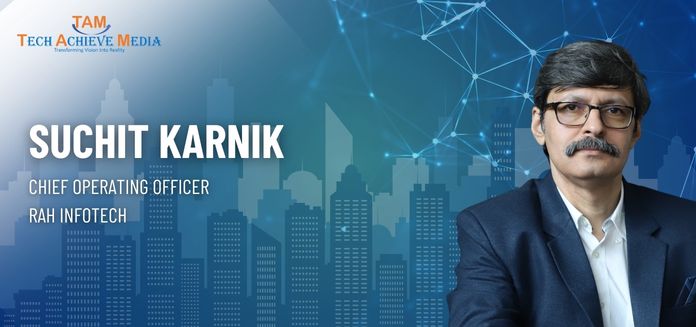
As enterprises modernise their IT environments, technology distribution is undergoing a significant transformation. Organisations today are looking beyond standalone products towards integrated solutions that combine cybersecurity, cloud, AI-ready infrastructure, networking, storage and compliance. This shift is redefining the role of value-added distributors, who are increasingly expected to provide technical expertise, partner enablement and solution support alongside product availability. In this exclusive interaction with Tech Achieve Media (TAM), Suchit Karnik, COO, RAH Infotech, discusses the company’s growth journey, expanding technology portfolio, the evolving distribution landscape, AI infrastructure readiness, cybersecurity, regulatory changes and the opportunities shaping the next phase of enterprise technology adoption.
TAM: RAH Infotech has grown rapidly over the past few years and has set an ambitious target for the coming year as well. What have been the key drivers behind this growth, and what will be your strategic priorities in achieving the next phase of expansion?
Suchit Karnik: Our growth has been built over many years, not through one or two short-term opportunities. The biggest driver has been our ability to stay close to the market, understand where enterprise demand is moving, and build the right OEM and partner ecosystem around those opportunities.
Cybersecurity continues to be a very important part of our business, but customer requirements are now much broader. Enterprises are looking at cloud, infrastructure, data, networking, power, storage and AI-readiness as connected priorities. For a value-added distributor like RAH Infotech, this creates a larger role. We are not just taking products to market; we are helping OEMs build reach, enabling partners with the right technical and commercial support, and making it easier for customers to access relevant technologies through the channel.
Also read: RAH Infotech Celebrates 19 Years of Service as Value-Added Distributor
The next phase of growth will depend on sharper portfolio choices, stronger partner coverage, deeper OEM engagement and better operational discipline. At our scale, growth cannot come only from adding more brands. It has to come from choosing the right technologies, building capability around them, and ensuring that partners, vendors and customers see consistent value from working with us.
TAM: The company has expanded beyond cybersecurity into cloud, compute, storage, networking, power, and AI-ready infrastructure. What factors are driving this diversification, and how is it helping RAH Infotech address evolving enterprise technology requirements?
Suchit Karnik: This diversification has been driven by the way enterprise buying itself has changed. Earlier, a customer could evaluate security, storage, networking or compute almost independently. That is no longer the case. A cloud project has security implications. An AI project needs compute, storage, networking and power readiness. A data protection conversation often connects back to compliance, resilience and infrastructure design.
For us, expansion beyond cybersecurity is not about becoming a broad catalogue distributor. That is not the intent. The idea is to build a complementary portfolio where one technology area strengthens the other and gives our partners more complete opportunities to address enterprise requirements.
This is especially important for the channel. Partners today need access to relevant OEM technologies, but they also need product knowledge, pre-sales support, solution mapping, training and commercial clarity. RAH’s role is to bring these elements together so that partners can go to market with more confidence, and enterprises can evaluate technology through a more structured ecosystem.
TAM: As Indian enterprises accelerate AI and digital transformation, how do you see the role of technology distributors evolving from product suppliers to strategic partners in enterprise transformation?
Suchit Karnik: The role of distribution has changed significantly. A distributor cannot remain only a fulfilment engine anymore. The market expects much more — from OEM onboarding and demand creation to partner enablement, technical validation, pre-sales support and post-sales continuity.
In fast-moving areas like AI, hybrid cloud, cybersecurity and infrastructure modernisation, partners often need support beyond pricing and availability. They need help in understanding use cases, positioning solutions, mapping customer requirements and building confidence around new technologies. That is where value-added distribution becomes relevant.
The important point is that distribution should strengthen the partner ecosystem, not bypass it. A good distributor understands vendor priorities, partner economics and enterprise expectations at the same time. When these three are aligned, technology adoption becomes much smoother. That, in my view, is where distributors will play a more strategic role in India’s digital transformation journey.
TAM: With regulations such as the DPDPA, increasing focus on data residency, and the rise of hybrid cloud environments, how are these trends reshaping enterprise technology investment and cloud strategies in India?
Suchit Karnik: Enterprise cloud decisions are becoming more mature. Earlier, many conversations were led mainly by scalability, agility and cost. Those are still important, but the discussion now includes governance, data residency, access control, security, backup, auditability and business continuity.
Regulations such as the DPDPA have also made organisations more careful about how data is stored, processed and protected. This does not mean every organisation will follow the same cloud model. Some workloads may move to public cloud, some may stay on-premises, and many will sit in hybrid or multi-cloud environments. The decision depends on the nature of the workload, the sensitivity of the data and the level of control required.
For a value-added distributor, this creates an important enablement opportunity. We work with OEMs and partners across cloud, security, data protection, identity, infrastructure and compliance-led technologies. Our role is to ensure that partners have access to the right portfolio and the right support to help customers make practical, well-governed technology decisions.
TAM: Many organisations continue to manage multiple standalone security solutions. In your view, what steps should enterprises take to build a more integrated, governance-led cybersecurity architecture?
Suchit Karnik: Many organisations have invested in good security products over the years, but the challenge is that these products often sit in separate pockets. One team manages endpoint, another manages network, another handles cloud, another looks at identity or data. When these layers do not speak to each other properly, visibility becomes fragmented and operations become harder than they should be.
The first step is to map security investments to business risk. Which assets are most critical? Where is sensitive data located? Who has access? Which systems are exposed? Once that picture is clear, enterprises can start building a more integrated security architecture across identity, endpoint, network, cloud, application and data security.
This is also where the ecosystem has to work better together. OEMs bring specialised technologies, partners bring customer context and implementation capability, and value-added distributors like RAH help connect the two with portfolio depth, technical enablement and solution support. The goal should not be to keep adding tools. The goal should be to make security investments work together in a way that improves governance, response and resilience.
TAM: As organisations prepare for AI adoption at scale, where do you see the biggest infrastructure gaps today across compute, storage, networking, and power, and how can enterprises address them effectively?
Suchit Karnik: AI adoption is creating a very different infrastructure conversation. Many organisations are looking at AI use cases, but not all of them have evaluated whether their underlying environment can support those workloads reliably.
The gaps are usually across multiple layers. Compute capacity may not be sufficient. Storage may not deliver the required performance. Network latency can become an issue. Power and cooling can be underestimated. Data protection and security also need to be planned from the beginning, not added later.
The practical approach is to first assess readiness by workload. Not every AI requirement needs the same infrastructure. A proof of concept, an analytics workload, a private AI deployment and a production-grade enterprise AI environment will all have different requirements. This is where partners will need strong support from the distribution ecosystem. RAH’s role is to work with OEMs and partners across compute, storage, networking, power, cloud, security and data management so that AI-ready infrastructure can be approached in a structured and scalable manner.
TAM: Looking ahead, what emerging technologies or market trends do you believe will create the biggest opportunities for RAH Infotech and the broader technology distribution ecosystem over the next three to five years?
Suchit Karnik: The biggest opportunities will come from areas where enterprise demand is growing and where partners need strong enablement. Cybersecurity will continue to be a major area, but the opportunity is becoming wider across AI-ready infrastructure, hybrid cloud, data protection, identity, compliance-led security, automation, OT security and infrastructure modernisation.
For RAH Infotech, the focus will be on building a stronger value-added distribution ecosystem around these areas. That means identifying the right OEM technologies, helping them scale in India and SAARC, building partner capability, and ensuring that the channel has the technical and commercial support required to take these solutions to market.
The next few years will reward distributors who understand execution. It is not enough to sign new OEMs or expand a portfolio on paper. The real value lies in creating demand, enabling partners, supporting solution discussions and helping technologies gain market adoption. That is where I believe RAH Infotech has a strong opportunity, because our business has always been built around the fundamentals of distribution – vendor alignment, partner reach, technical depth and operational discipline.