As artificial intelligence reshapes industries across the globe, universities are under growing pressure to prepare graduates with skills that go beyond coding and classroom learning. While AI courses have become increasingly common, industry leaders believe the next challenge is creating professionals who understand data, governance, ethics and enterprise problem-solving. With this objective, UPES has partnered with Salesforce to launch an industry-first BTech Computer Science Engineering (CSE) program with a specialization in Data Science. The program has been jointly developed with Salesforce and will be supported by a Salesforce Academia Centre of Excellence (CoE), developer certifications, faculty development, applied research and hands-on industry learning.
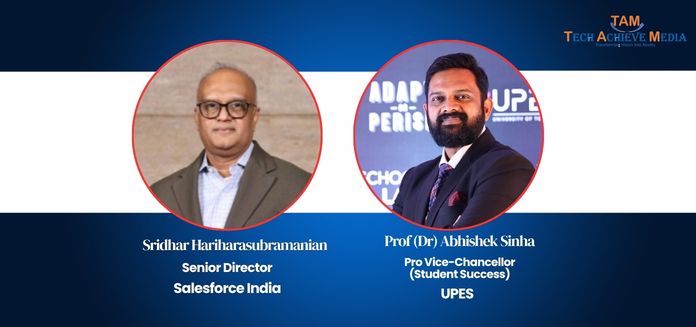
Speaking to Tech Achieve Media, Prof (Dr) Abhishek Sinha, Pro Vice-Chancellor (Student Success), UPES, and Sridhar Hariharasubramanian, Senior Director, Salesforce India, explained why the collaboration is designed to produce engineers who are not only technically skilled but also prepared to work responsibly with AI. According to Prof Sinha, the program is part of UPES’ larger vision of becoming an AI-first university: ”Being an AI-first university is not about introducing one or two AI courses,” he said. “It includes AI literacy, governance, investments in technology, faculty development and preparing students to become industry-ready professionals. Our collaboration with Salesforce follows a co-create, co-deliver and classroom-to-corporate model that gives students practical exposure alongside theoretical learning.”
For Salesforce, the collaboration is aimed at addressing the widening gap between university education and industry expectations. Sridhar Hariharasubramanian noted that while India has always produced strong engineering talent, the rapid pace of AI innovation demands continuous curriculum updates. ”AI is evolving faster than any technology we have seen before. Students today need much more than coding or prompt engineering. They need to understand data quality, governance, integrations, business workflows and the risks associated with AI. These are the skills that will help them succeed in the workforce,” he said.
One of the biggest focus areas of the program is data engineering. During the interaction, Hariharasubramanian stressed that enterprises often rush into AI projects without first building a strong data foundation: ”Your AI is only as successful as the quality of the data behind it,” he said. “Trusted, connected and governed data provides the context required for AI applications. Organisations sometimes invest heavily in AI pilots before doing the hard work of cleaning and governing their data. That is one of the reasons many projects fail to move beyond the proof-of-concept stage.”
The program also places significant emphasis on responsible AI and governance, an area both speakers believe is becoming critical for enterprises. Prof Sinha said UPES has already established an AI Transformation Office (ITO) to ensure students and faculty understand responsible AI practices before working with advanced technologies. “We have already trained around 1,300 faculty members on AI literacy, ethics, legal compliance and responsible AI usage. We are now extending the same training to nearly 19,000 students. Before students build AI solutions, they must understand governance, ethical practices and regulations such as the Digital Personal Data Protection Act,” he explained.
Also read: Moving Agentic AI from Experimentation to Scale – Deepu Chacko, Salesforce India
The discussion also touched upon concerns that excessive dependence on AI could reduce critical thinking among students. Prof Sinha believes the solution lies in AI literacy rather than restricting access to technology. “Technology keeps changing. We have already moved beyond prompt engineering towards agentic AI. Students must continuously learn how to use these tools responsibly. Once they master the technology instead of depending on it blindly, they develop stronger analytical and problem-solving abilities,” he said.
From Salesforce’s perspective, the future workforce will require a combination of technical expertise and human judgement. Hariharasubramanian observed that graduates will increasingly work alongside AI agents instead of simply writing code. “AI will augment people instead of replacing them. Future professionals will spend more time solving business problems, validating AI-generated outputs and redesigning workflows. Human judgement, critical reasoning and creativity will become even more valuable as AI takes over repetitive work,” he said.
Recognising that faculty play a central role in preparing students for this transition, the collaboration includes a train-the-trainer model under the Centre of Excellence. Prof Sinha said continuous faculty development is essential because technologies are evolving rapidly. “Salesforce experts work with these technologies every day. Through the train-the-trainer model, they continuously upskill our faculty, who in turn prepare students with the latest industry knowledge. This improves both classroom teaching and technical capability,” he added.
The partnership is also expected to support AI solutions tailored for India’s unique challenges. Hariharasubramanian said Salesforce already works across industries including banking, government, public sector, education and consumer businesses, and sees strong potential for developing India-specific AI applications. “If we can build AI solutions that work at India’s scale, they can work almost anywhere in the world. We are also exploring areas such as local language capabilities and citizen services, where AI can create meaningful impact,” he said.
UPES, meanwhile, plans to connect the collaboration with its existing social innovation initiatives. Prof Sinha explained that all first-year students complete mandatory social internships through Shrijan, where they work with more than 1,300 NGOs to understand grassroots challenges. “Our vision is to integrate Shrijan, our startup incubator Runway and the Salesforce Centre of Excellence. Students can use AI to solve real problems faced by communities, creating both technological and social impact,” he said.
Looking ahead, both organisations see the collaboration as a long-term investment rather than a conventional academic partnership. Hariharasubramanian said success would be measured by whether graduates leave the university with a strong understanding of data, governance, security and responsible AI principles that can be applied across industries. He also believes India has the opportunity to emerge as a global AI hub. ”India has been a global IT hub for decades. With the AI wave, we have the opportunity to become a global AI leader, and we hope collaborations like this contribute towards that journey,” he said.
Prof Sinha concluded that the objective is not simply to improve campus placements but to continuously expose students to industry-leading technologies and practices. “Technology will continue to evolve every few months. By working closely with Salesforce, our curriculum can evolve alongside the industry. Our goal is to create graduates who are truly industry-ready because they have learned with the best technology, the best tools and direct industry engagement throughout their academic journey,” he said.