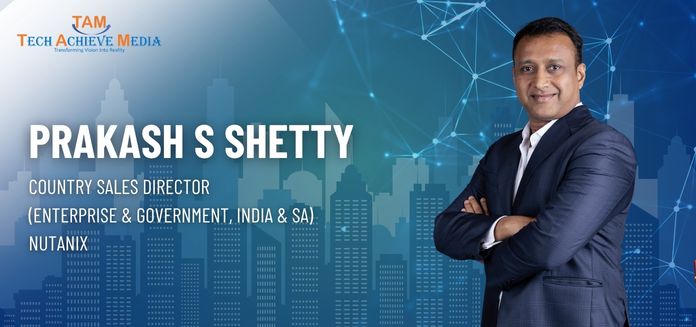
As enterprises race to embrace generative AI, most businesses are realizing that the real challenge lies in addressing the underlying fragmentation of data, outdated architecture, and deficiencies in governance. In an interview exclusively with Tech Achieve Media, Prakash S Shetty, Country Sales Director – Enterprise & Government, India & South Asia at Nutanix, discusses why organizations must create an integrated AI foundation before implementing AI programs, the dangers of “pilot-to-nowhere” syndrome and shadow AI, and why hybrid multicloud solutions are driving innovation for enterprises in India.
TAM: Everyone is talking about GenAI, but many organisations are still struggling with data silos and poor data quality. What is the “homework” enterprises need to complete before they can truly scale AI?
Prakash S Shetty: The conversation around GenAI has never been louder, but for most enterprises, the bottleneck isn’t the model. It’s the foundation beneath it. According to our ECI (Enterprise Cloud Index) report, 87% of global enterprises say AI is accelerating their adoption of containers for speed, reliability, and scalability. Yet, 85% of Indian organisations admit that organisational silos are actively slowing down technology execution.
Before enterprises can truly scale AI, three foundational shifts need to take place. First, they must break down data fragmentation, as most enterprises are still running across a patchwork of legacy systems, cloud platforms, and departmental data stores. For AI to work reliably, data needs to be contextual, governed, and continuously available, not locked in isolated pockets across the organisation; building a trusted, AI-ready data layer is the essential starting point.
Second, organisations need to modernise infrastructure for hybrid AI workloads, as our report found that 81% of organisations believe their current on-premises infrastructure isn’t fully ready for AI workloads, a gap that directly limits how far GenAI can scale in production environments.
Finally, it is crucial to establish unified governance across IT and business; as AI adoption becomes increasingly decentralised, without clear, consistent frameworks, organisations risk fragmented data usage, uncontrolled experimentation, and ultimately, AI that can’t be trusted at scale. Scaling AI is therefore not a tooling challenge but re-architecting the enterprise operating model, where data, infrastructure, and governance converge into a unified, AI-ready foundation.
TAM: In your conversations with customers, what is the biggest mistake organisations make when they rush into AI projects?
Prakash S Shetty: The biggest mistake we see is organisations treating AI as a point solution rather than a platform transformation. Most are jumping straight into GenAI pilots: chatbots, copilots, analytics assistants, without first fixing what’s underneath: fragmented data, unprepared hybrid infrastructure, and absent governance frameworks. The result is what we call “pilot-to-nowhere syndrome” – strong experimentation on paper, but almost no production-scale deployment in practice. The proof of concept works, the demo impresses, and then it stalls the moment you try to scale it enterprise-wide.
But there’s a second, more dangerous problem that follows: Shadow AI. When AI expands without central governance, you end up with duplicated tools, inconsistent security controls, and cost structures nobody can predict or explain. The ECI 2026 data makes this concrete as 73% of organisations in India report AI tools or agents being deployed entirely outside IT oversight, yet 96% of IT leaders believe this introduces significant business risk. That gap between what’s happening on the ground and what leadership believes is acceptable, that’s where the real exposure sits.
TAM: How important is having a unified data platform when it comes to delivering measurable AI outcomes?
Prakash S Shetty: A unified data platform is foundational; not optional when it comes to delivering measurable AI outcomes. Without it, AI systems tend to be inconsistent, hard to scale, and limited in their real business impact. AI performance is directly tied to the quality, accessibility, and governance of underlying data.
A well-designed data platform enables three outcomes. It ensures consistent access to trusted data across hybrid environments, it reduces operational complexity by eliminating duplication, and it strengthens governance by embedding policy and compliance controls directly into the data layer. In the AI era, the question is no longer where data resides, but how consistently and securely it can be accessed and leveraged across distributed environments to deliver reliable outcomes.
TAM: Many CIOs are facing a reality check on cloud spending. Has the conversation shifted from “cloud-first” to “cloud-smart”?
Prakash S Shetty: The conversation has clearly evolved from “cloud-first” to “cloud-smart.” While enterprises initially embraced the cloud to gain speed, scalability, and agility, many CIOs are now taking a more measured approach as they contend with rising cloud costs, increasing architectural complexity, and the operational challenges of managing distributed environments.
The emergence of AI is accelerating this shift. AI workloads require significant compute power, data movement, and infrastructure flexibility, making it increasingly important to determine the most efficient environment for each workload rather than defaulting everything to the public cloud. Ultimately, the question is no longer whether workloads belong in the cloud, but where they can run most effectively, securely, and cost-efficiently.
TAM: With India’s data protection regulations evolving rapidly, how are enterprises rethinking where their data and workloads should reside?
Prakash S Shetty: With increasing regulatory focus under the DPDP framework and sectoral guidelines, organisations are prioritising data sovereignty and local control of sensitive workloads. 82% of Indian enterprises prioritise data sovereignty, and 81% believe their current on-premises infrastructure is not fully ready for AI workloads. This dual pressure signals a shift for hybrid-first approach, pushing organisations toward dual-stack environments, one where sovereign infrastructure and cloud coexist under a unified governance layer.
This is driving the adoption of sovereign-aligned hybrid architectures, where sensitive data remains within governed environments while workloads can move dynamically across cloud and on-premises infrastructure based on policy, compliance, performance, and operational needs. By embedding governance, portability, and observability directly into the infrastructure layer, organisations can meet regulatory requirements without compromising the speed, scalability and innovation needed to scale AI initiatives.
TAM: Nutanix started by simplifying infrastructure. How is the company evolving its role in the AI era?
Prakash S Shetty: Nutanix was founded with a simple mission: to make infrastructure invisible by simplifying IT operations and enabling organisations to focus on innovation rather than complexity. In the AI era, that mission is evolving across three key dimensions. The best platform for AI: We ensure Nutanix is the optimal foundation for enterprises to run and scale AI workloads across hybrid environments. We are also empowering enterprises with the Nutanix Agentic AI solution, a secure, enterprise-grade software stack that allows these agents to run reliably in production.
Embedding intelligence: We are leveraging AI-powered assistants and automation to make our own products smarter, more autonomous, and easier to manage. Internal transformation: We are using AI internally to transform our engineering lifecycle, using it for bug triaging, design reviews, and testing to drive greater operational efficiency.
TAM: Where does Nutanix see its biggest opportunity in India over the next few years?
Prakash S Shetty: India represents one of Nutanix’s most strategic growth markets. We see our biggest opportunity at the intersection of hybrid multicloud infrastructure, AI adoption, and application modernisation.
As Indian enterprises accelerate their digital transformation journeys, they are increasingly looking for platforms that can simplify infrastructure while supporting the scale and complexity of modern workloads, particularly AI-driven applications. This creates a strong alignment with Nutanix’s core strengths in delivering a consistent operating model across hybrid environments.
Another important differentiator for India is its exceptional technology talent pool. The depth of software engineering talent in the country is accelerating innovation, enabling organisations to embrace modern application frameworks faster than in many global markets. Combined with India’s rapid digital transformation agenda and growing focus on AI-led innovation, we believe the country will continue to be a significant growth engine for us.
TAM: What differentiates Nutanix in a market where every infrastructure vendor is positioning itself as an AI platform company?
Prakash S Shetty: What differentiates Nutanix is that we view AI not as a standalone platform, but as the outcome of a modern, unified infrastructure foundation. While many vendors are positioning themselves as AI companies, enterprises continue to face challenges such as fragmented environments and data silos.
Nutanix’s differentiation is built on delivering a consistent operating model across on-premises, cloud, and edge, so AI workloads can run close to data without re-architecting for each environment. On top of that foundation, we embed governance and policy controls directly into the platform, which is critical for responsible and compliant AI adoption.
Finally, we focus on operational simplicity, using automation and intelligence to reduce the complexity of managing distributed infrastructure at scale.
Furthermore, we are actively enabling the rise of “neoclouds”, specialized, regional AI cloud providers, by providing the infrastructure foundation they need to deliver high-value AI services locally. Through innovations like our Agentic AI stack, we help enterprises operationalise AI with confidence and control.
TAM: If you had to give CIOs one piece of advice as they navigate AI, cloud and compliance simultaneously, what would it be?
Prakash S Shetty: If there’s one piece of advice for CIOs, it isDon’t treat AI, cloud, and compliance as separate transformation agendas. Instead, design a single, integrated operating model from the outset.
Many organisations are still approaching these in silos. The organisations seeing the greatest success are those building a unified hybrid infrastructure foundation that enables applications, data, and AI workloads to operate consistently across all environments under a common control and policy framework. CIOs should focus on a platform strategy that balances innovation with control, where resilience and compliance are built in by design, not treated as separate control layers.
TAM: Few years from now, what will separate organisations that successfully scaled AI from those that merely experimented with it?
Prakash S Shetty: The difference will come down to how fundamentally AI is integrated into the infrastructure and operating model. While most enterprises today operate in pilot-heavy environments, scaling AI requires moving from isolated use cases to enterprise-wide, production-grade execution frameworks.
As agentic AI systems mature, specifically through frameworks like the Nutanix Agentic AI solution, organisations will increasingly rely on them not just for insights, but for the autonomous execution of workflows and operational optimisation. Ultimately, what will separate leaders from experimenters is not the sophistication of their models, but the strength of their foundation, secure, portable, policy-driven infrastructure combined with a clear operating model that allows AI to run continuously in production and deliver measurable business outcomes.