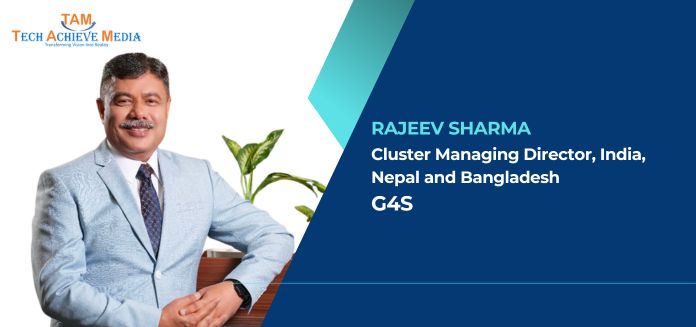
The role of private security is undergoing a fundamental transformation. As organisations contend with increasingly interconnected physical and digital risks, security has become a strategic function that supports business continuity, operational resilience and informed decision-making. Advances in artificial intelligence, analytics, remote monitoring and integrated command centres are reshaping how enterprises anticipate and respond to threats. In this interview with Tech Achieve Media, Rajeev Sharma, Cluster Managing Director, India, Nepal and Bangladesh, G4S, discusses how the company is combining technology with human expertise, the evolving expectations of clients, the future of India’s private security ecosystem, and the leadership principles driving transformation across the region.
TAM: The security industry is evolving rapidly with the adoption of AI, analytics and automation. How is G4S integrating smart technologies into its security solutions, and what impact are you seeing on client outcomes?
Rajeev Sharma: The security industry is rapidly moving towards predictive and intelligence-led risk management, driven by AI, analytics, and automation. Clients today expect greater visibility, faster response, and integrated security solutions that support operational continuity rather than simply responding to incidents. At G4S, we are integrating AI-enabled surveillance, IoT-based monitoring, analytics, remote monitoring centres, and command centre capabilities to strengthen situational awareness and identify risks at an early stage. We believe technology delivers the greatest value when it enhances the capabilities of trained security professionals. By combining human expertise with intelligent technologies, we help clients improve operational visibility, optimise resource deployment, strengthen response capabilities, and build more resilient security environments.
TAM: As businesses face increasingly complex physical and cyber-related threats, how has the definition of security changed over the last decade, and what are clients demanding today that they weren’t asking for before?
Rajeev Sharma: Security has evolved from being a reactive, manpower-led function to one that is intelligence-led, integrated, and technology-enabled. As businesses become more connected, physical and digital risks are increasingly converging, making security a strategic business enabler rather than just an operational requirement. Today, clients are looking beyond traditional guarding services. They expect integrated solutions that provide real-time visibility, predictive risk management, digital reporting, and faster decision-making. The focus has shifted from simply protecting assets to enabling operational continuity, strengthening business resilience, and proactively managing evolving risks through a combination of trained manpower and technology.
TAM: India’s economy is expanding across diverse sectors. What emerging security challenges do these industries present, and how is G4S positioning itself to address them?
Rajeev Sharma: India’s rapid growth across infrastructure, manufacturing, logistics, aviation, BFSI, healthcare, and critical infrastructure is creating increasingly complex security requirements. Larger operational footprints, greater movement of people and assets, and rising digital adoption require security solutions that are scalable, integrated, and proactive. Our approach is centred on a “phygital” model that combines trained security professionals with AI-enabled surveillance, remote monitoring, analytics, access control, and command centre capabilities. By integrating technology with human expertise, we help organisations strengthen operational resilience, improve response capabilities, and manage risks more effectively while supporting business continuity across diverse sectors.
TAM: With a workforce-driven business model, talent remains central to security services. How is G4S investing in workforce training, upskilling and technology enablement to prepare security professionals for the future?
Rajeev Sharma: People continue to remain at the heart of the security industry, and as technology becomes more integral to security delivery, continuous learning and workforce professionalisation have become essential. Today’s security professionals need to combine operational expertise with the ability to work confidently alongside advanced technologies. We continue to invest in workforce training, operational standardisation, and technology enablement across our operations. Our personnel are trained not only in core security operations but also in surveillance systems, digital reporting tools, compliance protocols, and incident management. By combining skilled manpower with technology, we are building a future-ready workforce capable of delivering higher service standards and addressing evolving security challenges.
TAM: As Chair of the FICCI Private Security Committee, what policy and regulatory changes do you believe are necessary to strengthen India’s private security ecosystem and elevate industry standards?
Rajeev Sharma: India’s private security industry has an increasingly important role to play in supporting public safety, business continuity, and critical infrastructure. As the sector continues to evolve, strengthening professionalism and building greater trust across the ecosystem will be critical. A stronger focus on the effective implementation of PSARA, labour compliance, and workforce professionalisation can help create a more transparent and credible industry. Continued investment in skill development, adoption of best practices, and closer collaboration between industry, government, and regulatory bodies will further strengthen service standards. As an industry, we must collectively move the conversation from cost-driven security to value-driven security that supports long-term resilience. The government should classify private security industry under essential services as it is similar to all other essential servies like police, CRPF, BSF etc.
TAM: Looking ahead, what is your vision for G4S in India, Nepal and Bangladesh over the next five years, and what role do innovation, partnerships and operational excellence play in achieving that vision?
Rajeev Sharma: Our vision is to further strengthen G4S’s position as a leading integrated security solutions provider across India, Nepal, and Bangladesh. As businesses continue to evolve, security must become more intelligent, connected, and proactive. Over the next five years, we will continue to invest in AI-enabled surveillance, remote monitoring, command centres, digital workforce platforms, and integrated risk management capabilities. At the same time, strengthening client partnerships, maintaining operational excellence, and continuing to invest in our people will remain central to our growth strategy. By combining innovation with execution, we aim to deliver scalable, technology-enabled security solutions that help clients operate with greater confidence and resilience.
TAM: You have led business transformation, M&A initiatives and large-scale operations across multiple markets. What leadership lessons have been most valuable in navigating change and driving growth in a dynamic industry like security services?
Rajeev Sharma: One of the biggest leadership lessons has been that transformation is as much about people as it is about strategy. In a rapidly evolving industry, organisations must remain adaptable, embrace continuous learning, and stay focused on long-term value creation. We believe in empowering teams, encouraging collaboration, and fostering a culture of accountability and innovation. While technology continues to reshape the security industry, sustainable growth is driven by people who are aligned with a shared purpose and committed to delivering excellence. By combining operational discipline with a willingness to embrace change, organisations are better positioned to navigate disruption and create lasting value for their clients.