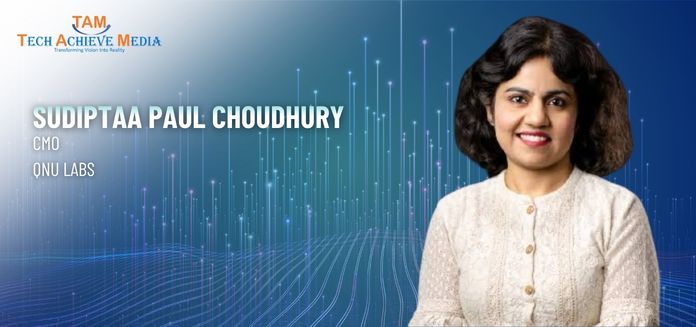
India is emerging as a significant force in the global quantum-security landscape, with enterprises and policymakers increasingly focusing on the transition towards quantum-safe infrastructure. As the threat of “harvest now, decrypt later” attacks gains attention, organisations are also evaluating the role of Post-Quantum Cryptography (PQC), Quantum Key Distribution (QKD) and hybrid security approaches. In an exclusive interaction with Tech Achieve Media, Sudiptaa Paul Choudhury, CMO, QNu Labs, discusses India’s growing role in quantum security, the challenges around enterprise adoption, and why organisations need to move from awareness to action.
TAM: Quantum security is still a relatively new category for many enterprises. How are you educating CXOs about the urgency of becoming quantum-safe today?
Sudiptaa Paul Choudhury: As a Chief Marketing Officer, I first try to understand the signals we are receiving from CXOs, how they consume information through the media and public sources, what they search for when conducting vendor research, what their key pain points are, and what they expect from a trusted partner like us. One of the fundamental areas we focus on is thought leadership. QNu Labs has established its presence not only in India but globally, and the depth and breadth of our quantum-safe portfolio have helped strengthen the brand.
We also see a growing number of organic leads coming through our website from organisations looking for partnerships and solutions to specific challenges. These enquiries come from sectors such as healthcare, banking and other critical industries, where organisations are looking to work with us to address quantum-security challenges. Our approach is to focus on issues that matter to CXOs. We publish sector-specific thought leadership reports, including threat intelligence reports for BFSI, government and PSUs, telecom, pharma and retail. We also examine emerging threats, including the potential impact of agentic AI, and discuss how organisations can prepare for them. We also engage extensively with the wider industry ecosystem. CXOs may be aware of the issue, but they may still be waiting for governments or regulators to establish specific mechanisms or deadlines before taking action.
This is why we work with initiatives such as the National Quantum Mission and the Department of Science and Technology, while also engaging with international standards and regulatory ecosystems, including NIST and regulatory bodies in Europe and Singapore. The larger challenge is that data has been silently collected for many years, and the threat is not limited to the future. Data stolen today could potentially be decrypted when sufficiently capable quantum computers become available.
We therefore also need to engage with traditional cybersecurity forums, where many CXOs are still focused on technologies such as RSA. There is often confusion between cybersecurity, quantum computing and quantum security. Quantum security is a specialised area within cybersecurity, and because it involves deep technology and research-heavy concepts, the subject can sometimes be difficult for CXOs to translate into business priorities. That is why we participate in platforms such as RSA events and quantum conferences, as well as organise roundtables in markets including Thailand and Malaysia. These forums help us understand regional requirements and bring together governments, policymakers, enterprises and technology providers.
We also work through partner conferences, podcasts and international partnerships. Our participation in QKD testbed programmes and research around photonics and QKD is another part of this ecosystem-building approach. Ultimately, it is about education and bringing the ecosystem together. Industry discussions, podcasts, media engagement and social media all play a role in keeping quantum security on the CXO agenda.
TAM: Data harvesting and the “harvest now, decrypt later” threat are already driving greater urgency around quantum security. How aware are enterprises of this threat, and what is still preventing faster adoption?
Sudiptaa Paul Choudhury: When I started my journey with QNu Labs, the market was largely listening but not taking action. This year, however, we have seen a significant change, primarily because governments and regulatory bodies in different countries are increasingly emphasising the need for quantum-secure migration plans and the transition towards post-quantum cryptography (PQC). Organisations such as the World Economic Forum and Quantum Insider have also played an important role in creating awareness. The World Economic Forum, for instance, started discussing quantum cybersecurity several years ago, and QNu Labs was featured in one of its financial reports through a case study.
However, adoption continues to be a challenge. Today, less than 5% of enterprises globally have a quantum-secure migration plan, based on the statistics we track. There is also a clear mismatch between the boardroom and the CISO. In our Quantum Risk Readiness research involving around 300 people globally, we found that in more than 58% of cases, the boardroom and CISO are not aligned on quantum risk. In more than 47% of cases, organisations do not have a dedicated budget or a specific team to address the issue.
The challenge is therefore not simply awareness. Many organisations understand what quantum computing and quantum cybersecurity are, but they do not know what to do next. They need clarity around the security risk register, governance framework, technology choices and how to initiate a pilot. Awareness has improved, but there is still considerable confusion between quantum computing and quantum security. Even in the media, quantum security companies can sometimes be categorised under quantum computing, which adds to the confusion among enterprise decision-makers. This is why continuous education is important. We have a monthly newsletter, while I personally write a Quantum + AI newsletter every fortnight. We also share reports, blogs and podcasts with our ecosystem to provide a concise view of the latest developments.
The urgency is increasing. Several industry and technology organisations have discussed 2029 as a potential timeframe for significant quantum-related risks. For enterprises, it is already the end of 2026, leaving limited time to prepare. Organisations that start now can prioritise their most critical data and systems and gradually transition them towards quantum-safe protection. Those that continue to wait could face challenges around compliance, customer-data protection, intellectual property and trade secrets. The objective is not to create fear, but to recognise the realities of the threat and encourage organisations to begin preparing.
TAM: QNu Labs operates across Quantum Key Distribution (QKD) and Post-Quantum Cryptography (PQC). How are you positioning these technologies within the broader enterprise resilience conversation?
Sudiptaa Paul Choudhury: One of the key themes of our anniversary was that digital trust is currently under severe stress. The “harvest now, decrypt later” threat has existed for some time, while agentic AI is also accelerating cyberattacks, making them potentially more economical and faster to execute. Without appropriate governance, clearly defined rules and access controls, organisations can find themselves exposed to new risks.
Our philosophy is that organisations should not become trapped by technology or become slaves to it. Technology needs to be used intelligently and responsibly. In this environment, our focus is on educating enterprises about the different components of quantum-safe security while demonstrating practical deployment use cases. We have worked across defence, government and banking, and are also collaborating extensively with academia. We have signed more than seven MOUs with academic institutions and are working with hardware manufacturers and other technology companies to help integrate quantum-safe capabilities into their environments.
The key question for enterprises is often not whether the technology exists, but how it can be applied. Demonstrating real-world use cases helps organisations understand what is possible and gives them the confidence to initiate pilots.
TAM: India has emerged as a significant player in quantum security, including QNu Labs’ work on a 1,000-kilometre quantum-secure network. How do you see India’s position globally, and how does enterprise awareness compare across geographies?
Sudiptaa Paul Choudhury: India’s position in quantum security is increasingly significant. The National Quantum Mission has played an important role in accelerating the country’s quantum ecosystem, and QNu Labs has been involved in several projects in this space. Interestingly, while technology adoption traditionally involves looking towards the West and then following those developments, India is showing leadership in quantum security. One of the things that stands out globally is the idea of a hybrid quantum-safe approach and an end-to-end, full-stack solution.
Many organisations globally offer point solutions. For an enterprise, however, deploying multiple point solutions can result in significant costs and create integration challenges. Large enterprises operate across countries, departments, employees and multiple technology environments, making it difficult to manage everything independently. Our approach is not to disrupt an organisation’s existing infrastructure or necessarily increase its technology budget. Instead, we first identify the organisation’s critical data, understand where that data and communication reside, and assess the severity of the associated risks.
Based on that assessment, we prioritise the most urgent areas and introduce a security layer over the existing infrastructure. Whether the organisation already has software, network security, hardware security, IoT or endpoint infrastructure, the objective is to add quantum-safe protection without requiring a complete replacement of the existing environment. This can help organisations transition from traditional security to quantum-safe security in a more efficient and cost-effective manner.
From a global perspective, Europe, the UK, France, Sweden and Germany are among the countries taking a proactive approach to quantum-safe security. Governments are establishing testbeds and bringing global technology players together to demonstrate interoperability and compliance. Singapore is also making progress, while India remains at the forefront. I would place India among the top two or three countries in terms of quantum-security progress.
Europe is particularly focused on a hybrid approach involving both QKD and PQC. In the US, the emphasis has largely been on PQC, although there continues to be research and debate around the role of QKD. The Middle East is also developing its own sovereign approach, with countries such as Saudi Arabia making significant progress. Japan has its own quantum-safe initiatives, while countries such as South Korea are also emerging as important players. Globally, I would say there are only around 10 to 12 countries that are currently at the forefront of quantum security.
TAM: As QNu Labs completes its first decade, what is the company’s vision for the next decade?
Sudiptaa Paul Choudhury: Vision is extremely important, but so is believing in that vision and bringing the right people into the team. For the next decade, our vision is centred around sensing, AI and quantum security coming together as one intelligent, sovereign fabric for the nation. We have already launched QShield 2.0 as part of this journey. We believe there are many more opportunities ahead, particularly as India and the government continue to build capabilities in this space. Karnataka, as one of India’s leading startup ecosystems, is also looking at ways to collaborate with companies such as QNu Labs.
The opportunity is significant, but we also need to remain focused. We cannot work on everything. Our objective is to identify the sectors where our capabilities can create the greatest impact and align our focused approach with those opportunities. The next decade will therefore be even more interesting and fascinating for QNu Labs, and we look forward to contributing to India’s quantum-security journey while expanding our global presence.