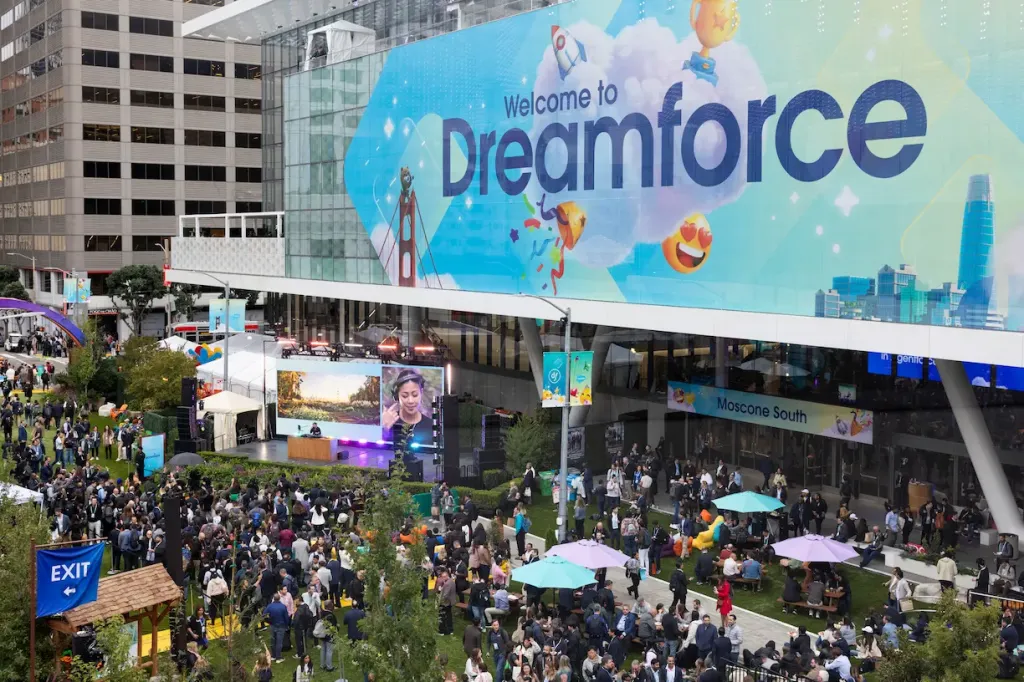
Salesforce is pushing enterprise software into a new phase where AI agents can access business data, workflows and logic beyond the traditional application interface, as the company unveiled a broader vision for AI-powered enterprise experiences at Dreamforce 2026. The company’s latest announcements centre on AIforce, a new interface layer designed to bring the Salesforce platform to different AI interfaces, alongside expanded capabilities across Agentforce, Data 360, Slack and the company’s partnerships with AI providers. Salesforce said AIforce is designed to allow agents to reason and take action across the data, workflows, business logic, permissions, security and governance already embedded within Salesforce. The approach is aimed at allowing organisations to use existing enterprise context rather than rebuilding their systems for every new AI experience.
Speaking to the media on the sidelines of Dreamforce, Patrick Stokes, President, Applications and Marketing, Salesforce, said the shift towards AI is changing the way software itself needs to be experienced: “This is an incredible moment. AI is not only right in front of us; it is changing the way we think about software. For decades, we have interacted with software through fixed interfaces and buttons. What we are seeing now is a move towards experiences that can understand context and help people accomplish what they need.” Stokes pointed to the broader shift from traditional application interfaces towards more dynamic, AI-driven experiences, where users may no longer need to navigate through multiple screens to accomplish a task.
From applications to capabilities
A key theme emerging from Salesforce’s announcements is the move from enterprise applications as destinations to enterprise capabilities that can be accessed wherever work takes place. Salesforce has been expanding Headless 360, its architecture for making Salesforce capabilities available to authorised AI agents and other applications through technologies including APIs, Model Context Protocol (MCP) servers, skills and developer tools.
The company is now extending that approach through AIforce, which Salesforce says will initially include Claudeforce, Slackforce and Agentforce Coworker. “We’re excited to introduce AIforce. AIforce is a set of capabilities, which you’ll see in a little more detail shortly, designed to help our customers break free from a shared user interface, where everyone is essentially using the same interface, and move towards a world where every individual in an organisation can have their own intelligent, dynamic interface. This is built on the foundation of security and trust that Salesforce brings to everything. Ultimately, it is the collaboration between humans and AI that makes this possible. We will see this come to life across three surfaces initially, with more to come as we move beyond Dreamforce,” said Stokes.
The development also reflects Salesforce’s expanded relationship with Anthropic. Under Claudeforce, Salesforce is bringing its enterprise data, workflows, business logic and governance into Claude through a prebuilt MCP server. Salesforce said the offering is available to customers in beta and includes prebuilt sales skills, with additional capabilities planned across areas such as analytics, service, marketing and commerce.
Breaking down enterprise silos
For enterprises, however, the challenge is not simply deploying another AI tool. It is enabling AI systems to work across fragmented data, applications and workflows without compromising governance. Scott White, Product Leadership, Anthropic, highlighted how AI can increasingly work across information that traditionally remains distributed across different enterprise systems: “Work is shifting from people clicking through software to agents actually doing work alongside people. For an agent to do that well and be highly capable, it needs two things. First, it needs to understand your business, and second, it needs to be able to take action and get things done. Salesforce and Claude are bringing both of these capabilities to the enterprise. As a product manager, I can now use Salesforce data to understand what customers are asking for and make decisions about what we should build. That was previously out of reach for me in my role. Now, with agents breaking down those silos across Salesforce and Claude, I can do that.” This could allow employees to spend less time searching across systems and more time acting on information, particularly in roles where decisions depend on multiple sources of enterprise data.
He further added: “For Anthropic, Claudeforce builds on what we have done together in the past with Slack. The goal is to enable people to do real work with Claude using the data and tools their companies already have. For example, a seller can now ask Claude for an update across their deals. Claude can look across their accounts, opportunities, emails, call transcripts, meetings and other business data, including information that may reside in Slack, and provide a summary. It can then also enable the seller to take action on that information.”
He further highlighted the importance of control: “As we ask AI to do more and more for us, trust and control become increasingly important, particularly in regulated industries. On the Salesforce side, Claude only sees what the individual is authorised to see. Users authenticate with their credentials, and Claude only has access to the data they are permitted to access. Every action flows through Salesforce, so access roles and record-level permissions are applied every time. Trust is ultimately what enables companies to move from AI simply answering questions to actually doing some of the company’s most meaningful work. We are very excited about bringing together the power of enterprise platforms with the governance layers that we provide. Looking ahead, I think we will see agents that can take abstract business goals, break them down into work across a variety of systems, and start accomplishing higher-order business objectives.”
Building AI with enterprise context
Salesforce is also placing significant emphasis on the underlying reasoning and data layer required for enterprise AI. The company has announced Koa, described as its first CRM reasoning model, built on NVIDIA Nemotron. Rohan Kumar, President and Chief Platform and Engineering Officer, Salesforce, said: “Built on NVIDIA Nemotron, this model brings together 27 years of Salesforce’s product development and innovation in CRM with years of research. We believe it can be a game-changer for complex agents performing multi-step tasks. For example, a sales agent can use it to determine the next best step towards closing a deal, while a customer service agent can identify the next best action to address a complex customer challenge and improve satisfaction. We also use the model internally at Salesforce for employee engagement, and it is already proving highly valuable. What is particularly important is our commitment to customer trust. Not a single byte of customer data was used to train this model.”
Salesforce says Koa is designed specifically for CRM-related reasoning and tasks rather than serving as a general-purpose model. “As enterprises transition to an agentic model, the focus is not limited to how individual roles change. The bigger shift is towards a digital workforce of agents that can understand business goals, orchestrate work across systems and help employees accomplish higher-order objectives,” added Kumar.
He further stated: “That requires an enterprise AI harness, one that combines an understanding of the business with data, context, business semantics, security and governance. Models may be highly intelligent and have extensive knowledge of the world, but they do not inherently understand an individual company’s customers, employees, products, interactions, business processes or history. This is where Salesforce’s platform capabilities come together. Informatica helps make data ready for AI; Data 360 helps create enterprise context; Tableau provides shared business semantics; Salesforce Guardian helps secure AI through capabilities including agent identity and data security; and MuleSoft with Agent Fabric helps organisations manage, connect and govern their AI assets.”
Kumar added that these capabilities form the foundation of an enterprise AI harness: “Our vision is to simplify this further through a universal, single composable platform and an AI control plane that helps organisations discover, connect, govern and manage their agents while ensuring they derive measurable business value from them.”