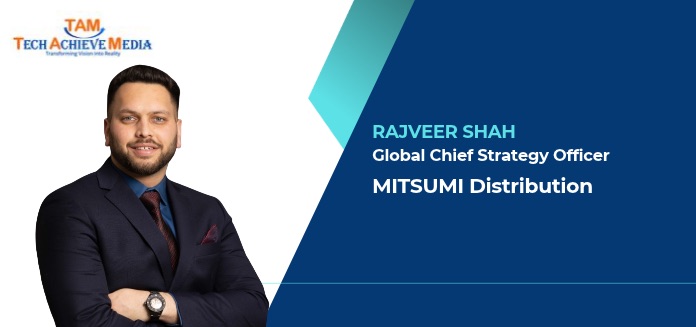
As the IT distribution industry moves beyond transactional fulfilment towards services-led models, distributors are increasingly expected to deliver strategic value through partner enablement, technology expertise and supply chain resilience. In this interview with Tech Achieve Media, Rajveer Shah, Global Chief Strategy Officer, MITSUMI Distribution, discusses the company’s evolving strategy, its plans for the Indian market, the growing convergence of cloud, AI and cybersecurity, and the global trends shaping the future of IT distribution. He also shares his perspective on partner readiness, festive-season demand and building resilient supply chains amid changing geopolitical and regulatory dynamics.
TAM: With the IT channel moving from transactional fulfillment to services-led models, how is MITSUMI redefining its core strengths to stay ahead of the competition globally and across India?
Rajveer Shah: The move from transactional fulfillment to services-led models is changing what partners expect from a distributor. On-time delivery is now taken as a given. Partners look for a distributor that helps them sell, deploy and support complete solutions.
Our response starts with what we already have. The first strength is our track record. We have spent decades as a value-added distributor across the Middle East and Africa, and that experience taught us how partners really work, what they struggle with and where a distributor can make a difference. The second strength is local presence. As projects grow more complex, partners value having people nearby who understand local conditions and can respond without delay. The third is a portfolio that keeps pace with demand, built around what the market needs and not around what is easiest to stock.
Also read: Why Value-Added Distribution Will Be Critical to Enterprise AI Adoption
In India, the services-led shift is a direction we are moving in, and I would not call it finished. We entered this year and we are still learning the market. We would rather show progress than announce it early.
TAM: Enterprises now view cloud, AI, and cybersecurity as an interconnected priority rather than standalone purchases. How is MITSUMI helping partners bridge skill gaps to capture these complex market segments?
Rajveer Shah: Cloud, AI and cybersecurity are now discussed together, and I agree with that approach. A customer who asks about AI soon raises questions about where the data resides, how it is protected and what it costs to run. A partner with expertise in only one of those areas will find the conversation difficult.
Closing the skill gap is a priority for us. In India we are at the planning stage and have no program to point to yet. Our approach begins with the partner. We want to understand where each partner is strong, where support is needed and which opportunities already exist within its own customer base. That allows us to focus on what matters most to each one, rather than offering the same training to everyone.
Distributors can also help by bringing the pieces together. Many partners specialize in a single area. If we can connect them with the right technology and the right expertise for the rest, they are able to take on projects they would otherwise decline. We intend to build that support step by step, with partner feedback deciding the order.
TAM: Modern channel partners expect strategic business enablement rather than just logistics and credit. What structured frameworks has MITSUMI introduced to accelerate local partner readiness and growth?
Rajveer Shah: Our structured approach to partner enablement in India is still taking shape, and we are building it with care. What I can share at this stage are the principles that will guide it. The first is readiness. Before taking on a new technology, partners should know what it requires, what a customer will ask and where support is available. The second is specialization. Partners perform better when they build depth in a few areas than when they spread themselves across many, so we will help them choose. The third is growth: a clear path from a partner’s current position to a larger, higher-value business, with milestones they can recognize.
We intend to design this together with partners and not present it to them finished. A framework that partners helped shape is one they will actually use. We are holding early conversations with partners, and these are setting our priorities. The approach is being finalized with that input.
TAM: As MITSUMI expands its footprint in India beyond metro hubs, how significantly does the festive season influence technology demand, and how are you gearing up the local team to support it?
Rajveer Shah: The festive season is currently under way in India and is a significant period for technology demand. As this is our first festive season in the market, we are working closely with our partners and drawing lessons from it as it progresses. Any view I offer is therefore a general one and does not draw on past results.
My view is that demand begins to rise well before Diwali. Businesses tend to refresh their equipment during this period and commit the budgets they have left for the year, while consumer purchases rise as retail promotions gather pace. Partners feel this first, because customers who want to buy quickly approach them directly. When stock is short or responses are slow, the sale is lost.
This shapes how we are preparing. Our local team is focused on stock readiness, so that partners can obtain what they need when they need it. We are also working on faster response times and on closer support for partners in smaller cities, where the pressure of the festive period can weigh most heavily on a small business. As this is our first season, we are observing closely and listening to partners. What we learn this year will shape our planning for the next.
TAM: What is your ultimate long-term vision for MITSUMI, and what major global trends will dictate the future of IT distribution?
Rajveer Shah: Looking further ahead, my aim is for Mitsumi to be a trusted, value-added distributor in every region we serve, with India as a large and growing part of that picture. Trust builds slowly in this business, and I would like us to be known for reliability and for helping partners grow.
In my view, four trends will shape distribution in the years ahead. First, AI is changing how technology is purchased. Customers are asking for outcomes and solutions, not only components, and that changes what partners need from a distributor. Second, services will overtake products in value. The product still matters, but the margin and the long-term relationship will increasingly sit with the services around it. Third, data and compliance requirements will influence where and how technology is delivered, and distributors will need to understand them thoroughly. Fourth, I expect vendors and distributors to form fewer but deeper partnerships, built on shared plans instead of one-off transactions.
Distributors that adapt to these changes will have more to offer. Those that remain purely transactional will find their role harder to defend.
TAM: Geopolitical shifts and localized compliance mandates are rewriting global trade and logistics. How are technology leaders structurally future-proofing their supply chains against sudden market shocks?
Rajveer Shah: Supply chains have experienced significant changes in recent years, making resilience and adaptability important priorities for technology leaders. At Mitsumi, our approach focuses on four key practices to ensure business continuity and strengthen support for our partners.
First, we diversify our sourcing to reduce dependence on any single supplier or route. Second, we maintain regional inventory closer to our partners, enabling faster deliveries and greater flexibility in managing shipment delays. Third, we focus on improving demand visibility, allowing us to anticipate changes and respond proactively. Finally, we maintain strong relationships with our vendors to ensure timely communication, better coordination and quicker resolution of potential challenges. These practices help us build a more resilient and responsive supply chain, minimise disruptions and ensure consistent support for our partners, even during changing market conditions.