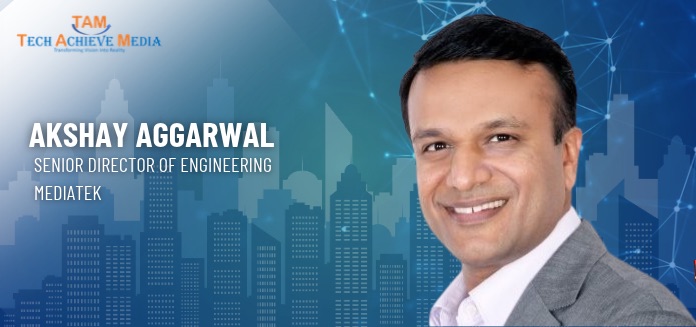
As the telecom industry prepares for the transition from 5G Standalone (SA) to 6G, the focus is shifting towards AI-native networks, energy-efficient computing and ubiquitous connectivity. The next generation of wireless technology is expected to support emerging applications, including agentic AI, integrated sensing and communication, and satellite-terrestrial network integration. However, realising this vision will require advances in chipset architecture, network design and collaboration across the global technology ecosystem. At the India Mobile Congress (IMC) 2026, Tech Achieve Media spoke with Akshay Aggarwal, Senior Director of Engineering at MediaTek, about the company’s approach to AI-enabled modem design, the architectural priorities for 6G, and the role of chipset innovation in balancing computing performance with power efficiency. He also discussed MediaTek’s research initiatives, its engagement with India’s academic and telecom ecosystem, and why identifying compelling real-world use cases will be critical to 6G adoption.
TAM: AI is evolving from a software capability into a foundational requirement for next-generation computing and connectivity. How is MediaTek architecting its upcoming modem designs to natively support AI and machine learning functions?
Akshay Aggarwal: We are making our modems smarter by integrating AI capabilities into both the modem and the mobile device. As agentic AI evolves, we want devices to perform as many AI functions locally as possible. This can help reduce latency and improve responsiveness.
However, not every task can be executed on a single device because of computing and resource constraints. In such cases, we can explore a distributed computing approach through what we call a device cloud, where nearby devices can share computing resources. For instance, if one device has a demanding computing task and another nearby device has available capacity, resources could be shared to execute that task. Tasks can also be offloaded to nearby edge infrastructure. Our approach is to make AI more accessible across the ecosystem by distributing workloads intelligently between devices, edge infrastructure and the cloud, depending on the requirements of each application.
TAM: You mentioned edge computing and cloud offloading. How does MediaTek view the distinction between the two, particularly when balancing latency, computing requirements and energy efficiency?
Akshay Aggarwal: The key consideration is latency sensitivity. Applications that require immediate responses should be processed as close to the device as possible, either on the device itself or at the edge. Applications that are computationally intensive but can tolerate some delay can be offloaded to a remote cloud. Consider an autonomous vehicle. Decisions that affect vehicle control must be made with minimal latency because even a split-second delay can have serious consequences. Such processing needs to happen locally or at the edge. In contrast, processing a large video file may tolerate a delay of a few seconds, making remote cloud computing a viable option. The objective is to strike the right balance between computing requirements, energy consumption and latency. Workloads should be allocated according to the needs of the application rather than relying on a single computing model.
TAM: The industry is working towards a transition from 5G to 5G Standalone and eventually 6G. What architectural challenges must be addressed in 5G deployments, and what lessons should inform the development of 6G?
Akshay Aggarwal: One important lesson from the 5G rollout is the need for greater clarity in network architecture and deployment strategies. The coexistence of Non-Standalone (NSA) and Standalone (SA) deployments created different implementation pathways for operators. Moving towards Standalone architecture is important to unlock the full capabilities of 5G and establish a stronger foundation for future networks.
For 6G, AI must be incorporated into the architecture from the outset. Energy efficiency must also be a fundamental design priority rather than an afterthought. Another critical requirement is ubiquitous connectivity. Today, connectivity largely depends on terrestrial networks. Integrating satellite and terrestrial infrastructure can help create a more comprehensive connectivity ecosystem, extending coverage beyond the limitations of conventional mobile networks. These priorities, including an AI-native architecture, energy efficiency and the integration of terrestrial and non-terrestrial networks, will be central to the development of 6G.
Also read: Dimensity 9600 Unveiled at MediaTek Tech Day
TAM: With 6G expected to enable advanced applications such as holographic communication and more sophisticated AI experiences, computing demands on smartphones will increase. How will MediaTek balance these requirements with the thermal, battery and form-factor constraints of mobile devices?
Akshay Aggarwal: We are looking at this challenge from several perspectives. First, access to advanced semiconductor process technologies is important. We work with leading foundries, including TSMC, to leverage advanced manufacturing capabilities. Second, our architectures must be optimised for power, performance and area, commonly referred to as PPA. The objective is to deliver high performance with minimal power consumption while keeping the silicon footprint as small as possible.
Sustainability is another important consideration. We also need to bring AI intelligence onto the device so that latency-sensitive applications can be processed locally, reducing unnecessary dependence on remote computing infrastructure. Finally, the development of 6G standards will play a significant role in determining the technology’s overall efficiency. MediaTek actively contributes to 3GPP, the international standards organisation responsible for developing mobile telecommunications standards. We are contributing to ongoing discussions and research to help ensure that 6G delivers the required performance while remaining power-efficient.
TAM: MediaTek is contributing to the development of 6G standards. What specific research areas are receiving attention, and how does the company translate its research into potential standards and deployments?
Akshay Aggarwal: Our standardisation proposals are supported by research, experimentation and collaboration with the broader ecosystem. One important area is the integration of terrestrial and non-terrestrial networks. We have researched how handovers should work between satellites and terrestrial mobile towers. We have collaborated with research partners in India and Europe and conducted trials to evaluate these approaches. The findings help inform our contributions to standards development. Another area is integrated sensing and communication, where communication networks can also sense aspects of their surrounding environment and use that information to support appropriate actions.
Edge computing is another focus area. We are exploring how computing resources can be distributed closer to users and applications to improve responsiveness and efficiency. We have also demonstrated relevant technologies with partners, including at events in Barcelona. Across these research areas, our approach is to work with partners and take the wider ecosystem along with us. This helps ensure that the technologies we develop are relevant to industry requirements and can be considered for broader adoption.
TAM: As global 6G research progresses, what opportunities do you see for deeper collaboration between MediaTek, Indian research institutions and the country’s wider technology ecosystem?
Akshay Aggarwal: India has significant potential to contribute to 6G research and development. We work closely with organisations such as the Telecommunications Standards Development Society, India (TSDSI), as well as academic institutions. Our engagement with academia involves discussions with professors and researchers to identify areas of mutual interest. We then explore the possibility of developing proofs of concept. Once a prototype has been developed, it can potentially be presented to the Indian government for further evaluation and testing, particularly where the technology could have applications in India as well as globally.
We also support university research and engage with PhD students through mentorship and collaborative initiatives. Academia is at the heart of innovation, and it is important to involve researchers and students in the development of future technologies. Telecom operators are equally important partners because they will ultimately deploy the infrastructure required to make 5G and 6G services commercially viable. Collaboration across academia, industry, standards bodies, government and operators will be essential to advancing the ecosystem.
TAM: Chipset innovation will be central to the performance of 6G devices and networks. Beyond advances in semiconductor manufacturing, what role will chipset architecture and software integration play in enabling the next generation of connectivity?
Akshay Aggarwal: Power, performance and area will remain critical considerations in chipset design. Power consumption must be minimised without compromising performance, while the silicon footprint must remain compact despite the increasing amount of computing capability being integrated into a chip. However, a chipset is not just about hardware. Hardware and software must work together efficiently to deliver the intended performance. At MediaTek, we focus on providing an integrated platform in which hardware and software are developed to work in concert.
Another important consideration is the relationship between AI and 6G. Networks need to be designed to support AI-driven applications, while AI can also help make networks more efficient and capable. Chipsets will play a valuable role in enabling this interaction through efficient processing, connectivity and platform-level optimisation.
TAM: Beyond the technical specifications, what do you see as the most compelling use case for 6G? What will make the technology valuable enough to drive widespread adoption?
Akshay Aggarwal: This is an important question because technological progress alone is not enough. We can move from 6G to 7G, 8G or even 10G, but the real question is what practical problems these technologies solve. When we moved from 3G to 4G, mobile internet browsing improved significantly. The transition from 4G to 5G brought further improvements, but the benefits were incremental for some users and applications. As a result, 5G adoption and the perceived value of the technology have not always matched the expectations associated with its launch.
For 6G, agentic AI could become a major use case. The industry needs to identify applications across enterprises, businesses and consumers where AI can deliver tangible benefits and where 6G connectivity can make those applications more effective. Ultimately, identifying these use cases will be essential to demonstrating the value of 6G and driving its deployment.