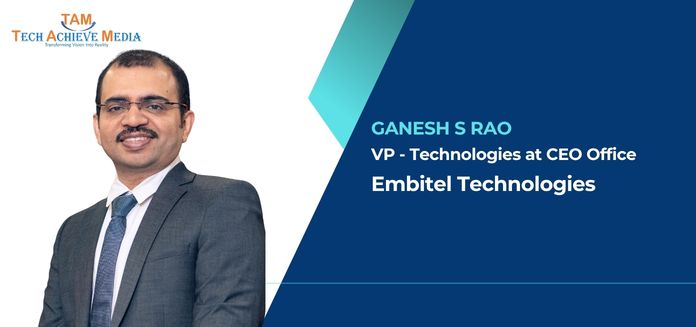
The automotive industry is entering a fundamental shift as software-defined vehicles (SDVs), AI and connected technologies reshape how vehicles are designed, engineered, tested and continuously improved. The transition is extending the vehicle lifecycle beyond the traditional start-of-production milestone, while placing greater emphasis on software, data, cybersecurity and continuous updates. At the same time, AI is moving beyond experimentation into areas such as ADAS, predictive maintenance, cybersecurity and engineering productivity. In this conversation with Tech Achieve Media, Ganesh S Rao, VP – Technologies at CEO Office, Embitel Technologies, discusses how the SDV transition is changing automotive engineering, the growing role of AI in development and validation, and why data, safety, human expertise and strong engineering foundations will be critical to building the next generation of intelligent vehicles.
TAM: The automotive industry is moving from hardware-led to software-defined vehicles. How fundamentally is this changing the way automotive companies build and compete?
Ganesh S Rao: The Shift towards SDV is a big transformation across the world, this shift is real and structural. The SDV trend is also making every company in the automotive ecosystem to relook into different aspect of their businesses and capture more market share OR create differentiated products and services. Most of the industry is not building software-defined vehicles yet. It is moving towards them, and that transition is a decade-long transformation rather than something that happens with a single model year. It changes how companies approach the entire vehicle lifecycle. Start of production was once the finish line for engineering. Today it is just one milestone, because software updates, security patches and new features continue throughout the life of a vehicle. At the same time, companies have to work through legacy architectures, supplier relationships and teams that were never designed to run on the same development cycles.
Also read: Stored Intelligence: Building the Foundation for Predictive Vehicle Maintenance
As a Volkswagen Group company working in automotive software since 2006, we spend much of our time inside this transformation journey. The advantage is shifting from what a company can put into a vehicle at launch towards how quickly it can develop, validate and deliver software across the vehicle’s life.
TAM: AI is now at the centre of this transition. Where are you seeing AI move beyond experimentation into real automotive engineering and production?
Ganesh S Rao: AI is becoming part of day-to-day engineering work rather than staying at the pilot stage. In ADAS, our teams are using it across data collection, refinement and model training, and we are moving from rule-based systems towards L2++ and L3 capability. Predictive maintenance is another area, where modelling sensor behaviour can flag early signs of a failure. For fleet operators the benefit is simple, which is fewer unexpected breakdowns and less downtime. Cybersecurity is a third area where this is taking shape.
AI is also improving the engineering process itself. We use a mix of in-house and third-party accelerators and automating parts of our test cycles has brought down turnaround times in many of our projects. This is definitely helping us in the deducing the development time significantly, improving quality and reduction in development cost.
TAM: ADAS is one of the biggest areas of this shift. What needs to change in the engineering approach to make AI-driven ADAS safer, smarter, and scalable?
Ganesh S Rao: Start with the data. An AI-driven system is only as good as the data it learns from, so collecting and refining that data is a core part of the engineering process, not a step before the real work begins. That is already a continuous effort across our ADAS teams. Capturing data with all of the real world scenarios is extremely costly, so big trend is towards virtual road environments.
The other big change is how these systems are proven. With a rule-based system, you can test whether it follows the rules you defined. With an AI-based system, you also have to account for how it behaves in situations it has never seen. That puts far more weight on how thoroughly you test, and simulation has to be realistic enough to serve as evidence rather than a development aid.
Safety has to be built in from the start under ISO 26262, not checked at the end. India adds a further challenge, because road conditions and driving behaviour differ enough that coverage built for other markets does not transfer cleanly.
TAM: As vehicles become increasingly software-defined, how is AI changing the role and productivity of the automotive engineer itself?
Ganesh S Rao: The role is changing quite fundamentally. Engineers are dealing with much more software complexity, larger volumes of data and shorter development cycles than they did before. AI can help manage that complexity, and we are seeing it used across the development process, from analysing data and logs to debugging, feasibility analysis and software development.
On a recent over-the-air update programme, our team built an AI-powered log analyser and AI agents trained on technical documentation to speed up feasibility analysis. Tasks that engineers previously had to work through line by line could be handled much faster, contributing to around a 10% reduction in validation and debugging effort during development. The bigger change is in the skills engineers need. They do not necessarily need to become AI specialists, but they do need to understand where AI can add value, how to check its output and when human judgement is essential. In safety-critical software, knowing where not to rely on AI is just as important as knowing where to use it.
TAM: Beyond the technology, what does this transformation mean for the automotive business, particularly in terms of customer experience, speed to market and differentiation?
Ganesh S Rao: The real test is what changes for the customer, not how much AI is inside the vehicle. Customers are more likely to notice things like better safety, better personalisation and more useful digital features. But those experiences depend on how their data is collected and used, which makes privacy and data governance an important part of the product itself. From our work as an OEM engineering arm, we have seen that trust is critical to whether customers adopt and use these features. Building a trusted digital experience is just as important as building an intelligent one.
Speed to market also changes. The challenge is not always developing software. It is getting it tested and approved across different markets. Differentiation is changing too. Once a feature exists, competitors can usually replicate it. What is harder to replicate is the ability to keep improving it safely, long after the vehicle has been sold.
TAM: Looking ahead, what will separate the automotive companies that successfully become AI-native from those that add AI features to existing vehicles?
Ganesh S Rao: The difference is whether AI is treated as a feature or as a capability that runs across the organisation. Adding a voice assistant or another intelligent feature to a vehicle can add value, but being AI-native is much broader. It means using AI across how vehicles are engineered, tested, maintained and ultimately experienced by customers.
We are already seeing smaller, specialised players enter the market with focused AI capabilities, always safe, rich digital experience, whether in cybersecurity or predictive maintenance. That is changing the competitive landscape. Scale alone is no longer enough. The foundations that make AI work well, particularly good data and strong engineering practices, take years to build. That does not mean taking people out of the process. Automotive is a safety-critical industry, so human expertise and accountability remain essential. The companies best positioned will be the ones that invested in these foundations before they had anything visible to show for it.