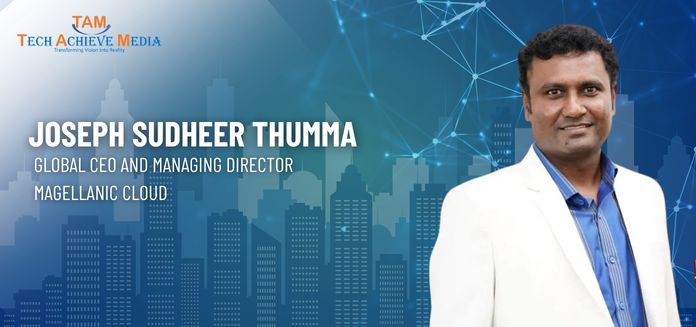
As Indian technology companies increasingly look beyond traditional IT services, few have diversified as aggressively as Magellanic Cloud. From cloud transformation and AI-led digital services to drones, intelligent surveillance and infrastructure technologies, Magellanic Cloud has evolved into one of India’s most diversified deep-tech enterprises. Under the leadership of Joseph Sudheer Thumma, Global CEO and Managing Director, Magellanic Cloud, the company has expanded beyond traditional IT services to build innovation-led businesses focused on solving real-world enterprise and infrastructure challenges.
In this exclusive interaction with Tech Achieve Media (TAM), Joseph Sudheer Thumma shares what inspired the company’s transformation, why Indian enterprises need to invest more in research and development, how Magellanic Cloud approaches acquisitions, and why passion, not quick profits, is the foundation of building globally competitive technology companies.
TAM: Magellanic Cloud has transformed from a conventional IT services company into a diversified deep-tech enterprise spanning AI, drones, intelligent surveillance and cloud technologies. What prompted this strategic shift, and what was the defining moment that made you realise services alone would not be enough?
Joseph Sudheer Thumma: I think Magellanic Cloud has always been driven by innovation, and personally, innovation has always been my passion. I constantly look at what the next big trend will be and where the world is heading over the next decade, and then ask myself how we can make that happen in India. That has always been the driving force for me.
Even in the traditional technology space, I have always tried to be at the forefront of emerging technologies—whether it was cloud, the early adoption of AI, or new areas of research. I closely study how the world is evolving and how global technology leaders are approaching these changes. That is where I draw my inspiration from. If you look at AI, it would not have been possible without advancements in computing power and the availability of cloud infrastructure. Similarly, innovations in chip design and edge computing, led by companies like NVIDIA, have played a crucial role in making AI practical and scalable.
Cloud has also changed the economics of innovation. Companies no longer need massive capital expenditure to invest in R&D. They can innovate, experiment and scale using a pay-as-you-go model. At the same time, connected devices and IoT are transforming how businesses operate.
That is when I changed my strategy. Instead of depending only on traditional IT services and software development, I wanted to build solutions where every device communicates with software, generates data and integrates seamlessly. Once you have data, the real question is how quickly you can analyse it and use it to make faster, smarter decisions. That became our area of focus across every aspect of day-to-day operations. I have always believed that technology should solve real business problems, make processes more efficient, more economical and enable faster decision-making.
That was the key reason behind our transformation from a conventional IT company into a deep-tech enterprise. Another important aspect is investing in R&D. However, investing in R&D does not mean building everything yourself. There are many companies that may have spent years developing a specific component or technology. Instead of reinventing the wheel, we integrate the best available technologies into a complete end-to-end solution. That ability to bring together different technologies into a finished product is what has always guided our strategy and continues to drive our innovation journey.
TAM: What are the biggest barriers Indian companies face in taking deep-tech innovations to global markets, and how can they overcome them?
Joseph Sudheer Thumma: When you look at high-end technology, India is still evolving in areas such as chip manufacturing and large-scale semiconductor production. Traditionally, our strength has been in IT services. We certainly have the talent and the capability to design chips and develop advanced technologies, but what has been missing is the complete ecosystem, the testing facilities, manufacturing capabilities, PCB fabrication, and validation infrastructure. Because of these gaps, the product development cycle has traditionally taken much longer. Fortunately, that gap is gradually closing, and we are beginning to see the ecosystem develop.
I believe this has been one of the biggest challenges for Indian entrepreneurs and enterprises. It is not just about infrastructure; it is also about the mindset. My thinking has always been slightly different. I have closely observed how Israeli companies build innovation-led businesses and achieve global valuations, and how technology companies in the US think and scale. They invest for the long term, build globally relevant products, and focus relentlessly on innovation. That is exactly the approach I have tried to replicate.
Having spent over 23 years in the US, I learnt a great deal from that ecosystem, and that experience has shaped my thinking. Coming back to India was a conscious decision because I believe the time has come for many of these advanced technologies to be built here.
Today, the global market is looking beyond China for technology leadership and manufacturing capabilities. India has a tremendous opportunity to emerge as a global innovation hub, but we need entrepreneurs who are willing to think big, invest in innovation and build products for the world. That is the difference I wanted to bring by returning to India, to contribute to Indian enterprises, strengthen the innovation ecosystem, and help build globally competitive technology companies. That has always been my thought process.
TAM: Your business today spans cloud, AI, intelligent infrastructure, surveillance platforms and drone technologies. On the surface, these appear to be very different businesses. What is the common vision that connects these verticals, and how do you ensure each business remains focused while contributing to the company’s long-term strategy?
Joseph Sudheer Thumma: My vision has always been to build for the next decade, not just the next few years. That’s why we diversified into areas like drones, AI and intelligent surveillance. Even before drones became a mainstream discussion, we saw their potential in solving real-world business problems ,from industrial inspections and logistics to security and defence applications.
Traditionally, surveillance has relied on CCTV and manual monitoring. We wanted to build intelligent solutions that could automate security, improve response times and make critical infrastructure safer. Today, those capabilities are equally relevant for defence, airports, data centres, industrial facilities and other high-value assets.
For me, diversification has never been about chasing opportunities. It is about anticipating where technology is headed and building solutions that will remain relevant for the next 10 to 20 years. Passion for innovation, not just financial returns, is what drives that vision. Each business vertical has its own leadership and execution team, while I focus on the overall strategy and long-term direction. Our approach is always to solve real customer problems by combining technology, operational efficiency and commercial viability, rather than simply offering technology for its own sake.
TAM: Magellanic Cloud has grown both organically and through acquisitions, including Motivity Labs, iVIS and Scandron. Technology acquisitions often struggle because of cultural differences and integration challenges. What is your approach to integrating acquired companies while preserving their entrepreneurial spirit?
Joseph Sudheer Thumma: My approach to acquisitions is simple. I don’t push for immediate results. I usually allow about a year for the acquired company to adjust culturally and align with our vision. During that period, we focus on understanding the business, strengthening its capabilities and identifying how it can scale.
Take Motivity Labs as an example. When we acquired the company, it was a $5 million business with around 50–60 employees. It had strong customer relationships, but what it lacked were the certifications and capabilities needed to win larger enterprise customers. We invested in certifications, strengthened our cloud, DevOps and automation offerings, and, most importantly, invested in people. Within four years, the business had grown to around $32 million. That’s the kind of hockey-stick growth we aim for: stabilise first, then scale rapidly.
We followed a similar approach with iVIS. The platform aligned with our vision around AI, edge computing and analytics, so we retained the leadership team initially while redesigning the platform to make it enterprise-ready, scalable and highly resilient. We then expanded its focus beyond banking into sectors such as railways, highways, public infrastructure and retail.
Today, we have an order book of nearly Rs 300 crore in railways and the public sector alone. We expect the business to grow from around Rs 150 crore earlier to Rs 300 to 400 crore this year, with the potential to reach a Rs 1,000 crore order book as we scale execution and convert the opportunities already in the pipeline. For me, acquisitions are never about adding revenue alone. They are about investing capital, technology and talent to unlock the next stage of innovation and growth.
TAM: Based on your own entrepreneurial journey, what advice would you give to the next generation of Indian founders who aspire to build globally recognised deep-tech companies rather than traditional IT services businesses?
Joseph Sudheer Thumma: My advice to Indian entrepreneurs is: don’t chase quick money or quick results. Instead, stay committed to building a unique product and be prepared to invest one or two years in strengthening your vision before expecting returns. If you look at any successful high-end technology product today, it has taken four to five years of sustained effort before achieving large-scale adoption. That journey is never easy, but it is what creates lasting value.
I also believe companies must invest consistently in R&D. Whether it is developing new technologies, integrating existing innovations or preparing solutions for the next generation, long-term investment in research and innovation is essential. That is how you build globally competitive businesses, and that is the advice I would give to every entrepreneur.
TAM: India has an enormous technology talent pool, but deep-tech demands specialised skills and continuous innovation. Do you believe India is producing industry-ready talent for emerging areas such as AI, autonomous systems and drone technologies, or does the industry still need to invest significantly in upskilling?
Joseph Sudheer Thumma: There will always be a group of people who adapt to change much faster than others. In my experience, around 10% of the workforce quickly understands the direction the organisation is taking and embraces new technologies. I believe leaders should invest their time and energy in developing this group because they, in turn, inspire and guide the rest of the organisation.
At the same time, there is still a mindset gap when it comes to continuous learning. Many people question why they need to keep learning or adapting to new technologies. That is something organisations have to consciously address. For us, the focus is on creating a culture of continuous learning. We empower our top talent first and then encourage them to drive that learning mindset across the organisation. That is how we build teams that are ready for the future.
TAM: Looking ahead, what is your long-term vision for Magellanic Cloud, and what role do you see the company playing in shaping India’s position as a global deep-tech innovation hub?
Joseph Sudheer Thumma: If I had to add one final thought, it would be that our direction has always been driven by innovation. India has already begun taking important steps in areas such as chip manufacturing. While building a complete ecosystem will take time, perhaps close to a decade, we are certainly moving in the right direction. At the same time, my advice to professionals is to move beyond routine, repetitive work and continuously build new skills. The future will belong to those who are willing to innovate, adapt and create value through technology.