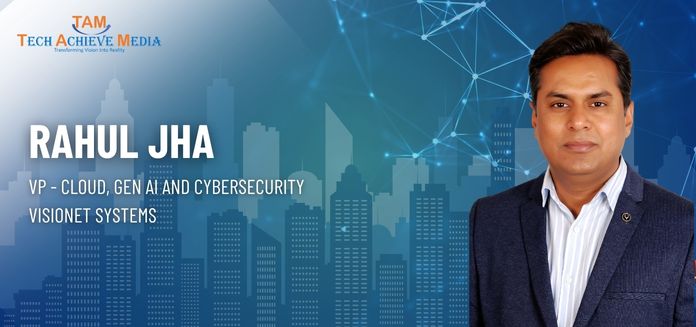
As organizations rethink how they operate in an era of constant disruption, resilience is emerging as the defining characteristic of modern enterprises. From AI-driven operations and distributed delivery models to data sovereignty and regulatory compliance, businesses are redesigning their strategies to remain agile and future-ready. In this interview with Tech Achieve Media (TAM), Rahul Jha, VP – Cloud, Gen AI and Cybersecurity at Visionet Systems, shares his perspective on how AI is transforming enterprise operations and why India is poised to play a pivotal role in the next generation of global digital services.
TAM: Why is resilience becoming the cornerstone of modern operating models?
Rahul Jha: For nearly three decades, enterprises optimized operating models around a single variable: efficiency at scale. But today’s world is shaped by supply-chain disruptions, geopolitical shifts, cyber threats, and rapidly evolving regulations. The operating assumptions of the past no longer hold.
Resilience has therefore evolved from being a risk-management function to becoming a fundamental design principle. The new strategic question is not, “How do we operate at the lowest cost?” but rather, “How do we sustain business continuity, customer trust, and innovation in an environment of constant disruption?”
The most successful organizations now architect for adaptability from day one, embedding redundancy, distributed execution, intelligent automation, and real-time decision-making into their core operations. In many ways, resilience is becoming the new productivity. Enterprises that can absorb shocks and continue delivering value will outperform those optimized solely for efficiency.
TAM: What is the role of AI in enabling distributed, “border-light” service delivery?
Rahul Jha: Artificial intelligence is fundamentally redefining the geography of work. Historically, services were tightly coupled with physical locations, creating dependencies on specific talent pools, time zones, and regional conditions. AI introduces a new paradigm where knowledge, workflows, and decision-making capabilities can be distributed intelligently across a global ecosystem.
When AI agents handle routine processing, augment human expertise, and orchestrate complex workflows, organizations gain unprecedented flexibility. Capacity can shift dynamically, operations can scale seamlessly, and service continuity can be maintained irrespective of localized disruptions.
A “border-light” model does not imply a borderless or people-less world. Rather, it represents a future where human talent, digital workers, and AI systems collaborate across geographies without being constrained by traditional operational boundaries. This is precisely the architecture Visionet is engineering for clients today, combining an engineering-first DNA with deep domain expertise and AI alliances across Microsoft, Google, AWS, Salesforce, and Anthropic. The enterprise of the future won’t be defined by where work is done, but by how intelligently it’s orchestrated and that’s the future Visionet is engineering for enterprises at scale
TAM: How are enterprises managing data sovereignty, regulatory fragmentation, and risk in a volatile global environment?
Rahul Jha: The future of globalization is not uniformity; it is governed by interoperability. Data sovereignty requirements are becoming stronger across every major market, and enterprises recognize that trust and compliance cannot be retrofitted. They must be engineered into digital systems from the outset. The emerging model is one of localized data, globally orchestrated intelligence. Sensitive data remains within national jurisdictions, while governance frameworks, AI models, and operational practices are designed to operate consistently across regions.
This requires explainable AI, transparent audit trails, robust identity and access controls, and policy-driven automation that can adapt to diverse regulatory environments. Organizations are increasingly treating compliance not as a cost center, but as a strategic capability that enables faster innovation and stronger stakeholder trust. In a fragmented world, resilience comes from building globally connected yet locally accountable operating models.
TAM: Why is India well-positioned to become a hub for AI-enabled, geopolitically resilient global services?
Rahul Jha: India stands at a unique intersection of talent, technology, and trust. For years, India was recognized as the world’s engine for scale and cost efficiency. The next chapter is far more significant: India is becoming the global center for engineering intelligent enterprises. Few countries combine deep digital talent, mature delivery ecosystems, entrepreneurial energy, and rapid AI adoption at the scale that India offers. Equally important, India has demonstrated institutional stability and the ability to support mission-critical operations for the world’s largest enterprises across industries.
As global organizations redesign their operating footprints for resilience, they are looking for partners that can provide not just workforce capacity, but AI capability, innovation velocity, and strategic reliability. India delivers all three. The opportunity ahead is not simply to be the world’s back office, but to become the world’s AI operations and innovation hub, building the intelligent, resilient, and globally distributed service models that will define the next era of enterprise transformation.