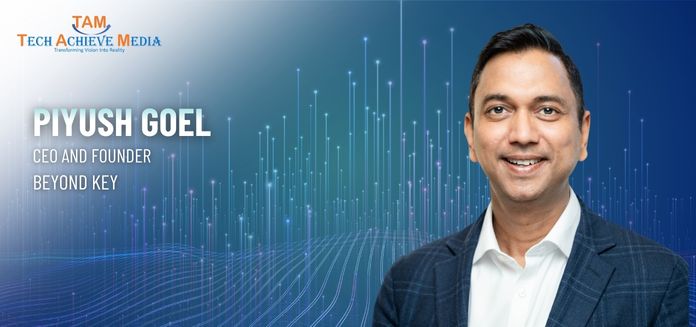
Despite the surge in enterprise AI adoption, many organisations continue to struggle with moving beyond pilot projects to achieve measurable business outcomes. In an interview with Tech Achieve Media, Piyush Goel, CEO and Founder of Beyond Key, explains why AI initiatives often stall after the proof-of-concept stage, the operational mistakes enterprises make while scaling AI, and why data quality, governance and workflow design matter more than deploying the latest AI models. He also shares his views on Shadow AI, legacy modernisation, global AI adoption trends, and what India must do to evolve from a global IT delivery hub into a leader in high-value AI innovation.
TAM: Almost every CXO started AI pilots over the last two years, but very few are seeing real ROI on their balance sheets. Why are so many enterprise AI projects getting stuck in the sandbox stage?
Piyush Goel: The honest answer is that most pilots were never designed to leave the sandbox. They were designed to impress a board, satisfy a vendor conversation, or tick a transformation checkbox. Proving that a technology works is not the same as proving that the business is better because of it.
At Beyond Key, the first question we ask a client is not “what do you want to build?”. It is “what is actually breaking in your operations right now?” That answer leads somewhere real. The other question, “what technology should we try?” usually leads to a demo that nobody funds twice.
TAM: What is the single biggest operational mistake enterprise leaders make when moving from a Proof of Concept (PoC) to full production AI?
Piyush Goel: They treat scaling as a copy-paste exercise. Take what worked in the pilot, deploy it across ten teams, and assume the results multiply. That is not how production environments behave. Data shifts. Business rules get messier. Compliance teams ask questions nobody anticipated. Users interact with systems in ways that no controlled pilot ever surfaces.
The decisions that actually determine whether production succeeds governance, monitoring, ownership, rollback plans are almost always made too late. By the time early pilot success creates internal momentum, those conversations feel like they are slowing things down. That perception is exactly what causes the failure later.
TAM: Everyone wants to deploy AI models, but nobody wants to fix legacy data pipelines. In simple terms, how bad is the data hygiene problem inside most large enterprises today?
Piyush Goel: It is worse than most leaders want to admit publicly. The problem is not that organizations lack data, they have more than they can process. The problem is that the same metric means different things in different departments, and nobody has been forced to reconcile that until an AI model produces a confident answer that finance and operations both reject for different reasons.
That moment is clarifying, but expensive. Data hygiene is consistently treated as maintenance work rather than strategic infrastructure. The organizations that have genuinely cleaned their data foundations are not doing it for AI. They are doing it because they got tired of making decisions on numbers they could not fully trust.
TAM: Companies are buying dozens of stand-alone AI tools, leaving employees confused with fragmented software. Why are end-to-end intelligent workflows the real answer here?
Piyush Goel: Eventually, the software suite itself will become a challenge. Instead of working, staff find themselves having to manage the software. Each handoff from one application to another is a decision point, a potential source of error, or an opportunity to fall back on the good old spreadsheet that everybody knows. Intelligence should sit inside the workflow, not alongside it.
At Beyond Key, when we approach transformation for a client, we start by mapping how work actually moves through the organization, not how it is supposed to move on paper, but how it really moves. The gaps in that map are where embedded intelligence creates genuine value. Another tool on the desktop rarely is.
TAM: How do you re-engineer legacy enterprise processes without shutting down daily business operations?
Piyush Goel: Cautiously, and with the proper order. Large companies don’t have the luxury of taking the time to reinvent themselves. During the transformation, the business must keep on functioning, which means that each step has to be reversible. The strategy that always succeeds is choosing a process that has some measurable influence and manageable risk. But also while running the old and the new systems simultaneously until the trust is built.
The other thing that matters enormously is involving frontline teams early. They carry institutional knowledge that never makes it into project documentation. Ignoring them does not speed up transformation. It just delays the problems until they are harder to fix.
TAM: How serious is the ‘Shadow AI’ threat in global firms right now, where teams use unapproved tools behind the IT team’s back?
Piyush Goel: It is serious enough that blocking it is not a realistic strategy. When workers turn to an unapproved technology, they are not making a point about information technology policy. They are addressing a problem that the approved system is not addressing quickly enough. There is a very real risk involved here: sensitive information leaking out of the controlled systems, decisions being made based on invalidated outputs, regulatory problems once lawyers get involved.
However, this is not something that can be solved through limitation alone. Organizations need to provide approved solutions that are easy to use, understandable policy, and ongoing discussion about appropriate use. Make the right solution the easier one, and most people will choose it.
TAM: You work with clients across the World. How does the mindset toward AI adoption differ between different enterprises and markets?
Piyush Goel: The divide is closing, but the agendas remain different. When talking to customers, quite a bit of time is spent on the topics of governance, who is responsible, how does that relate to regulation, what if the model fails? These are valid concerns, and they intentionally slow things down. For many markets, the emphasis is placed on moving quickly and gaining a competitive advantage.
Rather than worrying about what can go wrong, the issue becomes what gets lost if you do not move quickly enough. Neither approach is right or wrong. But one thing is true that we have seen at Beyond Key, the organizations that generate the successful outcomes are those who made decisions for their technology investments before writing a single line of code.
TAM: India built its reputation as the back-office IT delivery hub of the world. What will it take for Indian tech talent to lead in high-value AI innovation rather than just lower-cost implementation?
Piyush Goel: The talent is already present. That has never been an issue. Indian talent has been famous for exporting all along is its execution capacity, its capacity to execute at scale and within cost constraints. This legacy has to be respected and honored. However, what comes next involves a different set of requirements.
Such as thinking about problems faced in industries, building platforms in this country which then get taken around the world, and intellectual property that represents true domain knowledge and not just technical knowledge. This change is going to demand a closer relationship between academia, industry, and startups than what exists now.