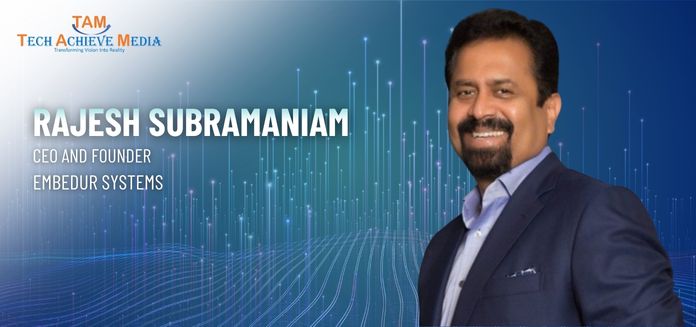
As India accelerates its semiconductor ambitions under the IndiaAI Mission, the next challenge is moving beyond chip design to building complete, commercially viable Edge AI systems. Rajesh Subramaniam, CEO and Founder, embedUR Systems, shares that the missing link is not more computing power or manufacturing capacity, but a repeatable ecosystem that brings together silicon, software, AI models and real-world workloads. In this conversation with Tech Achieve Media, Rajesh discusses the performance bottlenecks holding back on-device AI, why enterprises need to look beyond headline TOPS, the architectural mistakes engineers must avoid, and why long-term software portability will be critical as semiconductor platforms evolve. He also explains the thinking behind ModelNova, embedUR’s recently spun-out Edge AI entity, and why the industry is moving towards intelligence at the data source.
TAM: As the IndiaAI Mission pushes for domestic capability, what is the missing link in turning local hardware design into scalable silicon manufacturing for Edge AI?
Rajesh Subramaniam: India has advanced significantly in semiconductor design, but from our perspective, the missing link is not manufacturing capacity alone; it is the establishment of a comprehensive, repeatable product ecosystem. For Edge AI, manufacturing silicon is just one aspect. It also requires a mature software platform, optimized AI models, validation with real-world workloads, and a clear transition from prototype to mass production. The missing piece isn’t solely additional computing power but closer integration of silicon, software, and the specific application. A locally designed processor gains commercial value when developers can effectively run a real AI workload on it, deploy it efficiently, and sustain it through the product’s life cycle. Creating this bridge is essential as India shifts from simply designing semiconductors to developing competitive Edge AI solutions globally.
TAM: With enterprises shifting workloads from the cloud to on-device AI, where does the real performance bottleneck lie?
Rajesh Subramaniam: The bottleneck is increasingly not raw TOPS, or headline compute performance. It is how efficiently the entire system can translate that compute into useful application performance under constraints such as memory, power, latency, and cost. We regularly see hardware with strong AI acceleration capabilities, but a production model cannot simply be dropped onto it. Memory movement, model architecture, quantization, preprocessing, and post-processing can all become bottlenecks. At the edge, a theoretically more powerful processor can actually deliver a worse product if the software and model have not been optimized for that architecture.
That is why we look at Edge AI at the system level. The important metric is not how much compute exists on paper, but how much useful intelligence you can reliably deliver within the device’s actual constraints.
TAM: Partnering with giants like Arm, NXP, STMicroelectronics, and Infineon gives embedUR a unique vantage point; what is the most common architectural miscalculation hardware engineers make when trying to bridge raw semiconductor compute with production-ready AI models?
Rajesh Subramaniam: The most common mistake in architecture is attempting to address the Edge AI challenge primarily by increasing compute power rather than rethinking the model suited to that environment. Models designed for cloud or high-performance GPUs often possess resources and flexibility that aren’t needed for specific edge applications. Trying to shrink these models to fit the edge can introduce unnecessary complexity, which is problematic when every byte of memory and milliwatt of power counts. We advocate for creating specialized, purpose-built models for the edge from the start. If an application must excel at a single task, the model should be optimized for that task alone, rather than including extra capabilities for unrelated functions. This approach delivers strong performance with less compute, memory, and power, enabling advanced AI to run on embedded processors and MCUs rather than relying on GPUs or constant cloud access.
TAM: Across various verticals, what separates a successful Edge AI proof-of-concept from a secure, long-term operational deployment?
Rajesh Subramaniam: A proof-of-concept proves that an algorithm can work. A production deployment must demonstrate that it can continue to work. This involves going beyond mere accuracy and inference speed to ensure secure deployment, predictable resource use, device management, seamless model updates, hardware lifecycle planning, and strategies for handling model drift as conditions evolve. Such considerations are especially critical for products like industrial equipment, building systems, and other embedded infrastructure that often remain in operation for many years. The AI model must stay relevant despite changes in underlying hardware. At embedUR, we prioritize hardware flexibility and long-term software support, enabling the AI to adapt with the product rather than being limited to a single silicon generation.
TAM: For engineering leaders and semiconductor executives navigating the transition to intelligent edge computing, what is your definitive “stop-doing” list to avoid getting trapped in legacy hardware paradigms?
Rajesh Subramaniam: There are three things I would stop doing.
First, stop using peak TOPS as the primary measure of whether a platform is suitable for AI. Measure performance using the actual workloads the product needs to run.
Second, stop designing hardware and AI software in isolation. Edge AI is a systems problem involving compute, memory, power, models, toolchains, and application software, and the complete system needs to be evaluated as a whole.
Third, stop assuming that the hardware selected today will remain the hardware platform for the entire life of the product. Semiconductor cycles move much faster than many embedded-product lifecycles. Software and AI architectures should therefore be portable enough to move across platforms as requirements and hardware evolve.
The companies that avoid those traps will have much more freedom to adopt new silicon without continually rebuilding their AI products from scratch.
TAM: How is embedUR approaching the growing demand for on-device intelligence rather than cloud-dependent AI?
Rajesh Subramaniam: We consider the move toward on-device intelligence so crucial that we recently spun off ModelNova from embedUR as an independent entity focused solely on Edge AI. Rooted in over twenty years of embedUR’s embedded engineering expertise and our efforts to deploy advanced AI workloads on resource-limited devices, ModelNova emerged to address the industry’s key challenge: transforming AI models into reliable, efficient solutions for production hardware. Through ModelNova, we are developing a comprehensive pipeline, from pre-trained models and development tools to production-ready, licensable models and custom solutions, that supports a wide range of semiconductor platforms. Our aim is to make on-device intelligence feasible without forcing customers into a single hardware architecture or relying on continuous cloud access. Creating ModelNova reflects our belief that the industry is moving toward local intelligence at the data source, and we are investing accordingly.
TAM: What is the one shift you believe Indian enterprises need to make today to realise the potential of Edge AI fully?
Rajesh Subramaniam: Indian enterprises should shift their focus from asking, “What AI model can we deploy?” to questioning, “Where should intelligence live within this system?” Traditionally, the approach has been to collect data at the device level and send it elsewhere for processing. However, Edge AI challenges that approach. For applications that require immediate responses, limited connectivity, handling sensitive data, or controlling infrastructure costs, local processing is highly advantageous. India has a chance to develop the next wave of intelligent products by integrating Edge AI from the outset, rather than as an afterthought. Leveraging India’s strengths in software engineering and its expanding semiconductor industry could drive a particularly impactful transformation.