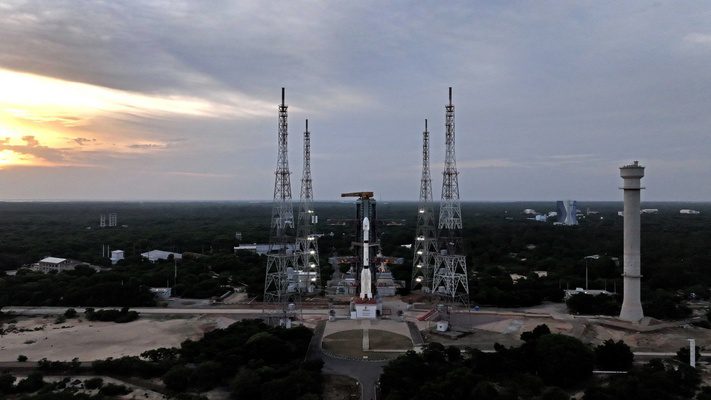
The Indian Space Research Organisation (ISRO) has successfully accomplished the GSLV-F17/EOS-05 mission, marking another significant milestone in India’s space programme. The GSLV-F17, the 19th flight of India’s Geosynchronous Satellite Launch Vehicle (GSLV), successfully placed the EOS-05 satellite into its intended Sub-Geosynchronous Transfer Orbit (Sub-GTO).
Also read: ISRO PSLV C62 Mission Fails, Here’s How
The mission was launched from the Second Launch Pad (SLP) at Satish Dhawan Space Centre, SHAR. For the mission, GSLV-F17 was configured with a 4-metre-diameter Ogive composite payload fairing, said the organisation. The successful deployment of EOS-05 is significant for India’s Earth observation capabilities, particularly as geosynchronous imaging can support more persistent and frequent observation of large geographic regions.
Commenting on the mission, Lt. Gen. A.K. Bhatt (retd.), Director General, Indian Space Association (ISpA), said: “We congratulate ISRO on the successful GSLV-F17/EOS-05 mission, which is a moment that reflects the resilience and engineering excellence of our space agency after a testing gap. The geosynchronous imaging capabilities of EOS-05 satellite will enable persistent, high-frequency observation of large regions rather than relying only on periodic satellite revisits, which is increasingly critical for India. This can be strategically valuable for tracking rapidly evolving weather systems, floods and forest fires, monitoring agriculture and natural resources, and strengthening situational awareness across India’s land and maritime domains. The real opportunity now lies in translating this rich, frequent satellite data into actionable intelligence through India’s private space and geospatial ecosystem. This mission also reaffirms the deepening partnership between ISRO and India’s private space industry, whose components and expertise increasingly power such national systems. As India’s ecosystem matures under robust policy frameworks and with support from ISRO, milestones like this will build the confidence needed to scale commercial participation further.”
The mission also highlights the growing role of India’s private space and geospatial ecosystem in converting satellite-derived data into actionable intelligence across sectors. Applications could span weather monitoring, disaster management, agriculture, natural-resource management and land and maritime situational awareness.