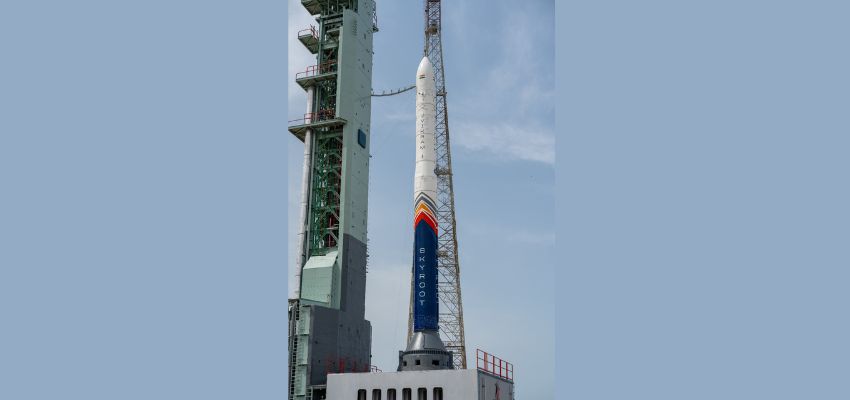
Skyroot Aerospace on Saturday successfully launched the maiden test flight of its Vikram-1 launch vehicle from the First Launch Pad at Satish Dhawan Space Centre (SDSC-SHAR) at 11:30 AM, marking a significant milestone for India’s private space sector. The mission, named Mission Aagaman, is the first time an orbital-class rocket fully designed and developed by a private Indian company has lifted off from Indian soil. The launch marks Skyroot’s entry into the global launch services market and follows the company’s successful Vikram-S suborbital mission in November 2022, which became the first private rocket to reach space from India.
Also read: ISRO PSLV C62 Mission Fails, Here’s How
Speaking after the launch, Pawan Kumar Chandana, Co-founder and CEO, Skyroot Aerospace, described the mission as an important step towards building the company’s future launch capabilities. “This is our first test flight, and we will be getting valuable data from it. This will be foundational to Skyroot’s aspirations of establishing launch cadence. We are excited to see this through,” said Pawan Kumar Chandana. The Vikram-1 mission carried multiple technology demonstration payloads from Grahaa Space, Cosmoserve, DCubed and Skyroot’s own SCOPE, along with Cosmos Diamonds’ artwork “Cosmic Bloom” and a micro-art payload.
Highlighting the commercial opportunity in the space launch sector, Chandana said the demand for satellite-enabled services continues to outpace launch availability. “The small satellite launch market is deeply constrained on the supply side. At the same time, the demand for services enabled by satellites in space will only continue to grow, and that is where Skyroot’s opportunity lies,” added Pawan. Vikram-1 is a seven-storey-tall, multi-stage orbital launch vehicle built using an all-carbon composite structure and powered by propulsion technologies developed in-house, including 3D-printed rocket engines and high-thrust solid-fuel boosters. The vehicle has been designed to carry small satellites weighing up to 350 kilograms into Low Earth Orbit (LEO). Its maiden test flight targeted a 450-kilometre orbit at a 60-degree inclination.
The successful launch drew appreciation from across India’s space industry. Lt. Gen. AK Bhatt (Retd.), Director General, Indian Space Association (ISpA), described the mission as a landmark achievement for the country’s private space ecosystem: ”The successful orbital launch of Skyroot Aerospace’s Vikram-1 (Mission Aagaman) is a defining milestone for India’s space journey. By executing the nation’s first fully private orbital flight, Skyroot has shattered legacy boundaries, demonstrating that our domestic industry is primed to handle end-to-end space missions. We are equally proud to congratulate the pioneering tech-demo payloads safely deployed on this flight, i.e. Cosmoserve Space’s EMBRACE robotic arm for orbital debris removal, Skyroot’s own SCOPE and Grahaa Space’s SOLARAS S3 satellite. The successful deployment of such complex, IP-heavy payloads prove that our private ecosystem is now building critical global infrastructure for space sustainability and high-resolution Earth intelligence. Beyond the engineering marvel of an all-carbon composite rocket, this launch is a masterclass in public-private co-existence. Furthermore, with Skyroot’s validation as India’s first spacetech unicorn, this success is a resounding signal to global sovereign and institutional funds. The Indian private space sector is no longer a high-risk bet; it is a highly bankable, globally competitive asset class capable of breaking the global small satellite launch bottleneck. Once again our best wishes as they lead private Space in India to new heights.”
Also read: Axiom 4 Launches Successfully with Shubhanshu Shukla Onboard: List of Indian Experiments
Reacting to the successful launch, Krishanu Acharya, CEO and Co-Founder, Suhora Technologies, said the mission would have a positive impact on India’s downstream space industry and Earth observation ecosystem: ”Suhora extends its heartiest congratulations to the Skyroot Aerospace team on the successful orbital launch of Vikram-1. This is a defining milestone for the entire Indian space ecosystem. For companies like Suhora into satellite data-analytics, a dependable domestic launch capability fundamentally changes the economics and speed of Earth observation. Lower-cost and more responsive launch services will enable more Indian satellite operators to deploy and replenish constellations, significantly improving the availability, revisit frequency and timeliness of Earth observation data. Equally important, it lowers the barrier for emerging downstream and application-focused space startups to own and operate dedicated satellite assets tailored to specific industry needs.”
Gautam Sharma, Managing Director, Viasat India, added: ” congratulate the entire Skyroot Aerospace team on the historic orbital launch of Vikram-1. Having spent years working within the satellite sector, witnessing this definitive moment is both inspiring and deeply moving. This milestone beautifully demonstrates how India’s space economy is thriving through a truly collaborative ecosystem where government, brilliant startups, academia, investors and global industry players are helping build the NewSpace future together. With the eyes of young India fixed on Sriharikota, the horizon for commercial innovation has never looked brighter.”
Grahaa Space, a spacetech company focused on developing Earth observation nanosatellites and geospatial intelligence solutions, successfully deployed SOLARAS, its technology demonstration nanosatellite, aboard Skyroot Aerospace’s Vikram-1 mission. The mission, named SIDDHI, marks an important milestone in Grahaa Space’s journey to build indigenous, stackable nanosatellite platforms that can be customized for various low earth orbit (LEO) missions, said the company.
Ramesh Kumar V, Co-founder and CEO, Grahaa Space, said: “It’s a defining moment for Grahaa Space. Watching SOLARAS successfully reach orbit is the culmination of years of engineering, perseverance and a shared vision of building world-class space technologies in India. This mission validates our indigenous nanosatellite platform and marks the beginning of an exciting new chapter for the company. We are grateful to Skyroot Aerospace for enabling this landmark mission and to our partners for their trust and collaboration. The success of SOLARAS strengthens our commitment to building scalable satellite platforms that make access to space faster, more affordable and more accessible for governments, enterprises, research institutions and the broader space ecosystem.”