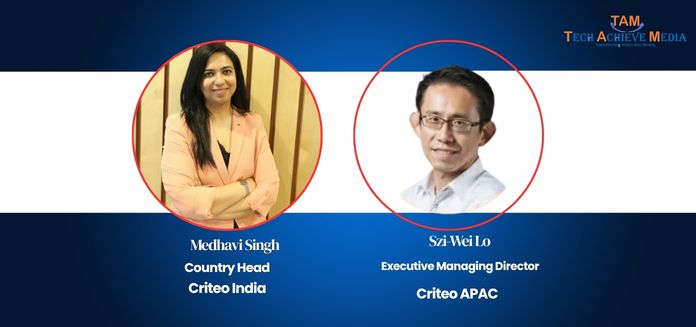
Indian market is entering a phase where rapid consumer adoption, quick-commerce growth, cross-channel engagement and AI are converging to reshape how brands understand and reach consumers. From using transactional signals to drive more precise campaigns to integrating AI across the marketing lifecycle, businesses are increasingly moving beyond experimentation towards measurable outcomes. Tech Achieve Media spoke to Szi-Wei Lo, Executive Managing Director – APAC, Criteo, and Medhavi Singh, Country Head – India, Criteo at the Criteo Commerce Forum India 2026, to understand why India is emerging as a distinctive commerce market in APAC, how AI is changing decision-making, and why the next phase of growth will depend on understanding consumers beyond individual channels. The conversation also examines the evolving Indian consumer, the growing importance of value over price, and why India’s ability to rapidly adopt and scale new digital models could make it a reference point for commerce innovation across the region.
TAM: As global brands evaluate their investments across APAC, are you seeing a structural shift in media budgets towards India? Is India now becoming the market where commerce innovations are tested before being expanded across the region?
Szi-Wei: I think it’s both yes and no. What makes India unique, to a certain extent, is its high rate of digital adoption. Consumers are very comfortable adopting new digital innovations, while at the same time, the commerce ecosystem is growing rapidly across segments, whether it is retail media, social, omnichannel, and now, LLMs.
This combination of high digital adoption and rapid growth in commerce is creating significant opportunities for brands. We have also spoken about the work we did with Kellogg’s, where we used transactional signals from quick-commerce platforms. I mentioned quick commerce earlier, and it is definitely a key driver in the Indian market. In this campaign, we took transactional signals from quick-commerce platforms and connected them with OTT awareness, Meta and open-internet retargeting. We have shared a lot of data in the presentation, but two numbers that really stood out for me were the average weekly reach of 2.1 to 2.3 million and the fact that 97% of the buyers were new to the brand.
TAM: Many markets in APAC have scale. Beyond scale, what makes India different from markets like China, Japan or Southeast Asia when it comes to commerce innovation? Has India influenced the way Criteo approaches other markets?
Szi-Wei: I think what’s unique about the Indian market is, as I said earlier, its high rate of digital adoption, rapid innovation and a very open and highly competitive commerce environment. This creates a situation where businesses and brands need to continuously innovate and develop new commerce models to keep pace with changing consumer behaviour.
Let me share two examples.
We work with Cleartrip, and to help them drive growth, we developed an intent-based campaign using AI technology. We used AI-assisted bidding and budget allocation, while also personalising creatives to re-engage dormant users. With Cleartrip’s agreement, we identified dormant users as a specific audience segment and developed the campaign around them. The campaign helped Cleartrip reach 10 million unique users and improve cost efficiency by 1.5 times compared with other paid channels. What was particularly interesting was that 42% of the purchase contribution came from dormant users ,people Cleartrip had already acquired but who were no longer actively engaged with the platform. So, rather than simply targeting new users, we identified an existing audience that represented an opportunity for growth and developed a campaign specifically around that segment.
The second example is with Zepto. We used our commerce-focused solution to help them acquire audiences across multiple channels. By combining social channels with the open internet, where we have strong capabilities, we helped Zepto improve its ROAS by 72% year-on-year, while the click-through rate improved by 108% and the conversion rate by 133%.
Also read: Criteo and Zepto Partner to Drive the Next Wave of Quick Commerce in India
As a marketer, I love those numbers, and I think my CFO would love them too. When you can demonstrate that kind of performance, it also becomes easier to make the case for additional marketing investment. We place a strong emphasis on cross-channel and full-funnel marketing. Open web is an important channel, video is another, and we continue to add channels to the overall mix. What we are seeing is the value that comes from bringing these channels together as part of a cross-channel, full-funnel strategy. At the same time, if you look at India’s digital penetration, there is still a significant runway for growth. As I understand it, the penetration rate is currently slightly below 39% of the population, compared with an average of around 54–55% across the broader market.
So, the combination of rapid innovation, changing consumer behaviour and a large untapped digital opportunity makes India a particularly dynamic market. And that is why I believe there is a lot that other markets, retailers and brands can learn from what is happening in India.
TAM: Looking ahead, what do you think people will say was the defining shift that changed commerce in India during this AI era?
Szi-Wei: Things are changing really fast. But fundamentally, I believe that AI helps improve decision-making and makes things more efficient and effective. So, I think the shift will be from simply using AI to automate work to using it to enable better decision-making. That shift is definitely essential. That said, AI shouldn’t replace human decision-making.
At the end of the day, we still need to understand how to create a fun and engaging shopping experience for consumers, rather than relying on AI alone. I think that is the balance we need to strike. The companies that succeed will be the ones that get that balance right and leverage partnerships across the industry to make it happen.
TAM: India’s digital economy is driven by millions of small and mid-sized businesses. Is AI-powered commerce becoming accessible to them, or are the biggest benefits still limited to large brands?
Medhavi Singh: I think the very essence of how AI has evolved is that it is trying to make things more accessible to everyone. Data and insights that were previously available mainly to larger companies are now becoming accessible to smaller businesses as well. These businesses are the true heart of the Indian economy and an important part of its growth. AI is helping level the playing field by giving them access to capabilities that were once available only to organisations with significant resources.
For SMBs, the opportunity is to partner with the right technology provider that can give them access to scale, and more importantly, to the right commerce signals to understand their audiences better. Because while you can use AI, ultimately, AI is only as good as the data it is trained on. So, how effectively businesses can access the right data and how well they partner with technology providers will determine their ability to compete with much larger organisations.
At Criteo, we take immense pride in the strength of our commerce signals. We process more than $1 trillion in transactions annually, giving us access to a rich set of commerce signals. That richness of data and the insights it enables can be particularly valuable for SMBs looking to better understand their audiences and compete more effectively in the market.
TAM: Almost every brand today says it has an AI strategy. From what you see in India, what separates businesses that are creating real business impact from those that are simply adopting AI as a buzzword?
Medhavi Singh: You know, it’s true. I’ve been hearing for a long time, even during panel discussions, that AI is the new buzzword. But I think the change we’re seeing across many organisations is that they are no longer treating AI as just a buzzword. They are integrating it into their everyday operations. And I think that is what really distinguishes organisations that are making meaningful use of AI from those treating it as a standalone project.
For me, the way to look at it is that even when you are thinking about integrating AI, it should never be an afterthought. You still have to go back to the basics and fundamentals, and those remain the same.
It always starts with understanding: What exactly is my business challenge? What strategy should I use to address it?Once you decide to integrate AI, it should be embedded across every step of that journey, from planning and strategy to optimisation, and then using the insights generated to continuously refine and replan the journey. It should be a closed loop, with AI playing a role at every stage. The organisations that are doing this effectively are the ones staying ahead because they are not treating AI as a standalone project or simply saying, “Let’s use AI.” Instead, they are asking, “How do we integrate AI into what we do, for everyone, at every stage?”
TAM: If you could ask every Indian CMO to stop doing one thing today to prepare for the next phase of commerce, what would it be?
Medhavi Singh: If I were to tell every CMO one thing, I’d say: stop thinking in silos. What’s happening today is that the consumer journey itself is not happening in silos. Consumers are not thinking, “Let me go to a social channel” or “Let me go to OTT.” They are watching OTT content, scrolling through social media, reading the news and perhaps playing a game later. Their journey moves across multiple channels and platforms, often in a non-linear way.
That’s how marketers need to think as well. Instead of thinking, “This channel is going to give me that outcome,” start thinking about the consumer as someone who is present everywhere. The question then becomes: How do I identify my highest-potential users and engage with them meaningfully across channels?
Even when it comes to measuring impact and outcomes, marketers need to look at the entire consumer journey rather than evaluating each channel in isolation. Of course, every brand will be at a different stage. You may already be a market leader, you may be a challenger, or you may be a new entrant. Depending on where you are, different parts of the funnel will have different priorities. But the full funnel continues to be important. So, how do you remain relevant to consumers at every stage and across every touchpoint, while making their user and shopping journey more relevant, engaging and useful? I think marketers who continue to do that will get it right.
TAM: What is one misconception that global companies still have about Indian consumers, and why does that assumption no longer hold true?
Medhavi Singh: I think globally, there has always been a perception that Indian consumers are very price-conscious and that price is the primary factor influencing their purchase decisions.
But I think that has changed significantly over the last few years. The Indian consumer has evolved, and what they are looking for today is value rather than just low cost. If the perceived value is right, they are willing to invest in a product or service.
You can see this shift quite clearly with the growth of quick commerce. Consumers are willing to pay a platform or convenience fee because they see value in getting what they need quickly. The same is true among Gen Z consumers. We see them purchasing higher-priced smartphones, often through EMIs, because they perceive the value of the product to justify the investment.
So, I think India is moving from “I want the cheapest option” to “I want my money to be worth it.” Consumers are increasingly looking for the right value for their money. That is an important shift, and brands need to recognise it. Their perception of the Indian consumer, and consequently, their marketing strategy, needs to evolve from simply focusing on price and affordability to communicating the value and experience that consumers are getting for their money.
TAM: Complete this sentence: “India is becoming APAC’s commerce innovation hub not because of AI, but because of ?Why?
Szi-Wei: It is because of the consumers themselves, driven by their high level of digital adoption and increasingly adventurous behaviour in the digital space. This is also pushing companies like ours, as well as brands, to continuously innovate, and, more importantly, to innovate faster, to keep pace with rapidly changing consumer behaviour.
Medhavi Singh: India doesn’t move at the speed of evolution; it leapfrogs it. I think that’s why India is where it is today. It is a market where the speed of execution is incredibly fast, and where multiple factors converge, from high digital adoption among consumers to the rapid mass adoption of new technologies and innovations. The speed at which consumers embrace something new and the speed at which marketers respond to those changes are both remarkable. All of these factors come together to create a unique environment. And I think that is what makes India a hub for innovation and digital growth.