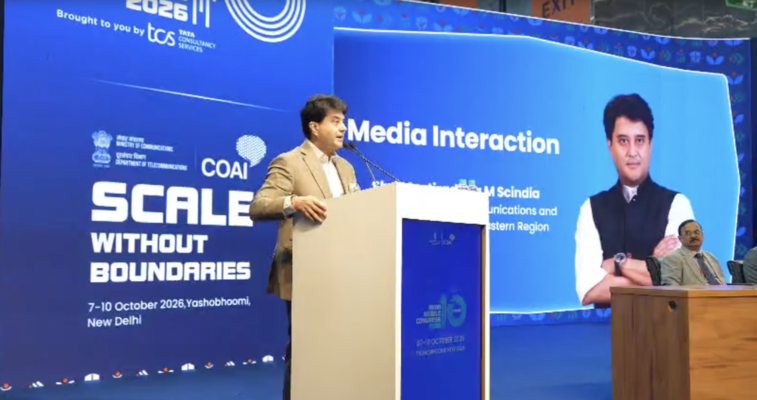
Jyotiraditya Scindia, Union Minister for Communications, says India’s mobile phone production has grown to Rs 6.27 lakh crore, with exports reaching nearly USD 28 billion, as the country looks to expand its role in global telecom manufacturing, technology standards and next-generation connectivity. India’s telecommunications sector is entering a new phase, moving beyond network expansion and rising data consumption towards technology innovation, value-added services and global market opportunities, Union Minister for Communications Jyotiraditya Scindia said while addressing the media at the Indian Mobile Congress (IMC 2026).
Highlighting the transformation of India’s mobile manufacturing ecosystem, Scindia said domestic mobile phone production had increased from Rs 19,000 crore approximately 12 years ago to Rs 6.27 lakh crore today. He also pointed to the growth in exports, the development of an indigenous 4G technology stack, India’s growing participation in 6G standardisation and the government’s efforts to expand broadband connectivity.
He added that India’s ambition was to move beyond manufacturing products domestically to developing technologies and solutions for international markets. “Our goal is to move from made in India, to design developed, made in India, but to serve the world,” he said. Mobile phone production rises to Rs 6.27 lakh crore, exports reach USD 28 billion. Scindia highlighted the growth of India’s mobile phone manufacturing industry, which he said had undergone a substantial change over the past 12 years. According to the minister, mobile phone production stood at approximately Rs 19,000 crore, or around USD 2 billion, 12 years ago, meeting only 26 per cent of domestic demand. Today, production has reached Rs 6.27 lakh crore, equivalent to nearly USD 63 billion, representing approximately 31 times growth from the earlier base.
Of the current production value, exports account for close to USD 28 billion, he said. “Mobile phones today is the highest, the commodity with the highest export in our full export basket of 842 billion dollars,” Scindia said. He also highlighted the expansion in the number of companies manufacturing mobile phones in India, from just two companies 12 years ago to approximately 300 today.
The minister said the shift had also extended to telecom equipment manufacturing, with Indian companies producing routers, MPLS equipment, antennas and quantum technology products for both domestic and international customers. “Our trade basket was completely skewed towards imports of telecom equipment. Today we have Indian companies that are producing routers, MPLS rings, antennas, quantum technology products, not only for domestic customers but for international customers,” he said. Scindia attributed part of this manufacturing expansion to the government’s production-linked incentive (PLI) scheme, which he said had generated nearly Rs 1.10 lakh crore in incremental sales, Rs 25,000 crore in incremental exports and 30,000 additional jobs. He said the expansion of domestic manufacturing had created a foundation for the development of a broader digital ecosystem. “India has moved the paradigm and the curve monumentally and exponentially and not incrementally. And what this has done is that this has provided the foundational layer on which multiple platforms can be based,” he said.
India’s digital public infrastructure builds on telecom connectivity
Scindia also linked the growth of India’s digital public infrastructure to the expansion of telecommunications networks, describing connectivity as the underlying infrastructure enabling digital services at scale. He cited the scale of transactions on the Unified Payments Interface (UPI), Aadhaar’s reach and the adoption of DigiLocker as examples of how digital platforms have developed on this foundation. “When you look at UPI, today 20 billion transactions a month, 260 billion a year, close to about 3.4 trillion dollars exchanged on UPI. 49% of the world’s digital transactions today take place in India,” he said.
He added that Aadhaar had empowered nearly 1.4 billion people, while DigiLocker had recorded nine billion documents uploaded and approximately 720 million downloads, according to the figures he shared. “The digital transformation has only taken place because this invisible highway has been built,” Scindia said, referring to the telecommunications infrastructure supporting the country’s digital services. India’s indigenous 4G stack lays the groundwork for 5G standalone and 6G.
A key part of the minister’s address was India’s development and deployment of its own 4G technology stack. Scindia said India had historically depended on overseas suppliers for telecom equipment and had largely adopted technology standards developed elsewhere. The development of an indigenous 4G stack, he said, represented a change in that position. He noted that India had deployed the stack across approximately 110,000 towers nationwide, enabling communications and digital services through domestically developed technology.
“India built its own 4G stack. We have executed it across 110,000 towers across the length and breadth of our country,” he said. Looking ahead, Scindia identified 5G standalone as the next stage in the evolution of India’s telecommunications networks and a bridge towards 6G. He cited approximately 550,000 5G base transceiver stations (BTSs), USD 50 billion in capital expenditure and around 550 million users as indicators of the scale of India’s 5G rollout. He said the country was looking to increase the number of 5G users to one billion by 2030. “The next frontier is 5G standalone, which will be the bridge between 5G, which was the fastest rollout in the world, close to 550,000 BTSs, 50 billion dollars of CapEx, 550 million users to go up to a billion users by 2030,” he said. Scindia said 5G standalone would serve as a transition towards the next generation of connectivity, with India seeking a greater role in shaping the global 6G ecosystem.
India seeks a bigger role in global 6G standards and patent development
Scindia said India’s telecommunications ambitions were no longer limited to deploying networks or adopting technologies developed elsewhere. The country was increasingly seeking to contribute to the development of international standards. He said the Bharat 6G Alliance, which brings together 90 institutions, had filed 7,700 patents, including 4,400 international patents. “Our proposal on ubiquitous connectivity has been accepted by the ITU and has been placed as one of the agenda items during 6G,” he said.
The minister expressed the ambition for India to contribute 10 per cent of global patents to the 6G standard-setting process, subject to the anticipated timeline for the development of standards. “When those standards are set, hopefully by N28 sometime in 29th, India will be a contributor in terms of 10% of global patents to that standard setting process,” he said. Scindia also highlighted the presence of research and development facilities operated by global telecommunications and technology companies in India, including Qualcomm and Cisco. He said these facilities employ thousands of people working on intellectual property development and research.
He described India’s growing involvement in research, patents and standardisation as a change in its traditional position in the telecommunications industry. “We were always a buyer of telecom equipment from abroad. We were always an adopter of technology standards. But we have turned full circle. We are now producing within India,” he said.
How will telecom operators monetise 5G investments as data consumption rises?
Asked about the monetisation challenges facing 5G, including rising data consumption alongside relatively low average revenue per user (ARPU), Scindia said the government’s role was to establish a regulatory framework that enabled competition and innovation, rather than construct the commercial strategies of telecom operators. “My job is not to construct the business plan of the telcos, right? So they’ve got to do, they’ve got to construct their business plan and do their discounted cash flow in terms of their projections going forward,” he said. He added that the government’s responsibility was to provide the regulatory architecture required to support multiple players and a broader range of services in the 5G ecosystem.
“My job is to provide the regulatory architecture so that we can do a plug and play and we can have multiple players in the 5G space,” Scindia said. Addressing the economics of India’s telecommunications market, the minister argued that the country’s large subscriber base offered operators a distinct commercial opportunity. “India’s story is not the story of low volume and high margin. India’s story is the story of high volumes,” he said.
He pointed to India’s approximately 1.35 billion subscribers and the scale of its domestic market, arguing that operators could expand their commercial opportunities by moving beyond conventional voice and data services. “As you grow from providing vanilla communication and vanilla data provision much more into value-added services which we call VaaS, therein you will have margin expansion and that margin expansion route is being worked on by all our telcos,” he said. Scindia said telecom operators were already expanding their service portfolios, with products and platforms on display at IMC demonstrating the potential to develop services on top of connectivity.
“Today our telcos don’t only offer vanilla voice and data, they also offer products, many of which you will see when you walk around the IMC,” he said. He indicated that value-added services could provide an additional source of revenue alongside conventional connectivity offerings, while leaving operators responsible for determining their investment priorities and commercial returns.
Government announces focus on telecom manufacturing ecosystem in Gwalior
Scindia also highlighted the proposed Telecom Manufacturing Zone (TMZ) in Gwalior, Madhya Pradesh, as an initiative to develop a more integrated domestic telecom equipment manufacturing ecosystem. He said approximately 31 companies had expressed interest in the project and submitted expressions of interest. The companies would be allocated land, and the government planned to conduct the Bhoomi Poojan ceremony within October 2026, according to his remarks. “This is the first time you’re hearing about a telecom manufacturing zone to set up the whole ecosystem of telecom manufacturing in one site,” he said.
The zone is being developed with participation from the Government of India and the Madhya Pradesh government. Scindia said it would offer plug-and-play facilities, including testing and certification infrastructure needed by telecom equipment manufacturers. He noted that telecom equipment testing requires specialised facilities and expensive equipment, which can pose challenges for manufacturers. “The quality of those labs have to be world class. The quality of that testing equipment is extremely expensive. And all that testing equipment is going to be put in place by government of India,” he said.
Scindia said the project’s architecture had been developed with inputs from the private sector, with the government taking on a funding and facilitation role. “The whole architecture of this TMZ has been done by the private sector in terms of what they require,” he said. He added that the initiative was intended to bring manufacturers and supporting infrastructure together at a single location, helping establish a stronger foundation for the domestic telecom equipment industry.
Telecom security gains importance as AI becomes embedded in networks
The minister also addressed the relationship between telecommunications, artificial intelligence and digital security, saying the integration of AI into telecom systems would require a secure operating environment. “Telecom and AI go hand in hand. AI becomes a platform and gets enmeshed into the telecom systems as well. That requires security,” Scindia said.
He highlighted the Department of Telecommunications’ Sanchar Saathi initiative, which he said had recorded 30 crore downloads following public discussion around the app. “Sanchar Sathi will only be successful in as much as people are participatory in the process,” he said, referring to citizen participation in telecom security. Scindia said approximately seven crore phones suspected of being involved in fraud had been disconnected. He also cited the Financial Fraud Risk Indicator (FFRI), which he said had been accepted by the Reserve Bank of India as a standard for helping protect people against financial fraud. According to the minister, nearly 1,600 agencies, telecom operators, law enforcement agencies, state police organisations and banks were part of the FFRI ecosystem.
“We have saved close to four and a half thousand crores of theft before it gets done,” he said, describing the initiative’s reported impact on fraud prevention. He added that the government and private sector were working together to strengthen the security of India’s telecommunications ecosystem.
BharatNet and Samriddha Gram aim to extend digital services to rural India
Scindia also highlighted the role of broadband infrastructure in extending digital services beyond urban centres, citing BharatNet and the Samriddha Gram project as key initiatives. He said BharatNet involved an investment of approximately Rs 1.39 lakh crore, or USD 14 billion, to expand broadband connectivity across the country. The project aims to provide connectivity to 256,000 gram panchayats and extend broadband services to 380,000 villages on demand, he said.
Scindia said the objective was to establish a broadband network capable of delivering 100 Mbps connections with more than 95 per cent uptime to customers across the country. “The middle mile to all gram panchayats will be provided through this broadband project, 256,000 gram panchayats. And then to 380,000 villages on demand, it will be a broadband highway,” he said. He added that the infrastructure would be available to service providers to deliver content and services to citizens across India. The minister also spoke about Samriddha Gram, a Department of Telecommunications initiative designed to bring broadband-enabled services directly to villages.
The project’s proof-of-concept phase involved three villages, one each in Madhya Pradesh, Andhra Pradesh and Uttar Pradesh. Scindia said the initiative provided 19 services spanning healthcare, education, telemedicine, diagnostic services and government documentation. The objective, he said, was to reduce the need for residents to travel to block or district headquarters to access essential services.
“There are 19 services that are provided through the Samriddha Gram project to citizens directly in the village, which means they don’t need to go to the district headquarters. They don’t need to go to the block headquarters,” he said. Scindia said the three pilot projects had received first prize recognition at the World Summit on the Information Society (WSIS) in July, according to his remarks, and that representatives from several countries had expressed interest in the model. He said the government intended to expand the project across India and explore its adoption internationally, particularly in the Global South.
IMC 2026 draws more than 1.5 lakh participants, 650 exhibitors
Scindia described IMC 2026 as a platform that had evolved from bringing global technology stakeholders to India to helping Indian technology and telecom capabilities reach international markets. He said this year’s event had attracted more than 1.5 lakh participants, 650 partners and exhibitors, representation from over 100 countries, more than 2,000 technology use cases and over 400 startups. The event also brought together approximately 900 thought leaders, alongside investors, incubators and accelerators. “The IMC this year has been a runaway success,” he said.
According to Scindia, the event’s next phase would focus on strengthening India’s global presence in telecommunications, digital technology and innovation.
“IMC 2026 started as a platform to bring the world to India. IMC 2026 in its avatar from 2017, the journey that it’s travelled. Now the next decade, as I said yesterday, is not to bring the world to India, but to take India to the world,” he said. He added that the government and the telecommunications industry would continue working together to support domestic innovation, manufacturing and the development of solutions for international markets. “Our aspiration is also to make it a reality for the globe,” Scindia said.
As India looks towards 5G standalone and 6G, the minister’s remarks placed the emphasis on a broader set of priorities: strengthening the commercial case for connectivity, expanding value-added services, building domestic research and manufacturing capabilities, improving telecom security and extending digital infrastructure to underserved communities. The direction outlined at IMC 2026 suggests that the next phase of India’s telecom development will be measured not only by network coverage and subscriber numbers, but also by the technologies, services and business models that emerge on top of that infrastructure.