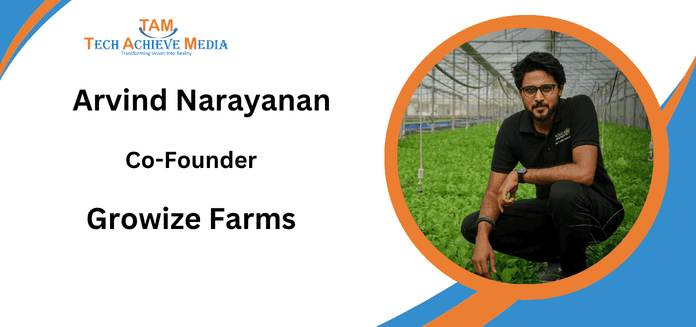
As India looks to make agriculture more productive, resource-efficient and resilient to changing climate conditions, technology is increasingly moving from the periphery to the centre of modern farming. Growize Farms is taking a technology-led approach through proprietary aeroponics, controlled-environment cultivation, automation and data-driven farm management. The company says its model is designed not only to improve yield and resource efficiency, but also to make clean, pesticide-free produce accessible at prices comparable with conventional produce. In this conversation with Tech Achieve Media, Arvind Narayanan, Co-Founder, Growize Farms, discusses the technology behind the company’s farms, the economics of aeroponics, the practical role of automation and AI, and the challenges of scaling a consistent farm model across geographies.
TAM: How is your proprietary aeroponics technology transforming the economics and scalability of modern farming?
Arvind Narayanan: Two things usually get in the way of scaling agriculture in India: land and weather. We took both off the table. Our aeroponic system grows crops without soil, feeding roots directly through a nutrient mist in a fully controlled environment. That alone changes the unit economics. One acre now produces upward of 360 tonnes a year of leafy vegetables, saving 400 million litres of water compared to what conventional farming would need for the same output. Our production cost is around ₹53 a kilo, which is why we’ve been able to price our clean, safe, zero-pesticide produce on par with regular market produce rather than at a premium. That last part matters more than people give it credit for – the market for “clean food nobody can afford” is small. The market for clean food priced like regular food is everyone. As for scalability, we scale acre by acre, deliberately. We’d rather prove the economics hold on a small footprint before we commit capital to the next one, than build fast and find out later that something doesn’t hold up.
TAM: What technology stack powers your farm operations, from cultivation and automation to monitoring and yield optimisation?
Arvind Narayanan: We didn’t import a system built for someone else’s climate and try to make it work here. Most of what’s sold globally as aeroponics was engineered for cooler markets with less sunlight, and it simply doesn’t translate to Indian heat and humidity. So we spent over a decade building our own, from the ground up – a system that supports our India crops and climate. The core is a mist-based root system, with cocopeat used as a buffer to keep nutrient delivery steady rather than relying on imported climate control. Around that sits a polyhouse structure that uses natural ventilation and evaporative cooling instead of heating and artificial lighting, which keeps our energy cost down. What optimises yield isn’t any single piece of that stack. It’s a well-calculated misting uptime, the crop suited to the system, and the people running it following a tight monitoring protocol. Take any one of those three away, and the numbers slip.
Also read: Collective Innovation and Community Empowerment Behind Arya.ag’s Smart Farms Initiative
TAM: How are AI, data analytics and automation being used to improve predictability of crop yields and farm performance?
Arvind Narayanan: I want to be straight with you here, because this space has a lot of loose talk about AI. What drives predictability today is automation removing human error from the variables that matter like dosing, climate response, early pest detection. Those are the tasks where one mistake, not a wage bill, is what actually threatens a harvest. That’s the real case for automation over cheap labour: it’s not about replacing people; it’s about protecting the crop from the kind of error that wipes out a season. On the data side, [we’re building forecasting on top of the cycle-level data every farm generates], which lets us commit supply ahead of harvest instead of reacting to whatever comes out of the ground. Where I’d push back a little: proper predictive AI needs years of clean, consistent data to be worth anything, and most farms, ours included, are still earlier in that curve than the marketing in this sector would have you believe. We built the operational discipline first, deliberately, because that’s what actually makes the data usable later.
TAM: How does the digital dashboard translate complex farm data into meaningful, real-time insights for investors?
Arvind Narayanan: We don’t pretend agriculture is risk-free, and I don’t think a dashboard should paper over that. Instead, it should give a farm owner the same visibility we have internally, without asking them to trust us blind. So it distils operational data on what’s growing, where each cycle stands, harvest and dispatch into a handful of plain indicators, alongside performance and audit reporting, rather than raw sensor data nobody outside our agronomy team would know what to do with. Our own R&D team run our farm directly, not a third party, which is also why we can put that data in front of people honestly. Trust is the real currency in this category, more than yield numbers. The dashboard backs that up with something checkable, not a promise.
TAM: What is the roadmap for scaling your technology across farms and geographies without compromising productivity or consistency?
Arvind Narayanan: We’re expanding our Phase I and also our flagship Growize EKA project – a 1.5-acre growing area in Sattegala, Karnataka and our Phase II, a farm with 3.5 acres of growing area in the same location. We plan to expand to 10 acres by May 2027. The mistake we’re not going to make is treating scale as “build more, faster.” What keeps output consistent as we add acreage is refusing to change the system each time: same crop protocols, same monitoring discipline, same trained teams, adapted only where the local climate genuinely requires it. Right now we’ve got more than 35 people on the farm as operators and trainees, and 17+ on the technical side, and that headcount has to grow in step with acreage, not behind it. Honestly, the harder problem at our stage isn’t growing more; it’s demand-side: making sure distribution can absorb several times today’s output without us having to drop prices to move it. With Bangalore demand alone running at several tonnes a day and climbing, we’re not worried about finding buyers. We’re focused on not letting quality drift as the footprint grows, because that’s what breaks trust with both customers and farm owners.