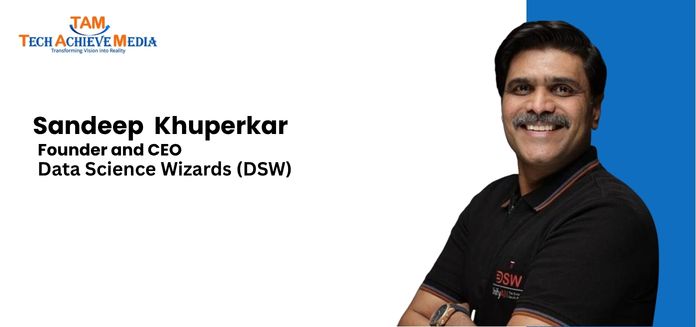
As Indian enterprises move beyond AI experimentation, the focus is shifting towards building scalable, secure and business-critical AI systems. While organisations are increasingly investing in Generative AI, large language models (LLMs) and agentic AI, translating these initiatives into production-grade deployments remains a challenge. In an interaction with Tech Achieve Media, Sandeep Khuperkar, Founder and CEO, Data Science Wizards (DSW), discusses the evolving enterprise AI landscape, the need for an AI-native architecture, and why governance, intelligence sovereignty and operational readiness will define the next phase of AI adoption. He also shares his perspective on how enterprises can move beyond isolated AI applications to build a unified, scalable and accountable AI operating environment.
TAM: Indian enterprises have moved rapidly from AI experimentation to pilots. What, in your view, is preventing these pilots from becoming production-grade, business-critical AI systems?
Sandeep Khuperkar: The problem is no longer primarily whether AI works. We now have capable models, abundant frameworks, improving compute access and strong engineering talent. The real challenge is making AI operate reliably inside the enterprise. A pilot proves capability under controlled conditions. A business-critical system has to survive reality: changing data, multiple identities, legacy applications, API failures, security controls, regulatory requirements, latency, cost, model changes and unpredictable user behaviour. It must also be observable, auditable and support intervention when something goes wrong.
Also read: AI Tools Are Not Enough: Why Enterprises Now Need an Operating System for AI
Agentic AI makes this significantly more important. Once AI moves from generating an answer to invoking tools, updating systems, communicating with customers or initiating a business action, model accuracy is only one part of the problem. We now have to answer: Who gave this agent authority? What can it access? What can it change? When must a human intervene? Can we reconstruct why an action happened?
That is why I believe the pilot-to-production gap is increasingly a systems-engineering and operating-model gap, rather than an AI-capability gap. There is also a business issue. Too many PoCs begin with “Where can we use AI?” rather than “Which measurable business outcome are we trying to change?” If the business purpose and success metric are unclear, even a technically successful PoC struggles to become business-critical. We need to change how we measure AI progress. PoC count is not an AI maturity metric. Time-to-production, production adoption, reliability, reuse and measurable business outcomes are far more meaningful. Build is a stage. Production operation and business outcome are the objective.
TAM: As enterprises adopt LLMs, agentic AI and autonomous workflows, are we reaching a point where AI needs to be managed as an operational layer rather than as individual applications and tools?
Sandeep Khuperkar:: Yes. I believe this is one of the most important architectural shifts now taking place. Five or ten independent AI use cases can be managed individually. But imagine an enterprise three years from now with hundreds of models and agents, several LLMs, multiple AI frameworks, thousands of AI-enabled workflows, and workloads running across cloud, private infrastructure and edge environments.
If every use case brings its own RAG implementation, model integration, agent framework, security controls, governance, observability and deployment pipeline, AI success itself creates operational complexity. Enterprise computing has faced similar transitions before. Applications did not each reinvent compute, memory, storage, networking and security. Common operating abstractions emerged. AI is reaching that stage.
This is why I distinguish an AI-Native Architecture from simply adding AI features. An AI-Featured enterprise embeds AI use case by use case into yesterday’s architecture. An AI-Native Architecture creates a reusable horizontal capability through which models, agents, knowledge and workflows can be built, integrated, governed, monitored and operated under common enterprise controls.
An AI-Native Enterprise is the organisational outcome of that architecture: intelligence can progressively participate in appropriate business processes, decisions and experiences without every new use case requiring a new technology island. AI-Native does not mean AI everywhere. It means intelligence is available everywhere it is appropriate. Models will change. LLMs will change. Agent frameworks and infrastructure will change. The enterprise should not have to redesign its business architecture every time the technology underneath intelligence changes.
TAM: What are the biggest challenges around governance, security, data, observability and integration that enterprises encounter when they try to scale AI beyond the pilot stage?
Sandeep Khuperkar: These challenges are increasingly interconnected. Data and integration come first. AI creates little enterprise value in isolation. It needs governed access to enterprise data, documents, APIs, applications and workflows. If every use case requires fresh integration engineering, scaling becomes slow and expensive. Connectors, context, APIs and enterprise knowledge therefore need to become reusable capabilities.
Security is also changing. With Agentic AI, enterprises are introducing a new class of non-human actors. An agent needs identity, permissions, approved tools, data boundaries and authority boundaries. Machine identity will become as important to AI architecture as human identity became to enterprise applications.
Then comes governance. Policies sitting only in documents and committees will not be sufficient for continuously operating AI. Governance increasingly has to become executable – governance by design and, where appropriate, governance as code. The system itself should be able to enforce what an agent may access, what it may do, when approval is mandatory and what happens when a risk threshold is crossed.
Observability also needs to evolve beyond traditional application monitoring. Enterprises need to know not just “Is the system running?” but “What did the AI produce? What context did it use? Which tools did the agent call? What action resulted? Was policy followed? Is behaviour drifting? What did it cost? Did it improve the intended business outcome?”
Finally, human oversight needs to be intelligent rather than ceremonial. Capability does not confer authority. An agent being technically capable of performing an action does not mean the enterprise has authorised it to do so. We therefore need graduated autonomy: Recommend → Assist → Act with approval → Act within bounded authority. Autonomy should increase only as evidence, controls and organisational confidence increase.
TAM: BFSI and fintech are among the early adopters of enterprise AI, but they also operate under stringent regulatory and data requirements. What have your deployments in these sectors taught you about making AI production-ready?
Sandeep Khuperkar:: Working with BFSI enterprises has reinforced one important lesson: production AI has to be defensible, not merely intelligent. If AI influences a claim, customer interaction, banking workflow, underwriting process or operational decision, the institution needs to establish what data was accessed, which model or agent version participated, what policy applied, what tools were invoked, whether a human intervened and what evidence remains for audit.
Identity and access controls, model and agent lifecycle management, evaluation, traceability, human approval, data boundaries and production monitoring therefore have to be part of the architecture, not additions after the model works. There is also a more fundamental change that enterprises need to recognise. Traditional software has largely taken enterprise data, applied programmed rules and workflows, and produced records, reports, transactions or information.
AI changes this equation. When enterprise data is combined with context, models and reasoning, something new can come out: intelligence. AI can infer intent, recognise patterns, predict outcomes, generate knowledge, recommend decisions and increasingly initiate bounded actions.
Data therefore remains a foundational enterprise asset, but Intelligence is becoming a new enterprise asset alongside Data. Over time, models, fine-tunes, agents, prompts, workflows, enterprise knowledge, policies and decision logic collectively form what I call Enterprise Intelligence – an emerging source of enterprise IP and differentiation.
This is why sovereignty has to move beyond data residency. Enterprises need custody and control of the intelligence they create, and the ability to change a model, framework, infrastructure provider or technology partner without losing the business capability accumulated around it. I call this Intelligence Sovereignty.
Regulation need not be a disadvantage. BFSI already understands risk, audit and accountability, and those disciplines can help it build some of the most mature AI operating environments. The objective should not be maximum autonomy; it should be maximum useful intelligence within explicit institutional control.
TAM: You describe UnifyAI OS as an Enterprise AI Operating System. What is fundamentally different about this approach compared with enterprises assembling AI capabilities through multiple point solutions, LLM platforms and AI tools?
Sandeep Khuperkar: Enterprises absolutely can assemble AI capabilities themselves. There are excellent models, vector databases, agent frameworks, policy engines, observability tools, Kubernetes platforms, model-serving technologies and cloud AI services available today. The question is not whether the components exist. The question is whether every AI initiative should independently assemble, integrate, govern and maintain its own operating stack. An operating-system approach is fundamentally about establishing common abstractions and reusable operating capabilities across heterogeneous technologies.
DSW UnifyAI OS is designed as a horizontal Enterprise AI Operating System through which enterprises can build, integrate, deploy, govern, manage, monitor and operate AI/ML, GenAI and Agentic AI across their existing technology ecosystem. It is not intended to replace Linux, Kubernetes, hyperscalers, data platforms, enterprise applications or the open-source AI ecosystem. It operates across them. The architecture is based on three important principles.
First, governance is part of the kernel, not an afterthought.
Second, choice remains open – models, frameworks, tools and infrastructure should be changeable as technology evolves.
Third, the enterprise should retain custody of the Intelligence it creates – its models, agents, workflows, knowledge, policies, decision logic, source code and associated IP.
The economic difference becomes important at scale. If the first production use case establishes integration, governance, evaluation, deployment and observability foundations, the tenth and hundredth use cases should reuse them rather than rebuild them.
That is one of the tests I would apply to an AI-Native Architecture: as AI adoption grows, does the architecture reduce the marginal effort of the next use case – or multiply complexity? An Enterprise AI Operating System is ultimately not about collecting more AI tools. It is about making a changing AI ecosystem behave as one governable enterprise system and creating the operating foundation on which an AI-Native Enterprise can evolve.
TAM: Looking ahead, what will separate enterprises that merely adopt AI from those that build AI into the fabric of their operations, and where do you see India’s enterprise AI journey heading over the next few years?
Sandeep Khuperkar: I see four transitions shaping the next few years. The first is from use cases to AI-Native Architecture. Enterprises will continue building use cases, but CIOs and boards will increasingly ask, “What architecture will support our next hundred AI workloads?” rather than only, “What is our next AI use case?”
The second is from GenAI to agentic operations. AI will increasingly move from answering and generating to reasoning, coordinating and acting. That will make identity, authority, runtime governance, observability and human accountability fundamental enterprise capabilities.
The third is from AI consumption to Intelligence ownership. We spent the last two decades learning to treat Data as an enterprise asset. The next decade will require us to recognise Intelligence as an enterprise asset alongside Data. The distinction is important. Traditional software primarily processes the data an enterprise already has: data goes in, software and rules process it, and information, reports or transactions come out.
With AI, data plus context can produce new Intelligence: intent can be inferred, outcomes predicted, patterns recognised, knowledge generated, decisions recommended and bounded actions initiated. The intelligence created from enterprise data, context and experience becomes something the enterprise must govern, protect, measure and retain.
The fourth transition is from AI metrics to business metrics. Boards should not ultimately care how many models or agents have been deployed. They should care whether customer experience improved, claims became faster, risk reduced, productivity increased, revenue grew or cost-to-serve declined. India has a significant opportunity. We have strong digital infrastructure, engineering depth, a large enterprise market and growing sovereign AI and compute capacity. But compute is a substrate, not a capability. The next step is to convert these foundations into governed, production-grade Enterprise Intelligence.
The enterprises that lead will not simply use more AI. They will progressively become AI-Native Enterprises – organisations built on an AI-Native Architecture through which intelligence can be introduced where it matters, governed where it matters, and operated as part of the enterprise while preserving human accountability, technology choice and control.
Soon, asking “Does your enterprise use AI?” will tell us very little. Almost every enterprise will. The more important questions will be: Can you operate it? Can you govern it? Can you scale it economically? Do you retain control of the Intelligence you create? And is it producing measurable business outcomes? That is the journey from using AI to operating Intelligence – and from being AI-Featured to becoming an AI-Native Enterprise.