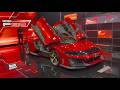
Ferrari is taking its engineering and racing expertise beyond the racetrack with Ferrari Hypersail, an ambitious offshore sailing project that aims to develop a fully energy self-sufficient racing monohull capable of competing in ocean races and challenging long-distance sailing records. Conceived around four years ago by Ferrari President John Elkann in collaboration with naval architect Guillaume Verdier, the project brings together expertise from Ferrari’s sports car engineering teams and the world of offshore sailing. Unlike conventional racing boats that operate within specific weather and sea conditions, Hypersail is being designed to handle demanding ocean environments, including winds exceeding 50 knots and waves of more than eight metres.
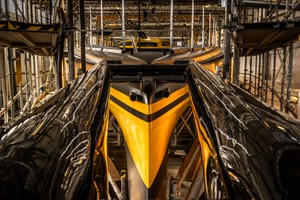
The 100-foot (approximately 30-metre) monohull features a 36-metre mast and sails covering more than 460 square metres. Its design centres on reducing drag through a single-hull architecture, supported by wide foils that enable the boat to lift above the water and achieve higher speeds. According to Ferrari, the boat could reach speeds of 45-48 knots in real wind conditions of 10-12 knots. A major part of the project is its energy architecture. Hypersail is being designed to generate the energy required for sailing through solar and wind power, along with kinetic energy recovery. The system will power its electronic controls, hydraulic mechanisms, foil adjustments and sail-trimming functions, reducing dependence on external energy sources.
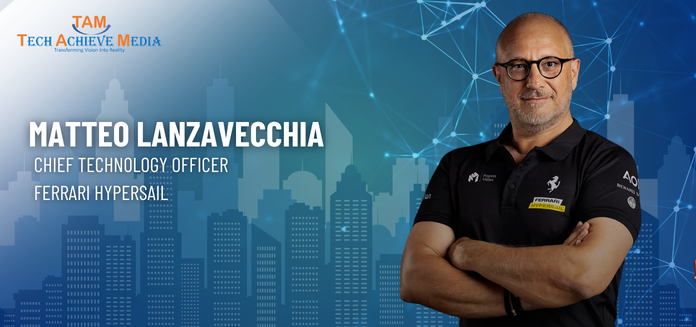
The project also serves as a two-way technology exchange between Ferrari’s automotive engineering operations and offshore sailing. Technologies and expertise developed in vehicle control systems, aerodynamics, energy management, simulation and advanced materials are being adapted for the boat, while innovations emerging from Hypersail could find applications in future Ferrari cars. In this interaction with Tech Achieve Media at Universo Ferrari, Matteo Lanzavecchia, Chief Technology Officer of Ferrari Hypersail, discusses the engineering challenges involved in taking a high-performance sailing boat into unpredictable ocean conditions, the role of automation and energy management, and how the project could influence Ferrari’s future automotive technologies.
TAM: Ferrari’s sports cars rely on advanced control systems, ground effects and active aerodynamics to maintain stability and performance at high speeds. However, the ocean presents a constantly changing and unpredictable environment. What are the key engineering challenges you foresee when Hypersail moves from the prototype stage to actual deployment, and how are you preparing to address them?
Matteo Lanzavecchia: There are some fundamental differences between a car and a sailing boat. In a car, the tyres allow you to generate force very quickly. If you brake, the response is immediate. On a boat, the situation is different. From an aerodynamic perspective, however, some of the principles are similar. In a car, we need to balance downforce with drag. Increasing downforce generally means adding more wing, which can also increase drag. The objective is to find the right balance between performance and efficiency. We follow a similar approach with Hypersail. The boat needs to maintain a specific ride height while flying above the water. It should neither move too far away from the sea nor get too close to it. The control system has to manage this continuously.
We have also been working on understanding the sea through sensors and simulation. On our cars, we have developed algorithms that estimate the available grip and help determine how much power and torque can be delivered to the ground. We are applying a similar philosophy to the boat. We have developed a simulator in which sailors have been training for more than a year. We understand that the conditions in the middle of the ocean can be extreme and that there are still things we cannot fully predict. However, we are putting in place the technologies and engineering approaches that we know can help us manage these conditions.
Another important consideration is reliability. We had several discussions about how far we should push performance while ensuring that the boat remains dependable. In an offshore race that can last more than 38 days, a small technical failure could cost you the record. The boat needs to be fast and innovative, but it also needs to be reliable. The underlying physics remain largely the same. The difference is in dealing with the density of air and water and adapting the engineering accordingly.
TAM: You spoke about technology transfer from Ferrari’s sports car engineering to Hypersail. Given the level of innovation involved in this project, do you also see technologies developed for Hypersail eventually finding their way into Ferrari’s road cars?
Matteo Lanzavecchia: One example is our by-wire technology. We have been working on winch-by-wire and manual-by-wire systems, where there is no direct mechanical connection between the control and the component being operated. Instead, the commands are managed electronically. These developments have been happening in parallel, with one project pushing the other forward. It has been a valuable exercise because the two projects have helped us explore new engineering possibilities.
Another area is materials. The foils need to be extremely strong, but they also need to be lightweight and have a very precise profile to achieve the required performance. We are using a combination of titanium and carbon fibre in their construction. This has required considerable work in simulation and manufacturing processes. Some of the knowledge we have gained through this work is already relevant to automotive applications. For instance, some of the roofs of our cars now use multi-material construction.
There are also lessons around cavitation. When a foil moves through water at high speeds, even a small imperfection can cause the water to vaporise. This can damage the material and result in a loss of load. Cavitation is also an issue in automotive cooling systems and pumps, so the understanding we are developing through Hypersail can be useful in that area as well. We have more than 20 patents related to the boat, and we are examining how some of these developments could potentially be applied elsewhere. It is still too early to identify specific components that will move directly into our cars, but the learning around materials, simulation, engineering methodologies and technology development is already valuable.
TAM: Hypersail is being designed as a fully energy self-sufficient racing boat. How are you approaching energy generation, storage and consumption, particularly for long-distance races that can last more than 40 days?
Matteo Lanzavecchia: Energy management is one of the biggest challenges for Hypersail. The energy we need will be generated on the boat through solar power and wind. We are also working on kinetic energy recovery and other methods of harvesting energy. This energy will be used to operate the electronic systems, move the foils and flaps, manage the hydraulic systems and control the sail trim.
We will have different voltage levels, ranging from 12 volts to 800 volts, depending on the requirements of the systems. The boat will have two battery packs of 50 kilowatt-hours each. One of the reasons for having two battery packs is redundancy. If one system fails, the other can provide the necessary backup. They can also work as energy buffers in certain situations.
We have carried out simulations using the same route as a boat that previously won an around-the-world race. These simulations factor in weather conditions, sunlight, wind and waves at different points along the route.
The objective is to understand whether the energy we generate will be sufficient to meet the energy consumed by the boat. It is not simply about achieving the highest possible top speed. We need to maintain the best average speed over the entire journey to have a chance of beating the record.
TAM: How are Ferrari’s vehicle control systems being adapted to manage the complex operations of a sailing boat, particularly when it is flying above the water?
Matteo Lanzavecchia: Control systems are one of the three major areas where we are transferring our automotive expertise to Hypersail. Over the past 20 years, Ferrari has developed extensive experience in vehicle control systems. Earlier, cars had relatively few electronic controls, but today a high-performance vehicle such as the F80 has more than 30 to 40 control systems, including electronic differentials, active suspension, active aerodynamics and active dampers.
As vehicle performance has increased, these systems have become essential in helping drivers use that performance effectively and safely. We are applying this knowledge to the boat’s flight control system. The sailor will be able to set the required ride height, while the control system manages the movement of the foils and flaps to maintain that position.
The sailor’s primary responsibility will be to determine the best route, while the system manages the necessary adjustments. We also have sensors at the front and rear of the boat that measure the waves, including their height and length. This information helps the system understand the sea conditions and adjust the controls to maintain stability. The objective is to make the boat’s response as controlled and predictable as possible, even when it encounters changing sea conditions.
TAM: Hypersail also introduces a patented winch-by-wire system and an electric pedestal. What advantages do these technologies bring to the sailing experience, particularly in terms of efficiency and the physical effort required from the crew?
Matteo Lanzavecchia: We have developed a system called winch-by-wire, which is patented and was developed through our engineering work. It removes the need for a direct mechanical connection between the controls and the systems they operate. We have also developed the electric pedestal, which uses electric motors to generate energy and operate the sail-control systems. One of the important advantages is that we can select the precise operating speed at which the crew can work most efficiently. With a traditional mechanical grinder, the sailor has different gears and may have to operate at speeds that require more physical effort.
With our system, we can select the speed at which the human body consumes less energy while performing the same task. Through this approach, we have been able to achieve an improvement of around 20% in human energy efficiency.
There is another advantage in how the system is designed. With a conventional mechanical arrangement, if you need the power of three people, you may have to design for four because not everyone can contribute power continuously at the same time.
With our electric system, the power generated by each pedestal can be used directly. If you need three units, you can design for three rather than adding an additional unit to compensate for inefficiencies. It also provides greater flexibility in the layout because there is no direct mechanical connection restricting where the equipment can be positioned. We have carried out several tests and are pleased with the results.
TAM: What are the next major milestones for Ferrari Hypersail as the project moves towards assembly and testing?
Matteo Lanzavecchia: We are moving towards assembling the boat at a location close to the coast of Italy. The plan is to bring the different components together and begin testing.
One of the first tests will be what we call a tow test. We will have the boat with its mast but without the sail, and another powerful boat will tow it using a cable. This will allow us to see whether the boat can lift above the water and whether the control system is working correctly.
After that, we will carry out tests to understand whether the energy recovery systems are working as expected. We will then install the sail and proceed with further testing. The next phase will be important because it will allow us to see how the concepts and engineering solutions we have developed perform in real conditions.
Ferrari’s Two-Way Technology Transfer
Hypersail represents a significant engineering exercise for Ferrari, extending its focus on performance, efficiency and control beyond conventional automotive applications. While the project draws on technologies developed for cars such as the F80 and the Luce, it is also creating opportunities to explore new approaches to materials, energy management, control systems and simulation.
With more than 20 patents associated with the boat, Ferrari is looking at the project as more than an entry into offshore sailing. It is an opportunity to bring together two engineering disciplines, allowing knowledge to move between the road and the sea. As the project moves towards assembly and testing, its next challenge will be to demonstrate that the technologies developed in simulation and through controlled trials can deliver the required performance and reliability in the demanding conditions of ocean racing.