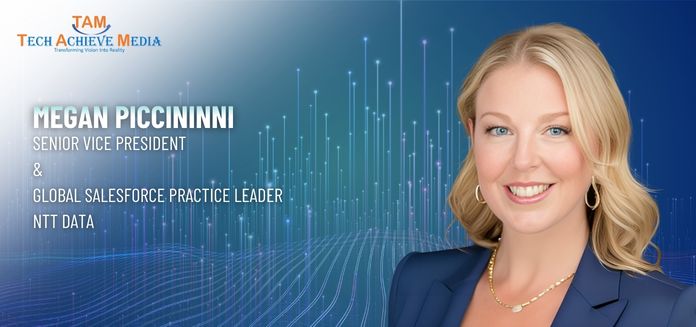
As enterprises move from GenAI experimentation to deploying autonomous AI agents at scale, the challenge is shifting from technology adoption to enterprise-wide transformation. While several organisations have successfully demonstrated AI capabilities through pilots and proofs of concept, integrating these technologies into complex business processes, ensuring governance and delivering measurable business outcomes remain significant challenges. In this interview with Tech Achieve Media, Megan Piccininni, Senior Vice President and Global Salesforce Practice Leader, NTT DATA Inc., discusses why enterprises need to move beyond isolated AI use cases towards end-to-end process transformation, the importance of agent readiness and control, and how cross-platform orchestration will shape the next phase of enterprise AI. She also shares NTT DATA’s approach to helping organisations build, orchestrate and operate increasingly intelligent and autonomous enterprises.
TAM: A lot of experiments on GenAI, copilots and AI agents fail to move beyond the pilot phase for companies. From your conversations with global enterprises, what would you say is the reason for this?
Megan Piccininni: Most pilots are built to answer a technology question, and they often answer it successfully: can an agent perform a particular task? What they don’t necessarily establish is whether an organization can integrate that agent into a live business process, operate it at scale and maintain the right levels of accountability and control. We are reaching the limits of treating AI as another technology deployment. The challenge is increasingly less about whether the technology works and more about whether enterprises are prepared to redesign how work gets done around it.
Too often, pilots focus on isolated use cases: a service agent, an HR assistant or a sales copilot. But enterprise work rarely happens in isolation. It crosses people, processes, data and multiple technology platforms. As AI becomes more agentic, organizations need to think beyond individual agents and toward intelligent systems of humans, agents and workflows working together.
Our 2026 Global AI Report finds that the organizations pulling ahead are rebuilding core applications and processes with AI embedded, rather than limiting themselves to surface-level additions. You cannot simply layer AI onto yesterday’s fragmented processes and expect tomorrow’s economics. In some cases, you may simply create a faster version of a broken process.
Also read: Nokia and NTT DATA Expand Global Private 5G Partnership
TAM: What can help with the large-scale deployment of these technologies for companies? What does it take to move an AI agent from a successful proof of concept into a production environment where it can deliver measurable business outcomes?
Megan Piccininni: Moving an agent into production is less about the agent itself than about the environment around it. AI is an amplifier: where data, processes and governance are strong, it can dramatically improve speed, productivity and decision-making. Where they are fragmented, AI can amplify those problems as well. That is why enterprises need to move beyond a portfolio of AI use cases toward end-to-end process transformation. The starting point should be the business outcome and the work required to deliver it. Break that work down and determine what should be performed by people, what can be performed by agents, what can be automated through workflows, and where human judgment remains essential.
At NTT DATA, we think about this through ARC – Agent Readiness & Control. The premise is straightforward: deploying an agent is relatively easy; creating an enterprise environment in which agents can operate securely, responsibly and at scale is much harder. That requires the right foundations across data and integration, identity and access, governance and observability, orchestration and operating models – and clear accountability for the outcomes these intelligent systems produce.
Getting an agent into production is not the end point. Enterprises need to know whether people are using it, whether agents are behaving as intended and, most importantly, whether the underlying business outcome is improving. The real opportunity is not to scale agents. It is to scale a better way of working.
TAM: As AI evolves from individual copilots to agents that can reason, collaborate and take action, how fundamentally will this change the way enterprises design their technology architecture and business processes? And what needs to be in place before organisations can safely give these agents greater autonomy?
Megan Piccininni: The change is bigger than technology architecture. As agents move from assisting people to reasoning, acting and orchestrating work, the operating model itself begins to change: how work gets done, who or what performs it, where decisions are made and how accountability is maintained. Historically, organizations have designed work primarily around people, processes and organizational structures. Increasingly, leaders will be orchestrating intelligent systems made up of humans, agents and workflows. The design question becomes: which decisions should people make, which can agents make, and where should the two work together?
That makes autonomy an important design choice rather than simply a technology capability. Autonomy should be earned and risk-adjusted. Identity, permissions, observability, governance, auditability and human accountability need to be designed in from the beginning. The more consequential the decision, the stronger those controls should be.
Our research finds that 78% of AI leaders already have a dedicated Chief AI Officer and formal AI governance. That is significant because ultimately, trust is the gating factor. Enterprises will only increase autonomy when their employees, customers and leaders trust the intelligent systems operating around them.
TAM: Enterprise processes rarely sit within one technology platform; they span CRM, ERP, ITSM, finance and other systems. How important will cross-platform agent orchestration become, and what will it take to make these agents work as a connected enterprise ecosystem rather than as isolated AI tools?
Megan Piccininni: The enterprise doesn’t operate in platforms; it operates in processes. AI has to do the same. The highest-value business processes cross Salesforce, SAP, ServiceNow, Microsoft, data platforms and proprietary systems. Lead-to-cash is a simple example. It may begin in Salesforce, move through SAP and interact with multiple other systems before payment is ultimately received.
An agent operating within one platform can optimize a step in that process. It cannot optimize the process end to end. That is why cross-platform agent orchestration will become increasingly important. Enterprises will need secure integration, shared context and governed access to data and tools, along with clear rules for how agents collaborate, when they can act independently and when they need to involve a person.
This is also why interoperability matters so much. Enterprises will not have one agent, one model or one platform. They will operate increasingly complex ecosystems of specialized agents and technologies. The ability to orchestrate those capabilities around the work – not around the boundaries of an individual platform – will become a critical enterprise capability. Ultimately, the winners will not be the companies with the largest number of agents. They will be the companies that can orchestrate people, platforms and agents around the work and the outcome they are trying to achieve.
TAM: This shift also changes what enterprises expect from their technology partners. How is NTT DATA helping organisations move beyond implementing individual platforms to bringing together AI, enterprise applications, data and managed services to deliver end-to-end business outcomes?
Megan Piccininni: The role of the technology partner has to evolve alongside the technology. Clients increasingly need partners that can bring AI, enterprise applications, data, integration, security and managed services together around an end-to-end business outcome. That requires moving beyond implementing individual platforms toward orchestrating and operating the broader intelligent enterprise.
NTT DATA is particularly well positioned because of the breadth of capabilities we can bring together. We can connect Salesforce into complex third-party and back-office environments, create the trusted data foundation AI requires, integrate and orchestrate agents and workflows across technology ecosystems, and then operate and continuously optimize that environment through managed services.
The managed-services model itself is also evolving. Traditional application management has focused largely on keeping platforms running. In an AI-led environment, the opportunity is much greater: continuously identifying where intelligence can improve the process, orchestrating human and digital capabilities around the work, and optimizing the system against measurable business outcomes.
Our 25-year relationship with Salesforce, more than 4,700 certified professionals and over 15,000 Salesforce and MuleSoft certifications across more than 30 countries give us deep platform expertise. But our differentiation comes from combining that depth with NTT DATA’s broader ability to integrate, orchestrate and operate across the enterprise.
TAM: Looking at the next phase of enterprise AI, where do you see NTT DATA having the strongest opportunity to differentiate, particularly as organisations look for partners that can help them move from AI experimentation to scaled, outcome-led transformation?
I believe our strongest opportunity is to become an orchestrator and operator of the increasingly intelligent and autonomous enterprise. Many organizations can implement an AI feature or deploy an individual agent. Enterprise-scale agentic transformation is different. It requires industry knowledge, AI and data capabilities, enterprise applications, integration, security, global delivery and managed services to work together around an end-to-end process, with responsible AI and governance embedded throughout.
That requires moving beyond deploying agents to creating the readiness, control and orchestration needed to operate them across the enterprise. It also means starting with the work and the business outcome, rather than the technology: identifying the domains where AI can materially change performance and redesigning those processes end to end.
Our research shows that only 15% of the organizations we surveyed qualify as AI leaders, yet they are nearly 2.5 times more likely to report revenue growth above 10% and 3.6 times more likely to operate at margins of 15% or higher. One of the things these leaders do differently is focus on a small number of high-value domains and redesign them end to end.
I also believe the economics of technology services will evolve alongside the technology. For decades, much of our industry has measured work in terms of human effort and capacity. As agents perform a greater share of that work, intelligence increasingly becomes the unit of work rather than human effort.
That creates an opportunity to evolve managed services and commercial models as well – from primarily pricing capacity toward increasingly aligning economics with the performance of the intelligent system: the quality, speed, cost and ultimately the business outcomes it produces. That is where I believe the next phase of differentiation lies: not simply helping enterprises deploy AI, but helping them redesign, orchestrate and operate the enterprise around it.