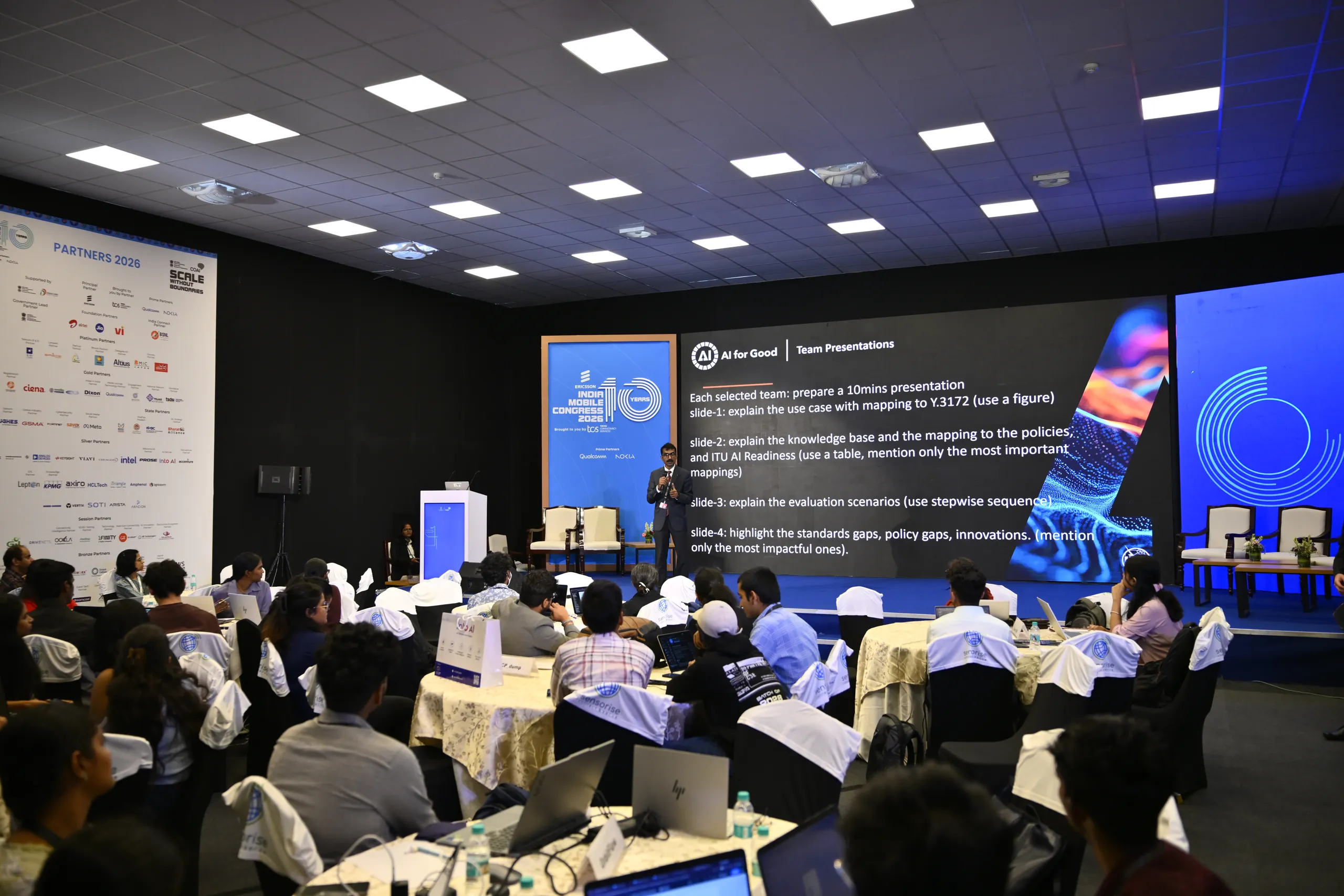
The 10th edition of the India Mobile Congress 2026 concluded on Saturday with a focus on artificial intelligence (AI) applications in agriculture, youth-led robotics, autonomous AI agents for 5G networks and expanding digital connectivity to underserved communities. Held under the theme ‘Scale Without Boundaries’, the four-day event brought together policymakers, industry leaders, researchers, startups and international organisations to discuss the development of indigenous technologies, global telecom standards and inclusive digital infrastructure. The concluding day focused on translating technological developments into practical applications, with sessions covering AI for agri-food systems, robotics innovation, 5G network orchestration and sustainable models for rural broadband deployment.
Ramakrishna P, CEO, India Mobile Congress, said the 10th edition had demonstrated how digital platforms could support innovation and international collaboration. “The 10th edition of India Mobile Congress has set a decisive benchmark for how digital forums drive actionable transformation. Over the past four days, IMC 2026 demonstrated that India’s digital narrative is no longer confined to rollouts and scale; it is about setting international benchmarks, incubating sovereign technologies and driving purposeful innovation. From International 6G Symposium to our concluding focus on agricultural AI and youth robotics, this edition has shown the world that India is building an inclusive, resilient and self-reliant technological ecosystem that scales without boundaries,” he said. The event follows the inauguration by Prime Minister Narendra Modi, who outlined a vision for indigenous intellectual property and sovereign semiconductor capabilities. Communications Minister Jyotiraditya M. Scindia also highlighted India’s ambition to contribute 10 per cent of global patents to the development of 6G standards.
Global initiative examines AI applications in agriculture
A key highlight of the concluding day was the Global Initiative on AI for Agri-Food Systems Meeting, organised in collaboration with the International Telecommunication Union (ITU). The discussions examined how AI could address challenges across agricultural production and food systems, while emphasising the importance of international standards, interoperability and solutions suited to the needs of farmers.
Dr. Bilel Jamoussi, Deputy Director, Telecommunication Standardization Bureau (TSB), Chief of the Study Groups and Policy Department, International Telecommunication Union (ITU), said AI applications in agriculture must be assessed by their practical impact rather than technological sophistication alone. “Agriculture and food touch every person, every community and every country, and AI is now moving from laboratories into the real economy to help address their biggest pressures. But the true measure of an AI solution is not how sophisticated its algorithm is; it is whether it solves a real problem for a smallholder farmer. That is why AI must be developed with farmers, not just for them. International standards are central to this, because they do not slow innovation; they make it work at scale, helping prevent fragmentation so that solutions do not remain trapped in isolated pilots. Through cooperation across governments, international organizations, researchers, industry and investors, we can move from vision to actualization, and build a sustainable, resilient and secure food future for all,” he said.
Syed Tausif Abbas, Sr. DDG and Head, TEC, Department of Telecommunications (DoT), said the initiative’s success would depend on improvements in agricultural productivity, farmers’ livelihoods and food security, alongside technological progress.“Connectivity links our farms, interoperability links our systems, and artificial intelligence links innovation with impact. But the success of this Global Initiative will be measured not only by technological advances, but by tangible improvements in farmers’ livelihoods, agricultural productivity, supply chain efficiency and food security. For that, AI solutions must be transparent, inclusive and accessible, with due attention to data quality, privacy and the needs of small and marginal farmers, and supported by international standards that let solutions built in different countries work together effectively,” he said.
AI standards must address fairness, transparency and reliability
The discussions also examined the need for structured evaluation frameworks to assess AI systems for bias, robustness and reliability across different deployment environments. Devendra Singh, Deputy Director General, Telecommunication Engineering Centre (TEC), Department of Telecommunications (DoT), said evaluating AI systems required a broader approach to assessing potential risks and performance. “Evaluating AI systems requires moving beyond traditional computing standards toward structured frameworks for fairness, transparency, and robustness. Bias in AI originates across multiple stages from uncurated training data and outliers to model selection and deployment environments. To address this, we assess risk across multiple tiers, combining domain specific metric evaluations with empirical testing across protected attributes and adverse conditions. A truly robust AI system must perform reliably in hostile or edge environments, maintain safety and security governance, and provide measurable, transparent outputs across every level of integration,” he said.
Debasish Mahalik, Deputy Director, Food and Agriculture Department, Bureau of Indian Standards (BIS), said standards would be important in ensuring that AI-driven agricultural solutions were secure, interoperable and suited to India’s diverse farming systems. “AI-driven agriculture can deliver meaningful impact only when technology is supported by robust standards for data quality, privacy, security and interoperability. At the Bureau of Indian Standards, our focus is on developing a system-wide framework for digital agriculture that reflects India’s diverse farming ecosystems and includes small and marginal farmers. By bringing stakeholders together to build common standards, we can enable trusted, scalable and sustainable agricultural solutions that translate innovation into tangible benefits on the ground,” he said.
Interoperability and data sovereignty take centre stage
The importance of enabling data to move across digital platforms while maintaining farmers’ control over their information also featured in the discussions. Jan Redlich, CTO, Bonn Systems, said fragmented digital ecosystems could restrict interoperability and limit the development of agricultural applications across platforms. “AI in agriculture can only deliver on its promise when data can be shared across systems while ensuring farmers retain control over their data. today, fragmented digital ecosystems create silos that limit interoperability, access and trust. The reference architecture developed by the Focus Group on AI for Agriculture addresses this through shared semantics, open interfaces and sovereignty by design. By building on existing standards for data models, identity and access, it enables applications and services to work across platforms. This allows new use cases to emerge without creating new silos, helping build a more connected, trusted and interoperable agricultural ecosystem,” he said. The reference architecture, as described by Redlich, is intended to support the exchange of agricultural data across systems through common standards and interfaces, while retaining data sovereignty.
Youth robotics and autonomous AI agents highlight innovation agenda
Beyond agriculture, the concluding day featured the Robotics for Good Youth Challenge India, organised by the ITU and IIT Delhi’s I-Hub Foundation for Cobotics (IHFC), with support from the Department of Telecommunications. The challenge focused on grassroots innovation and the development of future-ready talent through robotics. The ITU Build-A-Thon also brought developers and engineers together to work on autonomous AI agents designed for 5G network orchestration. The programme was complemented by interactive cybersecurity challenges under the Digital Defence Games. These activities reflected the event’s wider focus on developing practical applications of emerging technologies while encouraging participation from young innovators and the developer community.
Last-mile connectivity remains a priority
The session titled ‘Extra Mile for the Last Mile’ examined the financing and infrastructure requirements for extending digital connectivity to rural communities. Discussions covered sustainable financing mechanisms, rural broadband deployment and the need to ensure that network expansion translates into economic and social benefits. The emphasis on last-mile access complemented the event’s focus on agricultural AI and digital inclusion, with connectivity positioned as an enabler for the delivery of services and technology applications beyond urban centres.
With its concluding-day agenda spanning agricultural AI, standards development, robotics, network automation and rural connectivity, IMC 2026 brought together several strands of India’s digital development priorities. The event’s 10th edition placed particular emphasis on moving from technology deployment towards practical applications, international interoperability and solutions designed to serve communities at scale.