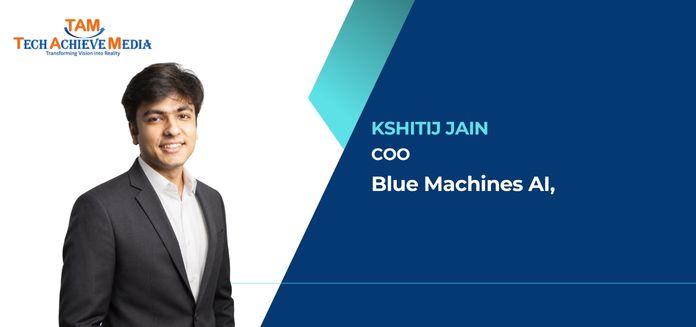
As enterprises move from AI experimentation to large-scale deployment, the real differentiator is no longer access to advanced models but the ability to integrate AI into core business workflows and deliver measurable outcomes. In an interaction with Tech Achieve Media, Kshitij Jain, COO, Blue Machines AI, discusses why enterprises remain stuck in pilot mode, how execution speed is reshaping competitive advantage, and why orchestration, deterministic guardrails and deep integrations are critical to scaling AI in regulated industries. Drawing on deployments across BFSI and other sectors, Jain also shares his perspective on India’s role in shaping global conversational AI adoption and the evolving value of the orchestration layer.
TAM: What separates enterprises scaling AI from those stuck in pilot mode?
Kshitij Jain: What separates these two groups isn’t capability, it’s conviction. That “pilot purgatory” phase is really just hedged conviction, running AI in a stripped-down way to build an internal case. That buys delay, not learning: enterprises that finally commit end up redesigning what they built, because a pilot designed to be safe couldn’t answer real deployment questions.
Also read: Blue Machines AI Launches Aurora
What that conviction produces is the real differentiator: winners don’t bolt AI onto an existing setup, they redesign the system around it, how agents take over escalations with full context, how deep integrations reach into calculators, knowledge bases and workflows. For us, this meant working with Aditya Birla Capital to ship 15+ integrations across three business lines in six weeks, because the brief was AI-first, not a voicebot.
That also changes how enterprises should treat vendor partners: ask hard questions, and hold them equally accountable for outcomes, not just deployment. Too many vendors treat this as stitching a speech-to-text and text-to-speech layer around a language model and calling it a voice bot. When that breaks in production, the enterprise doesn’t just lose time, it quietly concludes AI doesn’t work here, when it was really a vendor who never did the integration work. For us, this played out with Muthoot Finance, where the goal was never “deploy a bot” but driving branch visits, and we were judged jointly on the 150% uplift that followed. The real gap isn’t who believes in AI, it’s who has actually rebuilt their systems to run on it.
TAM: Why is execution speed emerging as the primary competitive point over model selection?
Kshitij Jain: Whoever reaches production first starts learning, what customers actually ask, where the model gets it wrong, months before a slower competitor finishes its second pilot. That’s worth more than any model upgrade, and it’s why speed, not model choice, is the real edge now. Most enterprise use cases already sit within reach of what today’s leading models can do; the gap that’s left isn’t intelligence, it’s deployment. Bain’s research shows exactly that gap: 74% of companies call AI a top-three strategic priority, but only 23% can tie it to revenue or cost savings. That’s not a model problem. It’s a speed-to-outcome problem.
We build for that speed directly, we take clients from discovery to live production in days, at most a few weeks, a shift from an era when enterprise deployments ran six months to a year, dominated by services contracts and headcount rather than systems. What makes that possible is that we don’t just put AI into our clients’ hands, we put it into our own: an internal system we call Polar Pilot builds and tests our agents, constructs our workflows, and runs our evaluation cycles before anything reaches a client. That same system lets us extend into a new language or a new channel, chat, email, voice, without rebuilding from the ground up. The fastest way to deploy AI, it turns out, is to use AI to deploy it.
TAM: How are enterprises architecting guardrails for deterministic control in regulated sectors?
Kshitij Jain: Data residency is solved at the infrastructure layer, sovereign deployment options, public cloud, private cloud and on-prem, so the enterprise chooses based on its own requirements rather than a vendor’s default stack. Certifications like ISO 27001 and SOC 2 are a starting point, not the answer.
The real determinism comes from what’s built above the model. We work with large enterprises in lending, insurance and investing, accountable to SEBI, IRDAI, RBI and TRAI simultaneously. At that level, you can’t rely on the model alone. The agent layer does the work: approved knowledge bases, real-time information fetches, and defined workflow states that constrain what an agent can say and do. Every deployment is tested against normal, edge-case and failure scenarios before going live.
We also run multiple speech and language providers with real-time switching in production, so a single provider’s degradation never reaches the customer. The principle is simple: the model can be probabilistic, but the system around it cannot be.
TAM: How do you mitigate compliance and liability risk in live, unscripted interactions?
Kshitij Jain: As voice AI takes on a bigger share of core business conversations, every unscripted exchange carries real liability, a claim made on a live call is functionally a commitment the business has to honor. That’s a different bar than a general-purpose assistant like ChatGPT is built to clear.
ChatGPT is designed to be maximally helpful in the moment: it will improvise, speculate, and answer almost anything asked of it. An enterprise agent in a regulated conversation can’t work that way, because every claim it makes has to be one the business can stand behind. That’s why nothing our agents say, or calculate, is left to the model’s judgment. If an agent offers a customer a 10% discount, it’s citing a specific clause in an approved policy document, not improvising because it sounded reasonable. If a customer asks for their SIP or EMI amount, the agent isn’t asking the model to do the math, that’s exactly where language models are unreliable, it calls a deterministic function built for that calculation and reads back the result.
When a conversation drifts outside what’s approved, or confidence drops, it escalates to a human instead of the AI guessing. Every interaction is logged in an audit trail, so if a claim is ever disputed, there’s a record of exactly what was said and done. The bar for enterprise voice AI was never “can it hold a conversation.” It’s “would we stand behind everything it just said and did, on the record.”
TAM: What structural advantage does India offer in shaping global AI adoption?
Kshitij Jain: Few markets test a voice AI system as thoroughly as India does. The scale, diversity and cost expectations here are extreme versions of what every market eventually demands. For some of our customers, we’re already handling lakhs of calls a day and delivering true business outcomes at strong ROI.
We saw that land firsthand at Contact Center Week in Las Vegas this June, where global operators and analysts were genuinely surprised by the scale and complexity we’ve had to solve for. Globally, conversational AI grew up chat-first; India has been voice-first from day one, and voice in real time is the harder problem: low latency, multilingual switching, interruptions, holding context and streaming infrastructure, all at once. The diversity isn’t just linguistic. Customers move between English, regional languages and financial terminology mid-sentence, over networks that range from strong urban 5G to patchy rural connections with real packet loss and jitter. The agent has to hold a coherent conversation either way.
And the customer on the other end can be anyone from a sophisticated investor fluent in financial jargon to a first-time borrower who needs the same concept explained simply, without sounding condescending. Building for that range is genuinely battle-tested design. India has always paired world-class engineering with cost-effective, high-quality services, that combination, applied to AI deployment, is a winning template globally. It’s what we’re now taking to the US, built on exactly the muscle India forced us to develop.
TAM: How much true architectural defensibility exists at the orchestration layer?
Kshitij Jain: Our defensibility is deliberately built above the model layer. Blue Machines AI is model agnostic, which allows us to orchestrate across multiple LLM, speech to text and text to speech providers based on accuracy, latency, cost and compliance requirements, trade-offs that shift not just by provider, but by language and use case too. That doesn’t mean we stay out of the model layer entirely. Where a real gap exists, we intervene directly. Floe, our context aware language detection model, is one example. So is Aurora, our BFSI-native speech-to-text model, trained specifically on financial terminology, EMIs, KYC, SIPs, NAVs, policy numbers, because off-the-shelf models weren’t built to get that right.
But the proprietary value mostly sits in everything that makes these models useful inside an enterprise: our workflow engine, evaluation and guardrail infrastructure, integration layer, and internal systems like Polar Pilot that help us build and test all of it faster. The deeper advantage also comes from our deployment experience. Every enterprise deployment gives us new integration patterns, workflow intelligence, outcome orientation, and evaluation data that strengthen the platform. As foundation models become more interchangeable, the value shifts to the orchestration and operating layer around them. That is where we are building our moat.
TAM: How scalable is the FDE model, and how much can be productized vs customized?
Kshitij Jain: The FDE model scales when every deployment makes the next one more productized, engineers turn what they learn into reusable integration patterns, workflow templates and evaluation frameworks that strengthen the platform. What still needs a person is the final mile, a customer’s specific systems, policies and edge cases, and something less technical: aligning stakeholders across ops, compliance and business who don’t naturally agree on how a deployment should work. That’s judgment built across many deployments, not any one client’s data. That judgment matters most early, in a client’s first year or two of redesigning their business around AI, when nobody yet knows what a good retry policy or a well-designed conversation should look like for them. The objective is therefore not to eliminate FDEs. It is to make every FDE engagement progressively more leveraged. If each deployment takes less time, requires less customization and creates more reusable product capability, the model compounds rather than scales linearly.