India’s journey towards becoming a global player in quantum technologies is moving beyond research and development, with increasing emphasis on indigenous innovation, strategic security, commercial deployment and workforce readiness. As the country strengthens its digital public infrastructure and expands its technology ecosystem, quantum computing, communication, sensing and security are emerging as important areas of national technological capability.
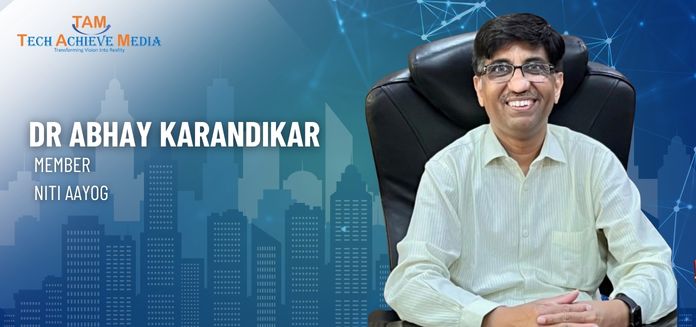
Speaking to Tech Achieve Media about India’s quantum technology journey at QNu Labs’ 10th Anniversary celebrations, Dr Abhay Karandikar, Member, NITI Aayog, highlighted the role of the National Quantum Mission (NQM) in developing indigenous capabilities across critical quantum technology domains. He said the mission, operationalised during his tenure as Secretary, Department of Science and Technology (DST), was conceived to enable India to move from being a consumer of advanced technologies to developing deep-tech capabilities domestically.
“When we operationalised the National Quantum Mission, our objective was to develop indigenous technologies across quantum computing, quantum communication, quantum sensing, and quantum materials and devices. These technologies are going to become extremely important from the perspectives of strategic security and technological sovereignty. For India, therefore, building capabilities in these areas is not just about advancing research; it is about developing technologies that are critical to our future security and technological independence,” he highlighted. The mission has established a national framework for advancing quantum research, strengthening institutional capabilities and supporting deep-tech startups. Its significance is also reflected in the growing importance of quantum security, particularly as India’s digital economy becomes increasingly interconnected.
Quantum Security: Protecting India’s Digital and Financial Infrastructure
India’s extensive digitalisation has created a strong foundation for financial inclusion, digital transactions and public service delivery. However, the scale of this digital ecosystem also makes the security of financial systems, telecommunications networks and critical infrastructure an important national priority.
Karandikar emphasised that quantum security will become increasingly relevant for India, given the widespread adoption of digital payments and the deployment of Digital Public Infrastructure (DPI): “India’s financial systems, including banks, are heavily digitalised, which is a very positive development. We have deployed digital public infrastructure, and our UPI systems are among the largest digital payment transaction systems. However, this also means that our systems are more exposed to cyber threats. Securing our financial systems, stock exchanges and digital transactions is therefore extremely important, particularly as quantum technologies evolve and the security requirements of these systems become more demanding.”
Role Played by QNu Labs in Furthering India’s Quantum Ambitions
He pointed to the potential role of post-quantum cryptography (PQC) and quantum key distribution (QKD) in strengthening India’s security architecture. These technologies are expected to become increasingly relevant for organisations managing sensitive financial transactions, telecommunications infrastructure and other critical digital systems.
Highlighting the work of QNu Labs, Karandikar said indigenous quantum security solutions could have significant applications across these sectors: “In this context, products developed by QNu Labs, whether in post-quantum cryptography or quantum key distribution, have an important role to play in the coming years. These technologies could be deployed across banking, financial transactions and telecommunications systems, helping us strengthen the security of our digital infrastructure. As India continues to expand its digital economy, developing and deploying such indigenous security technologies will become increasingly important.” The emphasis on quantum security reflects the need to prepare critical infrastructure for emerging technological capabilities rather than treating cybersecurity as a static requirement.
National Quantum Mission Establishes Specialised Research Hubs
The National Quantum Mission is building a collaborative research ecosystem through specialised hubs established at leading academic and research institutions. The quantum communication hub has been established at IIT Madras in collaboration with C-DOT, while IISc Bengaluru hosts the quantum computing hub. IIT Bombay is leading work in quantum sensing, and IIT Delhi is focusing on quantum materials and devices. Together, these institutions are contributing to research across the quantum technology value chain, from fundamental science to applications with potential strategic and commercial relevance.
“Under the National Quantum Mission, we have established a quantum communication hub at IIT Madras in collaboration with C-DOT, a quantum computing hub at IISc Bengaluru, a quantum sensing hub at IIT Bombay, and a quantum materials and devices hub at IIT Delhi. These hubs are bringing together researchers working across different areas of quantum technology. Approximately 150 researchers are currently working in these areas under the mission, and we have also supported several deep-tech startups. This combination of institutional research and startup participation is important for building a strong indigenous quantum ecosystem,” he added.
The mission’s support for startups is particularly relevant as India seeks to translate research capabilities into products, platforms and deployable technologies. By connecting academic research with entrepreneurial activity, the programme is creating pathways for indigenous quantum innovations to move towards practical applications. Karandikar expressed confidence in the country’s long-term prospects, noting that the foundations being established through the mission could help India strengthen its position in the global quantum technology landscape.
Quantum Education: Expanding the Talent Pipeline
While research infrastructure and technology development remain central to India’s quantum ambitions, the availability of skilled professionals will determine how effectively these capabilities can be scaled. Addressing the need for quantum skilling, Karandikar outlined the National Quantum Mission’s efforts to introduce specialised educational programmes at undergraduate and postgraduate levels. The mission has supported undergraduate minor programmes and master’s programmes in quantum technologies, alongside teaching laboratories in engineering colleges and technical institutions.
“One of the important steps taken under the National Quantum Mission has been the introduction of undergraduate minor programmes and master’s programmes in quantum technologies. We are also supporting 75 engineering colleges and technical institutions in establishing teaching laboratories in this area. These initiatives are intended to give students access to quantum technology education and practical learning opportunities. We hope to support more institutions as the ecosystem develops, because building a strong talent pipeline is essential to our ambition of becoming a global player in quantum technologies,” said Karandikar.
The focus on higher education reflects the interdisciplinary nature of quantum technologies, which require expertise spanning physics, mathematics, computer science, electronics and engineering. However, Karandikar noted that the development of specialised programmes at the college level needs to be complemented by early exposure to emerging technologies in schools.
School-Level Awareness Remains a Gap
As artificial intelligence and quantum technologies reshape the technology landscape, introducing students to these subjects at an early stage could help build familiarity and encourage interest in future technology careers. Early exposure to emerging technologies could help establish a stronger foundation for specialised learning at the university level, particularly as quantum computing and AI increasingly intersect with multiple fields of research and industry.
Karandikar identified school-level awareness as an area requiring further attention, particularly as the country expands its efforts to develop a future-ready workforce: “At the school level, I believe we need to introduce students not only to quantum technologies but also to other new-age technologies such as artificial intelligence. At the very least, students should develop familiarity with these emerging areas so that they understand the technologies shaping the future. This is certainly a gap area that needs to be addressed. While the National Quantum Mission has already undertaken initiatives at engineering colleges, technical institutions and science colleges, school-level awareness also needs to become part of the broader education effort.”
Faculty Development: A Critical Requirement for Scaling Skilling
Beyond introducing new courses and establishing teaching laboratories, Karandikar highlighted the need to strengthen the pool of educators capable of delivering quantum technology education. Since quantum technologies are relatively new areas of study, faculty members across universities and colleges require access to specialised training and development opportunities.
He emphasised that faculty development and train-the-trainer programmes must become an integral part of the country’s quantum skilling strategy: “The second important issue in education and skilling is the availability of trained faculty and trainers. Quantum technology is a new field, and faculty members in universities and colleges must themselves be equipped with the necessary knowledge and skills before they can effectively teach students. We therefore need strong faculty development programmes and train-the-trainer initiatives. Some efforts are already underway, but these need to be scaled up significantly. Unless we develop a strong pool of trained faculty members and trainers, we will not be able to expand quantum skilling programmes at the scale required.”
The emphasis on faculty development highlights a key requirement for sustainable capacity building: educational infrastructure must be supported by educators who can deliver specialised instruction and keep pace with technological developments. As more institutions introduce quantum technology programmes, strengthening faculty capabilities will be essential to ensuring that these initiatives translate into meaningful learning outcomes.
Building the Foundations for Global Quantum Leadership
India’s quantum strategy is taking shape across research institutions, deep-tech startups, security applications and education programmes. The National Quantum Mission has established specialised research hubs, supported startup development and initiated efforts to expand quantum education across engineering and technical institutions. At the same time, the growing importance of quantum security is bringing the technology closer to practical applications in banking, financial services and telecommunications. The next phase will require sustained investment in indigenous technology development, stronger collaboration between research institutions and industry, and a coordinated approach to education and faculty development.
For Karandikar, the opportunity lies in building an ecosystem that can support both technological innovation and its eventual deployment: “Overall, I am confident that India has an opportunity to become a global player in quantum technologies in the coming years. We have started building capabilities across quantum computing, communication, sensing, materials and devices, while also supporting deep-tech startups and developing the talent pipeline. The important next step is to strengthen these efforts, particularly in education and faculty development, so that we have the research capabilities, skilled workforce and indigenous technologies required to sustain this growth.”